


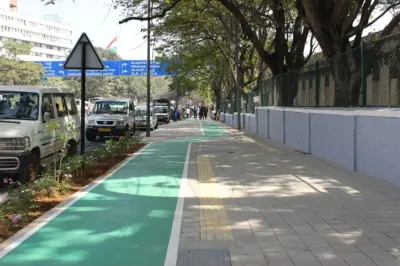

Walking on a Delhi footpath often means negotiating garbage collection points, public urinals, utility boxes, poles and broken paving, leaving pedestrians with little room to move.
To address these gaps and the wide variation in pavement design, the Delhi public works department (PWD) has set up a three-member committee to review existing agreements and provisions for footpath repair and to draft a model tender for future projects.
The step follows concerns that tender specifications differ from one PWD zone to another for comparable works.
An office order issued on 25 August named superintending engineer Arvind Kumar Singh as head of the panel, with deputy director (vigilance) Mukesh Kumar Sharma and executive engineer Suresh Chand Sharma as members. The committee has been given 15 days to submit its report.
"The exercise is expected to examine how footpaths are constructed and repaired, and bring greater uniformity to specifications followed by different zones. Based on the report, all future footpath designs will have standardised specifications," an official said.
The decision comes after the Supreme Court order of 19 June declaring that walking on demarcated footpaths is a fundamental right flowing from Articles 19 and 21.
Wherever a road exists, the court held, public authorities are duty bound to provide, maintain and safeguard a demarcated footpath.
Indian Roads Congress norms under IRC 103-2012 prescribe a clear walking zone measuring at least 1.8 metres in width and 2.2 metres in height, kept free of poles, electricity, water and telecom boxes, trees and signage, with kerb height capped at 150mm.
Wider stretches are recommended for commercial areas, shopping frontages, bus stops and high intensity commercial pockets. Surfaces are required to be firm, even and slip-resistant, with paving laid to prevent water accumulation.