
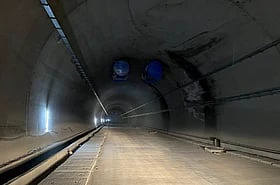

The 4-lane Digdol-Panthyal twin tube tunnel project on the Ramban-Banihal section of National Highway-44 in Jammu & Kashmir has achieved over 87.2 per cent physical progress, according to the Ministry of Road Transport and Highways (MoRTH).
The project, being executed at a cost of Rs 866.37 crore, is a key component of the ongoing four-laning of the Ramban-Banihal stretch, which forms part of the vital Jammu-Srinagar highway corridor connecting the Kashmir Valley with the rest of India.
According to the Road Transport and Highways Ministry, the twin tube tunnel system includes a north-bound tunnel measuring 2.6 Km and 0.619 Km, while the south-bound tunnel extends to 3.08 Km.
The infrastructure is being developed to bypass hazardous sections of the highway that have historically been prone to landslides, falling rocks, and severe weather disruptions.
For decades, the stretch between Ramban, Digdol and Panthyal on National Highway 44 was known by a name that locals rarely spoke about without concern - Khooni Nallah, the ministry said.
Traffic disruptions on the stretch often lasted for hours or even days due to unstable terrain, landslides, falling rocks, and adverse weather conditions.
The tunnel project is expected to address these issues by providing a safer and more reliable alternative route.
According to the ministry, the tunnels are being constructed using the New Austrian Tunnelling Method (NATM), a technique suited for excavation in complex geological conditions such as those found in the Himalayan region.
"Work on the tunnels began simultaneously in 2022 and has since progressed rapidly, with the project now approaching its final stages. The excavation has been carried out through a combination of heading and benching to ensure stability and safety during construction," the ministry said.
Once operational, the tunnels will significantly reduce travel time along this stretch and ensure all-weather connectivity.
The improved corridor is expected to benefit commuters, goods transporters, tourists, and security forces by enabling faster and more dependable movement across this critical route.
The project also holds strategic importance, as it will facilitate smoother movement of defence personnel and logistics along the Jammu-Srinagar axis, enhancing response capability during emergencies while strengthening connectivity in the region.