

Texts like Mahāsalilam and Parāśaratantra delved into cloud formation, monsoon patterns, probabilistic modelling, and climate cycles.
Their answers, which modern readers too easily dismiss as mythology, are more systematic than you'd expect.
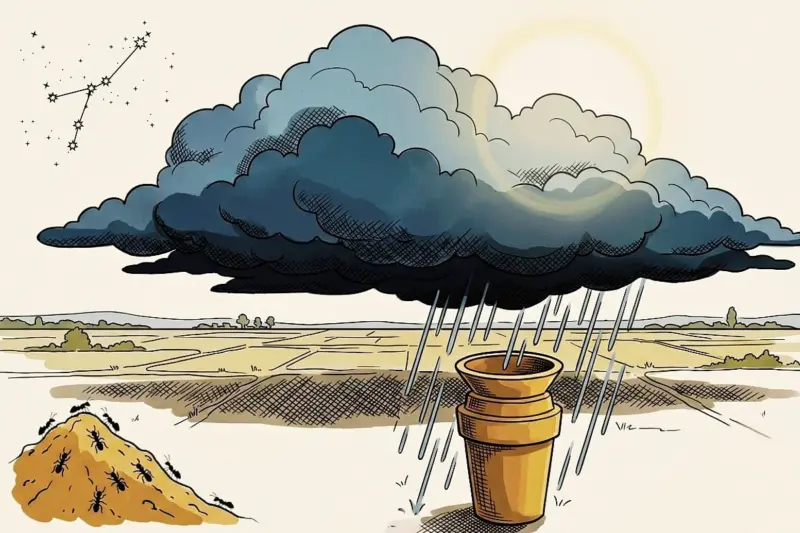
On a humid afternoon, just before the monsoon breaks, small signs begin to appear. Ants carry their eggs to higher ground. The air thickens. A faint halo forms around the sun. Somewhere in the distance, clouds gather, but not yet here.
For most of human history, these were not curiosities. They were data.
Long before modern meteorology emerged as a formal science, Indian thinkers were asking a set of questions that feel strikingly contemporary: how do clouds form? Why does it rain in one place but not another? What governs the timing, intensity, and failure of rainfall?
These questions are preserved in early Sanskrit works such as the Mahāsalilam and the Parāśaratantra. Read closely, they reveal something striking: a sustained attempt to understand rainfall as a natural process governed by observable causes, measurable patterns, and long-term variability.
What emerges is a layered system of environmental knowledge - part physical theory, part empirical observation, and part probabilistic modelling.
The question of rain
The Mahāsalilam opens not with declarations but with inquiry. In a series of sharply framed questions, it asks: how are clouds formed? From where do they bring water? Why does it rain in one place but not another? What supports clouds in the sky? How do thunder, lightning, and hail arise?
This is not speculative metaphysics. It is the language of investigation. It is inquiry in the spirit of katham etat? (how does this occur?)
The answers that follow do not offer a single unified theory. Instead, they present multiple models, parallel attempts to explain the same phenomenon. One account describes how strong winds drive upward-moving heat and particulate matter, which then condense into clouds. Another speaks of vapours rising from the earth, mountains, and vegetation, lifted by wind and shaped by solar radiation. A third describes the sun drawing up water through its rays, "as through the stalk of a lotus."
These explanations differ in imagery, but they converge on key principles: upward movement of moisture, transformation in the atmosphere, and eventual condensation into rain-bearing clouds.
More striking is the emphasis on wind. Again and again, wind is identified as the regulator of rainfall. It moves clouds, concentrates them, disperses them, and ultimately determines where rain falls. "Where the wind comes to rest," one passage notes, "there it rains."
This is a clear statement of convergence: rainfall occurs where moisture-laden air slows and accumulates.
From sky to life
Rain is not treated in isolation. It is part of a larger ecological chain.
A passage attributed to Vasiṣṭha outlines the sequence: space gives rise to wind, wind drives clouds, clouds release rain, rain nourishes the soil, seeds grow into crops, living beings consume this food, and life continues through reproduction.
This is not merely poetic. It is a systems model, an early articulation of the interdependence between atmosphere, agriculture, and biological life. Rainfall is not an event; it is a link in a continuous cycle connecting the sky to the sustenance of living beings.
Observation as method
Alongside theoretical explanations, these texts preserve an extensive catalogue of observational indicators.
Some are atmospheric: halos around the sun and moon, the colour and texture of clouds, sudden cooling winds, or the appearance of multiple rainbows. Others are terrestrial: ants relocating their eggs, birds altering their flight patterns, cattle behaving restlessly, or moisture appearing on polished surfaces.
These are not presented as superstition but as repeatable signs - phenomena that, when observed together under the right seasonal conditions, indicate imminent rainfall.
There is also an awareness of false signals. The same signs, if observed outside the monsoon season, are said to produce "fear" rather than rain. In other words, context matters. Observation is not enough; it must be interpreted within a seasonal framework.
Measuring the monsoon
Perhaps the most concrete evidence of a scientific approach lies in the attempt to measure rainfall.
The Arthaśāstra, apart from the Parāśaratantra, clearly describes the use of a rain gauge - a vessel of specified dimensions used to collect precipitation. It goes further, recording regional rainfall quantities for different parts of the kingdom. Rainfall, in this context, is not merely observed; it is quantified and incorporated into state administration.
Other texts describe similar measurement systems using units such as droṇa and āḍhaka, with clear conversion rules and standardised containers. Even a rough equivalence to modern rainfall depth can be established from these descriptions.
This marks an important transition from qualitative observation to quantitative recording.
A calendar of rain
If measurement provides data, prediction requires structure.
The Parāśaratantra offers one such structure through a simple rule: the nakṣatra in which the first rains of the season occur determines the total rainfall for that year. Each of the 27 nakṣatras is assigned a fixed rainfall value.
Taken together, these values define a fixed set of possible rainfall outcomes. Each year corresponds to one of 27 possible outcomes, each with equal likelihood.
This is not prediction in the modern deterministic sense. It is closer to statistical modelling - a recognition that rainfall varies within a bounded range, with some outcomes more typical than others.
When these ancient values are compared with modern rainfall data from central India, an interesting result emerges. The variability - the ratio of standard deviation to mean rainfall - falls within the same range observed in contemporary measurements. The ancient model does not capture extreme events, but it reproduces the core statistical character of the monsoon.
This suggests not precise forecasting but a long-term empirical understanding of climatic variability.
Cycles in the sky
Beyond annual variation, these texts also describe multi-year rainfall cycles.
A five-year cycle links rainfall to broader calendrical rhythms. A seven-year cycle associates planetary sequences with patterns of abundance and scarcity. A shorter cycle, tied to the visibility of Venus, appears to track fluctuations on a two-to-three-year timescale, close to the periodicity of modern climate oscillations such as El Niño.
No physical mechanism is proposed in the modern sense. Yet the recognition of recurring patterns is unmistakable. These are attempts to detect structure in what might otherwise appear as randomness.
Gods, forces, and language
One of the main obstacles to taking these texts seriously is their language. Rain is sometimes described as being "commanded" by figures such as Indra, Parjanya, or the Maruts. To a modern reader, this appears theological rather than physical.
But the texts themselves offer a clue. In the same passages, rainfall is also explained in terms of wind, gravity, and the aggregation of water in the atmosphere. The "commands" can be read as a layered way of describing processes: the sun as heat, the atmosphere as moisture, and wind as movement acting in sequence.
Rather than literal agents, these figures function as personified abstractions - mnemonic devices embedded in a cultural vocabulary.
When read this way, the apparent divide between myth and mechanism begins to dissolve.
A different scientific language
What emerges from these sources is not a fully formed science in the modern sense. There are no equations, no controlled experiments, and no formal theories of thermodynamics.
And yet, there is something undeniably systematic: multiple competing explanations tested against observation; careful attention to environmental indicators; quantification and standardisation of measurement; recognition of variability and probabilistic outcomes; identification of multi-year climatic patterns.
This is not the absence of science. It is science expressed differently, through a language that combines observation, analogy, and symbolism.
By the classical period, these ideas appear even in literary works. In Meghadūta, Kālidāsa describes a cloud as composed of elements such as smoke, fire, water, and wind:
dhūmajyotiḥ salilamarutāṃ saṃnipātaḥ kva meghaḥ
Such descriptions suggest that knowledge about rainfall was not confined to a single domain. What we would now separate into science, literature, and philosophy often coexisted within a shared intellectual vocabulary.
An older beginning
The story of monsoon science does not begin in the modern laboratory. It extends back into a much older intellectual landscape, one in which observation, analogy, measurement, and pattern recognition were already being brought together in systematic ways.
What these sources reveal is not a finished science, but something perhaps more interesting: a tradition in the process of becoming one.
And in that process - in the careful watching of clouds, the counting of rain, and the search for pattern in uncertainty - we may recognise the early outlines of a question that still remains unresolved:
How does the monsoon really work?