




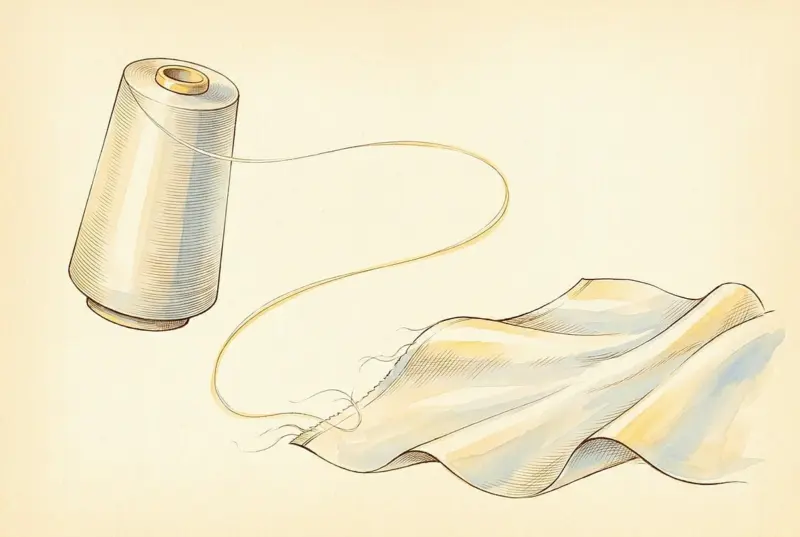

Lyocell was the rare advanced industrial category where India produced, at commercial scale, what Europe wanted to import. That position is being demoted fast by Chinese capacity, a price collapse, and a Thoothukudi MoU.
Sateri's newest lyocell plant produced its first commercial bale on the morning of 13 March 2026, at Yutai in China's Shandong province. The plant was the company's fourth. Once fully built out, the single Yutai site will hold more lyocell-making capacity than the entire global industry possessed as recently as 2023.
India, for once, was inside this story when it began.
Lyocell is made from wood pulp by a closed-loop chemical process that India's Technology Development Board helped fund a generation ago. Aditya Birla Group runs the only Indian plant of consequence, at Kharach in Bharuch district in Gujarat. When that plant was commissioned, India joined the small handful of countries equipped to produce, at any commercial scale, what the textile trade calls a third-generation regenerated cellulosic - the category around which the European Union is reshaping its $263 billion textile import market.
For most of the advanced, regulated industrial categories Europe now favours in its sustainability rules, India figures as a customer rather than a producer. Lyocell was, briefly, the exception.
That position is being unmade. Six years ago, Sateri did not produce lyocell. It now holds 600,000 tonnes of installed capacity across four sites in China, roughly a dozen times Birla's footprint, with Yutai's full build-out targeted to take its total close to one million. The fibre designed to sell at a premium over conventional viscose now trades in China at a discount to it.
Lenzing, the Austrian producer that dominated the global market, has lost four-fifths of its share-price value since 2021 and is gradually withdrawing from commodity lyocell altogether. Birla is investing, but at a scale Sateri can match in a calendar quarter. And Sateri's Singapore-headquartered parent, Royal Golden Eagle, is now bringing the same Chinese capacity onto Indian soil through a new plant at Thoothukudi committed in August 2025.
We have watched the pattern play out before, in solar panels, lithium batteries, electric vehicles. What separates the lyocell version is that in those areas, India was never really in the game. Here, it was.
Here, the chemistry is also worth looking at. The world's clothing rests on three families of fibre. Cotton, the oldest, comes from the plant. Polyester, the largest, comes from petroleum. Between them sits a third group, made from wood pulp by chemical processing, called regenerated cellulosics - and it has three generations.
The first is viscose, also called rayon, invented in the 1890s and still the most widely produced. Manufacturing it requires carbon disulphide, a chemical hazardous enough that Europe has steadily outsourced its production to Asia. The second is modal, a refinement of the viscose process with better strength and hand-feel. The third is lyocell, developed by an Anglo-Austrian effort in the 1980s and 1990s. Lyocell uses different chemistry: the cellulose is dissolved directly in a non-toxic organic solvent called N-methylmorpholine N-oxide, spun into fibre, and the solvent is recaptured in a closed loop. Producers recover upwards of 99 per cent of it.
Europe's interest in lyocell rests on its combination of environmental credentials and performance. The fibre is biodegradable, drawn from forests certified by the Forest Stewardship Council, and the closed-loop process avoids the toxic emissions that have given viscose its reputation. It is stronger than cotton when wet, holds dye well, drapes like silk, and breathes like linen.
The largest European fashion buyers - Inditex, H&M, Decathlon, Marks & Spencer - have written lyocell into their sustainability commitments. The European Union's incoming regulatory architecture, with its Digital Product Passport, deforestation regulation, and ban on unsubstantiated green claims, is designed to favour fibres of this kind. The global lyocell market is small, around $1.5 billion in 2025, but growing at near double-digit rates. Indian demand is growing faster still, projected at more than 15 per cent annually for the next five years. The fibre is what brands want and what regulators reward. Its share of total textiles is tiny. Its share of the textiles Europe is willing to import on premium terms is rising.
Three companies made lyocell at commercial scale until recently. Lenzing of Austria, the inventor and dominant producer, sold its fibre under the TENCEL brand and turned it into a label European consumers learned to look for. Birla, through its cellulose business, ran the only large non-Chinese plant outside Lenzing's network. The third was Courtaulds, since absorbed into Lenzing.
The framing of a "lyocell duopoly" between Lenzing and Birla flatters India's actual position. Lenzing has, across five plants in Austria, Thailand, the United States and Britain, around 360,000 tonnes of installed lyocell capacity. Birla has, between Kharach and its Nagda plant in Madhya Pradesh, roughly 53,000 tonnes. Against Lenzing, the ratio is around seven to one. Against Sateri, as already noted, it is twelve to one. Birla's existing capacity also goes overwhelmingly into non-woven applications - wipes, hygiene products, industrial uses - rather than into the premium textile-apparel market where TENCEL competes.
The salient fact, the one the duopoly framing was reaching for, is that Birla was one of only two large producers of lyocell outside China. The technology to make the fibre at commercial scale is non-trivial. The plant Birla built at Kharach was supported by the Technology Development Board precisely because the spinning chemistry and the closed-loop solvent recovery were difficult enough to warrant state-backed industrial assistance.
The original Courtaulds patents on the core process have long since expired. The know-how to run a commercial-scale plant has not entered the public domain. There are perhaps a dozen places in the world where it is possessed in working form.
This is the position India quietly held. Modest but real.
Birla is a working producer with credible architecture. Its FSC-certified pulp comes from upstream operations the group owns at Domsjö in Sweden and AV Group in Canada. A blockchain traceability platform called GreenTrack lets consumer brands plug into the supply chain, and the fibre carries a brand of its own, Liva. Canopy, the forest sustainability NGO, gives Birla its highest "Dark Green Shirt" rating, which the company has held for four consecutive years, tying Lenzing in the most recent assessment. The architecture was real. What was missing was scale.
The Royal Golden Eagle group, the conglomerate to which Sateri belongs, is a vertically integrated player in pulp and paper. Through plantations in Indonesia and Brazil, it controls the upstream cellulose. Through Sateri itself, it is the world's largest producer of viscose. Its corporate provenance does not match its industrial footprint - RGE was founded by an Indonesian-Chinese family - but the lyocell manufacturing sits entirely in China, draws on state support, and operates within the certification, regulatory and capital framework Beijing has built for the cellulosic-fibre sector.
Lyocell was the natural extension of that ambition. Sateri's first pilot line, of twenty thousand tonnes, opened at Rizhao in Shandong in May 2020. Rizhao expanded. A 100,000-tonne plant came up at Changzhou in Jiangsu in 2022, and another at Nantong followed in 2023. The largest of them, at Yutai, produced its first commercial bale this March, with an eventual plan for four production lines totalling 600,000 tonnes at that single site. The path reads like a stylised case study of Chinese industrial scaling.
Sateri did not produce lyocell six years ago. Yutai's full build-out, by itself, will eventually exceed the entire global industry of 2023. This is the rate at which the gap with India opened.The more interesting part of Sateri's expansion is the second one, which departs from that template. The standard assumption, held among Western industry observers, European policymakers and many Indian commentators, has been that Chinese producers would compete on price but not on credentials. European regulatory standards and brand sustainability commitments were supposed to function as a quality barrier, preserving a premium tier for the established Western producers.
Sateri has set out to make that assumption obsolete. It became the first lyocell producer in China to hold OEKO-TEX STeP at the highest level, and the first globally to combine STeP with the Made in Green label. It carries the USDA Certified Biobased mark. It holds EU-BAT compliance, the regulatory benchmark Europe applies to viscose-grade fibre manufacturing. In 2025, it rebranded itself as The Lyocell Company, complete with global sales offices across Asia, Europe and the Americas. Where Lenzing built TENCEL into a consumer-facing brand over twenty-five years, Sateri is compressing that arc into half a decade.
There is one credential Sateri does not yet have and cannot easily acquire. Canopy places it at "partial red shirt" rather than the "dark green shirt" reserved for Lenzing and Birla. The reason is upstream. RGE's pulp comes in part from APRIL, a sister company operating on drained tropical peatlands in Indonesia. The 2023 Pulping Borneo investigation by the Environmental Paper Network documented 37,105 hectares of natural forest cleared in Kalimantan since RGE's 2015 no-deforestation pledge.
As the European Union's Deforestation Regulation enters force from December 2026, this upstream complication becomes a more substantive market access issue. It is one of the few areas where the regulatory wall might still function as designed. Whether that wall holds, or whether RGE finesses it through sourcing realignment, remains uncertain.
Lyocell was designed to sell at a premium. It was the higher-priced, higher-margin, third-generation product, positioned above modal and well above viscose. For most of its commercial life this is what it did.
Pricing data assembled by the Chinese industry intelligence house CCFGroup tells the story of how that ended. When international producers dominated the Chinese market, lyocell sold above 20,000 yuan per tonne. By the middle of 2024 it had fallen to around 13,000 yuan per tonne, roughly $1,800. CCFGroup's analysts attributed the fall not to weak demand - operating rates in the Chinese industry had climbed from 44 per cent in 2022 to 85 per cent in 2024 - but to capacity additions outpacing the absorption rate.
The result, in the same domestic market, has been a price inversion anyone familiar with the cellulosic family would have considered improbable until recently. Lyocell, the third-generation premium fibre, now sells in China at a discount to viscose, the older fibre it was engineered to improve upon, and below cotton. Once a market reaches the point where the premium product trades below its own substitute, the architecture of the industry has to change. Premium positioning by the established producers stops working because, at least for the current cycle, the premium does not exist.
Lyocell was designed to sell at a premium over the cellulosic family it improved upon. Chinese capacity additions, outpacing absorption, have inverted that order. Once a premium product trades below its own substitute, the architecture of the industry has to change.Lenzing entered this competition with everything an incumbent could want. The technology, the brand, three quarters of a century of operating experience, integrated upstream pulp from an Austrian forest base and a Brazilian joint venture, and the world's largest single lyocell plant at Prachinburi in Thailand.
By the end of 2025, its share price had fallen from a 2021 peak of about 122 euros to 23 euros and change. The company has posted net losses for three consecutive years: 593 million euros in 2023, 138 million in 2024, 135 million in 2025. No dividend has been paid since 2021. Net debt at 1.35 billion euros against a depressed earnings base leaves Lenzing with limited room to fund a defensive expansion even if it wanted to.
The strategic response Lenzing announced in September 2025 was sharper than most companies in its position would have produced. It put the Indonesian viscose plant under strategic review for potential sale, taking an 82 million euro impairment in the process. It announced 600 job cuts in Austria, targeting more than 45 million euros in annual savings. Specialty fibres now account for over 92 per cent of its fibre revenue, up from 79 per cent only a year earlier.
The Alabama lyocell expansion it announced in 2018, from 51,000 to 140,000 tonnes, at a cost of 293 million dollars, has been mothballed. Lenzing is no longer trying to be the world's largest lyocell producer. It is repositioning as the world's premium lyocell producer, defending a niche it can hold against Chinese volume.
The price level in India has fallen sharply through 2025 in sympathy with the Chinese market, and Grasim, Aditya Birla Group's listed flagship, has cited "low-priced dumping from China" on recent earnings calls as a reason for compressed cellulosic fashion-yarn margins. The arc from rapid capacity addition through price collapse to incumbent retreat played out across roughly seven to ten years in solar, batteries and EVs. The lyocell version is moving faster. The full Yutai build-out, if completed on schedule, will add by itself the equivalent of Lenzing's entire global lyocell footprint within five years of Sateri's pilot line opening.
Whether Lenzing's niche is itself defensible at scale is one of the larger unanswered questions in the cellulose industry. The Swedish recycled-fibre producer Renewcell filed for bankruptcy in February 2024 despite holding H&M's commitment to take 18,000 tonnes - an episode that demonstrated what happens when brands fail to pay the price differential needed to keep premium suppliers solvent.
The willingness of European consumers to pay a sustainability premium, measured at 17 per cent by the Boston Consulting Group, is not large enough to bridge the gap. The strategy taking shape in China's lyocell factories aims to make the premium tier irrelevant by meeting its credentials at lower cost rather than competing for it on price alone. This is the part of the playbook the European policy class has not yet fully absorbed.
There is a serious case against the framing of this piece.
The case is that fibre is the wrong place to fight. Fibre is around three to five per cent of a garment's retail cost. The conversion stages - spinning, weaving, dyeing, finishing, garmenting - capture the rest. India's comparative advantage in textiles has historically sat in those downstream stages, in the cotton-spinning clusters of Tamil Nadu, the synthetic-fabric ecosystem of Surat, the garment ecosystems of Tiruppur and the National Capital Region.
The argument runs that India should let Sateri and Lenzing fight over upstream lyocell margins that the price collapse has already eroded, and instead focus its industrial policy on becoming the world's preferred converter of imported lyocell fibre into finished textiles for the European market. The fibre price has fallen; the value has migrated downstream; the FTA's tariff advantage applies to what India exports, not what India imports. On this reading, the Thoothukudi MoU is not a problem. It is the solution - foreign capital building the upstream India does not need to fund itself, freeing Indian capital to build the downstream that captures the real value.
This is the most serious case against the position this piece is taking, and it gets a great deal right. But not all of it.
What it gets wrong is the rules of origin. The India-EU FTA requires substantial transformation in India for textile categories to qualify for preferential tariffs. A garment finished in India from imported Chinese lyocell fabric does not qualify. That is the design of every modern EU trade agreement, and it is the design of this one. The architecture of the FTA was built on the assumption that real conversion requires real upstream presence - that a country which imports the fibre and exports the garment is being used as a finishing room rather than a textile economy, and the agreement is designed not to subsidise that arrangement.
The downstream case also misreads what is happening in the European market. Brand sourcing teams, increasingly, want fibre-level traceability. The TENCEL premium captured by Lenzing exists because European brands can put a verified fibre claim on a garment label, and Lenzing has invested in fibre-identification technology that allows a brand to prove its garment actually contains TENCEL rather than a substitute. The premium TENCEL captures in retail is not accidental - it was constructed.
The Digital Product Passport, as it phases in, is pushing that traceability from optional toward mandatory. A converter who does not control the fibre cannot control the claim. The downstream-only strategy works for commodity garments. It does not work for the premium tier that is the reason the European opportunity exists at all.
India needs both. The downstream case is right that the downstream matters. It is wrong that the upstream can be ceded.
India's response, such as it is, runs through Birla Cellulose. The company has read the same data Lenzing has read, and has chosen to expand rather than retreat.
In November 2025, Birla's business head for cellulose, Vadiraj Kulkarni, confirmed plans for a new lyocell plant at Harihar in Karnataka. The investment is around 1,350 crore rupees for the first phase, roughly 160 million dollars, with a planned capacity of 55,000 tonnes coming online in mid-2027. A second phase of equal size is envisaged after that. The combined eventual capacity at Harihar is 110,000 tonnes, which would triple Birla's lyocell footprint and bring its all-India total to roughly 163,000 tonnes.
The decision is the right one. The strategic problem is that 163,000 tonnes is around a quarter of Sateri's current installed capacity, and substantially less than half of what Yutai alone is designed eventually to reach. The mismatch is not in direction but in scale. Sateri is state-backed, vertically integrated upstream, and patient in a way that more accommodating capital costs permit. Whether the Aditya Birla Group has the appetite for the multi-plant, multi-decade commitment that would close the gap, and whether any other Indian conglomerate would put serious capital behind lyocell, is a question still unanswered.
India's entire planned lyocell footprint, including the foreign-owned Thoothukudi plant, is a fraction of what Sateri's Yutai site alone is targeting. The FTA buys India the right to compete. The capacity to compete does not yet exist.Birla is also fighting the marketing battle in difficult conditions. Liva, the brand Birla puts on garments that use its fibre, is recognised by over a hundred Indian and international brands and appears on more than seventy million pieces a year. By Indian retail standards this is a serious presence. By the standards of what TENCEL has been allowed to become in European consumer recognition, it is a different category altogether.
TENCEL has been actively built, since the 1990s, as a consumer-facing label whose retail premium was constructed, not accidental. Liva today is a business-to-business marker. Whether it can become a consumer demand creator depends partly on Birla's marketing willingness and partly on how much money the Aditya Birla Group is willing to put behind it.
India's existing lyocell capacity also goes mostly into the non-woven hygiene and wipes sector rather than premium European apparel. The non-woven trajectory is itself a growing market, driven by the EU's Single-Use Plastics Directive and by the broader shift from synthetic to cellulosic disposables. But Lenzing's TENCEL competes in apparel, and apparel is where India would need to be to convert its upstream advantage into the European textile exports that are the headline opportunity. The textile-apparel ambition lives, on the Indian side, almost entirely in the Harihar expansion, which is two phases and several years away.
Three months before Birla announced Harihar, on 4 August 2025, at the TN Rising Investors Conclave in Thoothukudi, the chief minister of Tamil Nadu presided over the signing of 41 memorandums of understanding totalling more than 32,000 crore rupees.
Among them was an investment commitment from Royal Golden Eagle for a 4,953 crore lyocell plant in Thoothukudi district, with a planned capacity of 150,000 tonnes per annum of lyocell and an additional 50,000 tonnes of tissue paper. The project will be operated through Asia Pacific Rayon, RGE's regional cellulosic-fibre business and a sister company of Sateri within the wider RGE group.
The lyocell capacity envisaged at this single Indian plant exceeds the entire current Birla footprint and is roughly comparable to what Birla expects to have after Harihar is fully built, several years from now.
The stated intent is that the Thoothukudi plant will primarily serve the Indian domestic market. Asia Pacific Rayon's regional head has cited India's lyocell demand trajectory as the commercial logic. The framing is plausible. India is the fastest-growing major lyocell market, and serving that demand with domestic capacity is sound business strategy irrespective of who builds the plant.
But what happens after the plant is built? The Rules of Origin chapter in the India-EU FTA does not discriminate by ownership. A 150,000-tonne lyocell plant in Tamil Nadu, processing pulp sourced from RGE's plantations and converting it into fibre on Indian soil, is Indian for the purposes of any preferential tariff arrangement. If RGE chooses, at some future point, to redirect part of its Thoothukudi production toward European export - perhaps because Chinese-origin lyocell has become a more contested category in Europe by 2028, perhaps because the FTA's tariff advantage becomes too substantial to ignore - there is nothing in the structure of the agreement that prevents this.
The question is whether India's policy machinery, in pursuing the political and commercial value of investment commitments at events like the TN Rising conclave, has thought through what, exactly, it is celebrating.
The India-EU Free Trade Agreement, concluded on 27 January 2026 after nineteen years of intermittent negotiation, eliminates the European import duty on Indian textiles. The rates being lifted run from 8 to 12 per cent, with apparel categories at the higher end. In nominal terms, this is a substantial advantage. China has no FTA with the European Union. Indian textiles will, once the agreement enters into force, land in European ports with a 9-to-12 percentage point cost benefit over Chinese textiles of equivalent specification. For a producer in the lyocell-textile chain, that advantage is meaningful enough to alter the competitive equation.
The qualifier "once the agreement enters into force" carries weight. EU FTAs typically take one to three years from political conclusion to ratified entry. The Indian textile sector therefore faces a window of perhaps two years during which it continues to pay Most Favoured Nation duties before the FTA's preferential rates take effect.
The deeper qualifier sits in the Rules of Origin chapter. Real conversion has to happen on Indian soil for the FTA tariff to apply, and this is where the FTA opportunity collides with the second Indian gap. India does not have, at industrially relevant scale, a lyocell processing ecosystem oriented toward European export specifications. Lyocell's wet processing, its dyeing and finishing, is technically different from polyester's. The fibre is prone to fibrillation, the surface micro-breakdown that produces unwanted pilling on finished garments, and requires specialised jet dyeing equipment, enzyme treatments and crosslinking chemistries that most Indian processors have not invested in.
Surat, the country's largest synthetic-fabric cluster, is built around polyester. Tiruppur runs primarily on cotton and blends. There is no Indian equivalent of the integrated lyocell-textile clusters that have grown around Lenzing's plants in Austria or Sateri's in Jiangsu and Shandong. The fibre will exist at Harihar in 2027. The cluster that converts it into European-specification finished textiles does not yet exist anywhere in India.
The Indian government's main industrial-policy instruments, the PLI scheme for textiles and the PM-MITRA mega-park programme, do not address lyocell specifically. Neither does the National Fibre Mission, which sets aggregate targets for man-made cellulosic fibre growth without disaggregating into the lyocell sub-segment that Europe most demands. The instruments treat man-made cellulosics as a category. The category is where Lenzing competes by leaving and Sateri competes by scaling - and the policy can describe neither.
The FTA is the policy instrument India is celebrating. The means to use it are either absent or generic.
This is the position when Yutai's first commercial bale rolled off the line on 13 March 2026. A single plant in Shandong, six weeks after India and the EU concluded their trade agreement, came online with a capacity programme that by itself will eventually exceed the entire global lyocell industry of three years earlier. The new Indian capacity is foreign-owned and points at the domestic market by intent, with nothing in the agreement preventing future redirection. The Indian-owned capacity is a quarter the size of the foreign capacity coming onto Indian soil, and a fraction of the Chinese capacity it would have to compete with.
The window in which India can still preserve a meaningful position in lyocell is open, narrower than it was in 2023, and probably closing on present trajectories. Closing it would require things that are not yet happening at the necessary pace. Birla's expansion at Harihar is the right kind of investment but its size is mismatched to the rate of Chinese addition.
The Liva brand needs the kind of multi-year, multi-hundred-million-dollar marketing effort that builds a fibre ingredient into a consumer demand signal - what Lenzing did with TENCEL, what Indian conglomerates have rarely done with industrial inputs. A processing cluster, in dyeing and finishing and fabric conversion at European specifications, would need to be built around Harihar or in adjacent geography, and the policy instruments capable of incentivising it would need to be designed and funded. The trade deal buys India the right to compete. It does not provide the means.
None of this is impossible. India has done parts of it elsewhere.
The lyocell variant of the loss, though, is the variant that matters most for the way the country thinks about industrial capability, since lyocell is the one fibre where India was not an absent player trying to catch up. It was inside the small group that produced the thing the world is now coming to want most. That position is being demoted while we are not paying attention.
The lesson, if there is one, is that being a producer is a perishable status. It does not, in industries with a Chinese capacity wave running through them, last by inertia. The competitive position survives only when it is treated as a strategic asset and resourced at the speed of the threat, not at the speed of comfortable business expansion.
India has the materials. Urgency is what is visibly missing.