




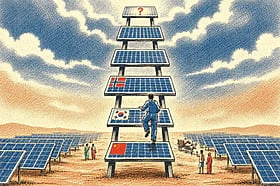

The Production Linked Incentive (PLI) scheme and the new cell mandate have built and protected India's manufacturing base. The next instrument - moving technology targets that rise every twelve to eighteen months - is the one that decides whether the industry stays a licensee or becomes a designer.
The Ministry of New and Renewable Energy has now confirmed what manufacturers had hoped and developers had feared in equal measure: from 1 June 2026, all new government-supported solar projects in India must use cells produced by domestically approved manufacturers. There will be no blanket extension.
Project-specific relief may be granted to a handful of delayed schemes on a case-by-case basis, but the principle holds. The second list of the Approved List of Models and Manufacturers - covering solar cells rather than just modules - takes effect on schedule.
That sentence reads, on first pass, as a fairly technical regulatory development. It is in fact the most consequential signal Indian industrial policy has sent in this sector since the original Production Linked Incentive scheme was launched in 2021, and it is worth understanding why.
The renewed instability in West Asia has made energy independence a live political subject again. India spent $137 billion on imported crude oil in the financial year just ended, with 88 per cent of its consumption coming from abroad, much of it through the Strait of Hormuz.
Solar power is the most credible domestic substitute India has for that exposure - sunlight is one resource the country has in abundance, and it does not need to be shipped through a contested waterway. Five years and ₹24,000 crore into a PLI scheme designed to build the manufacturing base behind that substitution, the cell mandate is the test of whether the policy has worked deeply enough to be enforced, or only superficially enough to be deferred. The government's answer this week was: enforced.
This essay argues that the answer was the right one, but that it solves only half of the problem the PLI scheme was meant to solve. The cell mandate rescues the manufacturing economics of an industry that the subsidy scheme built; it cannot, and does not, build the technological autonomy that the strategic case for the industry ultimately requires.
Those are separate goals running on separate tracks, and the policy architecture has answered the first while not yet beginning to answer the second. The first half of what follows explains what the mandate fixes. The second half explains what it cannot reach.
To follow either, it helps to know what is actually inside a solar panel. The familiar blue or black rectangle on a rooftop is a module: a sandwich of about sixty to seventy-two cells, sealed between glass and a polymer backsheet and held in an aluminium frame.
The cells - wafer-thin squares roughly the size of a CD case - are where sunlight actually becomes electricity. Each cell is built on a wafer, a sliver of crystalline silicon less than half a millimetre thick, sliced from a cylindrical ingot grown out of molten polysilicon. The polysilicon, in turn, is purified from quartz sand in a chemical process that takes vast amounts of electricity and equipment that costs hundreds of millions of dollars per plant.
That sequence - sand to polysilicon to ingot to wafer to cell to module - is the solar value chain. The further upstream you go, the harder, more capital-intensive, and more knowledge-intensive the process becomes. Assembling modules is essentially a precision lamination job: you can build a module line in eighteen months for about ₹170 crore per gigawatt.
Making cells requires clean-room conditions, photolithographic precision, and a dozen specialised steps to deposit and pattern the layers that give the cell its efficiency; a cell line costs roughly ₹650 crore per gigawatt and takes two years. Making wafers means growing monocrystalline silicon ingots - which is metallurgy at the atomic level - and slicing them with diamond wire to micron tolerances. Polysilicon is industrial chemistry on a vast scale.
Where the chain breaks - India's solar value chain capacity, May 2026China understood this thirty years ago and built its dominance from the top down. India's Production Linked Incentive scheme, introduced in two tranches in 2021 and 2022, was an attempt to build the same chain from the bottom up, by paying manufacturers to integrate backwards from modules into cells and from cells into wafers and polysilicon.
The mechanism was simple: bid for a slice of the ₹24,000 crore subsidy pot, and the more of the value chain you committed to build domestically, the more you would win. Reliance, Adani, Tata, Waaree, Vikram, Premier Energies and several others took the bait. On paper, 48.3 gigawatts of integrated capacity was awarded.
The module half of the chain has been a clear success. India had perhaps 18 GW of module capacity in 2020. By May 2026, it has somewhere between 144 GW under formal audit and 210 GW on industry nameplate - the world's second-largest assembly base, against domestic demand of only about 40 GW a year.
The tariff wall imposed in April 2022 - a 40 per cent customs duty on imported modules, since reduced - gave Indian assemblers a captive home market.
The Approved List of Models and Manufacturers locked that market in. And for three years, a windfall export channel opened up to the United States, where a 2022 forced-labour law had effectively banned Chinese modules, and Indian factories were among the few non-Chinese options available. Module exports grew twenty-three-fold from FY22 to FY24, peaking near $2 billion. Margins on those US sales ran forty to sixty per cent higher than at home, and the cash funded the next round of capacity additions.
It is at the cell stage that things get harder, and here the cell mandate begins to matter. A cell is not just a smaller, thinner module - it is a different kind of object. To make one, you take a wafer, etch its surface to trap more light, dope it with phosphorus to create the electrical junction that does the actual converting, deposit anti-reflective and passivation layers using machines that operate at near-vacuum and several hundred degrees centigrade, and finally print silver electrodes on the surface with a precision measured in microns.
Each of these steps uses specialised equipment that only a handful of companies in the world make - and most of those companies are Chinese.
Suzhou Maxwell Technologies, in particular, dominates the market for the heterojunction cell tools that Reliance bought to equip its Jamnagar facility, to the tune of roughly $300 million in a single order. Bloomberg's analysis of 2024 trade data found that two Chinese tool-makers together supplied more than half of all solar manufacturing machinery imported by India's ten largest solar firms. Premier Energies' TOPCon cell facility in Hyderabad, commissioned in 2025, sourced about sixty per cent of its equipment from Europe instead - a deliberate de-risking choice, but European tool-makers depend, in turn, on Chinese and Korean process expertise.
Whose technology, India's factories - PLI winners and their licensed cell technologyIndian cell capacity stood at about 27 gigawatts in May 2026, against the 48 GW awarded across two PLI tranches. The shortfall is not a question of money - the subsidies were generous and the companies that won bids are well-capitalised. It is partly a question of supply chains for the equipment, partly of engineering teams who know how to commission a cell line, and partly of an earlier policy mistake.
The ALMM module mandate was suspended for FY24 to accommodate a perceived supply shortage. The timing turned out to be unfortunate: Chinese cell prices collapsed during the same months, from about $0.12 per watt to $0.03 per watt within half a year, and Indian integrated lines that had built their business cases on the higher price found their cell economics ruined just as they were commissioning. Investors who had committed billions of rupees to upstream capacity watched their margins evaporate.
This is the specific problem the cell mandate is designed to solve. By forcing all new government-supported projects to buy from domestically approved cell manufacturers from 1 June 2026, the rule creates a guaranteed offtake floor for the integrated PLI investments - Reliance's HJT lines at Jamnagar, Adani's cells at Mundra, Tata's TP Solar at Tirunelveli, Waaree's 5.4 GW cell facility in Gujarat, Premier's TOPCon line in Hyderabad, Vikram's planned capacity.
Without that floor, the developer lobby's preferred outcome - continued imports of cheap Chinese and Southeast Asian cells - would have crushed the unit economics these companies were promised when they committed to building cell lines four years ago. The mandate is, in this sense, a rescue. It restores the bankability of the PLI's integrated bets.
It is also, by extension, the pre-condition for the next stages of manufacturing to be built at all. Indian wafer capacity stood at about 5.3 gigawatts in May 2026, almost all of it tied to two facilities: Adani's Mundra plant, and a 2 GW joint venture between Premier Energies and Taiwan's Sino-American Silicon. Tata Power's board approved a 10 GW wafer-and-ingot plant in Nellore in late 2025, but that capacity will not be operational before 2028. Polysilicon, the apex of the chain, sits at about 3.3 gigawatts of capacity.
Each of these upstream investments is justified by the demand pull from downstream cell capacity - without profitable Indian cell lines, there is no domestic customer for an Indian wafer; without a domestic wafer demand, no rationale for Indian polysilicon. The June 2028 wafer mandate, when it takes effect, will perform the same function for the wafer stage that the June 2026 cell mandate performs for cells. This is industrial policy operating as a ratchet: each rule converts a domestic market into the patient capital that the next, harder stage of the industry requires.
The industrial policy ratchet - PLI 2021 to the rungs yet to be writtenSo far, so logical. But it is at exactly this point that the limits of the instrument become visible.The cell mandate forces developers to buy Indian-made cells. It does not require those cells to be based on Indian intellectual property.
A factory making licensed TOPCon cells on imported Chinese equipment satisfies the mandate identically to a factory making truly indigenous cells. Indeed, every commercial high-efficiency cell technology in Indian production today is licensed from abroad - PERC and TOPCon from Chinese and Korean developers, heterojunction from a Norwegian firm that Reliance acquired in 2021. The mandate protects the licensee position. It does not move India toward the licensor position.
This distinction matters because of how solar technology actually evolves. Cell efficiency - the percentage of incident sunlight a cell converts to electricity - has improved on a roughly five-year cadence for two decades. Standard PERC cells, the workhorse of the mid-2010s, plateaued at about 22.5 per cent. TOPCon, the current production frontier, runs at 24 to 25 per cent. Heterojunction can reach 25.5 to 26.
The next generation - tandem cells that stack a perovskite layer on top of silicon, and interdigitated back contact designs that move all electrical contacts to the rear surface - is targeted at 27 to 30 per cent, and prototypes are already there. Each percentage point of efficiency, compounded across the lifetime of a 25-year asset and the gigawatts produced annually, is a significant cost advantage.
The moving target - solar cell efficiency by generation, and who owns the IP at each rungThe companies that own the technology behind each generation decide who gets to make it, on what terms, and when. They license their process recipes, but they typically license them with a generation lag - the developer keeps the frontier for itself and licenses the previous generation to others.
The licensee can manufacture cells, but cannot decide what comes next. When the next generation arrives, the licensee must either license again, at whatever terms the developer offers, or fall behind.
A factory built to make TOPCon cells with Chinese equipment will, when tandem cells become commercial in 2028 or 2029, need either a new licensing agreement or new equipment or both. The licensor controls the upgrade. The licensee follows.
India is, on present trends, a licensee for the foreseeable future. The reason is the absence of indigenous research and intellectual property at any meaningful scale. India's flagship solar research centre, the National Centre for Photovoltaic Research and Education at IIT Bombay, has received about ₹200 crore in cumulative funding from the renewable energy ministry over fifteen years - roughly $23 million. The same ministry's deployment programmes spend nearly that much in a fortnight. India does not appear in the World Intellectual Property Organization's leading filers for photovoltaic patents; China, Korea, Singapore and Israel do.
The pilot work at IIT Bombay is excellent - an IIT-incubated firm, ART-PV India, has demonstrated a silicon-perovskite tandem cell with 29.8 per cent efficiency, near the global research frontier - but no Indian-developed cell technology has yet made the jump to commercial production. The structural deficit is two orders of magnitude: India spends about a hundred times more on deploying solar than on the research that would let it own the technology being deployed.
None of this is touched by the cell mandate. The rule that takes effect on 1 June 2026 makes no distinction between a cell built on licensed TOPCon process recipes from a Chinese developer and a cell built on truly indigenous Indian process IP, because no factory of the latter description exists. The protection it offers is unconditional. It does not reward technological autonomy, because there is no technological autonomy yet to reward.
The first instinct, on confronting this gap, might be to question whether the PLI scheme was the right instrument in the first place. That instinct is wrong. Building manufacturing capacity at the downstream end of a complex value chain - modules, then cells, with the upstream stages to follow - is precisely what a country in India's position should do first, and a production-linked subsidy is precisely the right tool for it.
Downstream assembly is where domestic capability can be built quickly, where the capital requirements are tractable, where the engineering skills are transferable from adjacent industries, and where a tariff-and-mandate architecture can create the demand floor that justifies private investment.
The cell mandate, refusing the blanket delay, is the policy bolt that holds this entire edifice together. Without it, the upstream investments that the PLI was meant to incentivise would not be commercially viable, and the wafer and polysilicon stages would never follow. This much the government has got right.
What the government has not yet done - and what is now overdue - is design the second instrument that must run in parallel to the first. The PLI scheme rewarded production. It did not reward technological progress, and the cell mandate, being a market-protection rule, cannot do that work either.
What is needed, beginning with this very cell mandate, is a sequence of moving technology indigenisation targets pegged to the edge of existing manufacturers' capabilities - achievable with effort, not achievable by inertia. The cell mandate of June 2026 should be followed, six to twelve months later, by a target requiring that a defined and rising share of cells supplied under the mandate use process IP either developed in India or co-developed with Indian institutions.
A year after that, the target should rise again. Two years after that, equipment indigenisation - first for module lines, then progressively for cell lines - should enter the mandate. The principle is straightforward: each protection the government extends should come with an obligation to climb one rung further up the technological ladder, and the rungs should keep moving.
This is how Korea built Samsung from a transistor licensee into a semiconductor designer. It is how China built Huawei from a switch reseller into a 5G patent holder. It is how Taiwan built TSMC. In each case, the state subsidised the capability the firm could build, then withdrew the subsidy on terms that required the firm to build the next capability.
The PLI scheme, the cell mandate, and the proposed wafer mandate are the first three steps of this ladder. The missing steps are the technology mandates that must follow them - beginning now, while the rescued manufacturing economics still give beneficiary companies the margin to invest in R&D rather than survive on subsidy.
The R&D funding has to follow this architecture, not precede it. A ₹2,000-crore annual allocation to indigenous solar process IP, structured through the Anusandhan National Research Foundation and ring-fenced from deployment budgets, would be the necessary public counterpart to a moving technology target imposed on private beneficiaries.
The two instruments work together. Public money funds the laboratories and the pilot lines; private money, drawn by the moving target, funds the commercial translation. Neither half works without the other. Pure subsidy without the technology mandate produces sophisticated assembly lines for foreign IP, which is what India has today. Pure mandate without the public R&D produces unenforceable targets that beneficiary companies meet by paper compliance, which is what India risks tomorrow.
The factories are real. What is inside the factories is, for the moment, still mostly someone else's design. The cell mandate beginning on 1 June 2026 is the policy that holds the manufacturing layer together. The policies that would build the design layer - moving technology targets imposed on beneficiaries, sustained public R&D structured to feed them - have not yet been written. They should be the next thing the government writes.
The PLI was the right answer to the question of how to build a solar manufacturing industry. The harder question, of how to build a solar industry that India actually owns, is still waiting for its answer.