
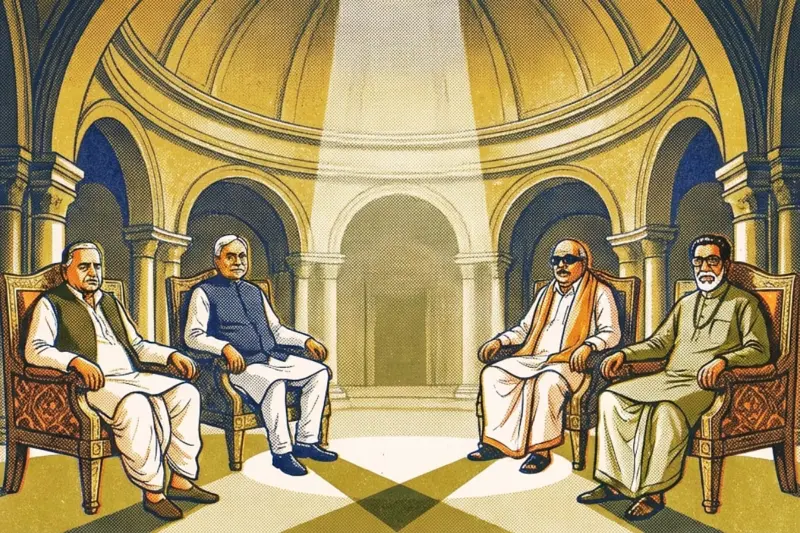

Regional parties in India do not become dynastic only because their founders are selfish. Many become dynastic because they are organised in ways that make non-dynastic succession unusually difficult.
Patna has seen enough succession rumours to know when something is real. In March 2026, it was real. The party office was set up for the occasion, and workers were already speaking as if the future had been decided.
Cameras gathered where they always do - at the moment when a private family decision becomes a public political fact. Standing there was Nishant Kumar, son of Bihar's longest-serving chief minister, Nitish Kumar.
The younger Kumar had long been kept away from politics. When he finally stepped in, it was not as a candidate with his own story, but as the answer to a question Bihar had been asking quietly for years: who comes after Nitish?
Nishant Kumar's inevitable arrival matters for two reasons.
Firstly, because Janata Dal (United) (JD(U)) has discovered some especially novel forms of succession.
Secondly, because it closes one of the last symbolic gaps in Indian regional politics.
Nitish Kumar built his career, in no small part, as the anti-Lalu. For Bihar, he chose to be seen as the sober administrator against the rustic court, the practitioner of governance against the theatre of the clan, the Jayaprakash Narayan disciple who could still claim descent from a politics that distrusted inherited power.
If even that story ends here, with a son entering the frame as custodian of the father's political estate, then what collapses is the lingering hope that some major regional parties might still escape the same institutional fate, which is now familiar enough to be mistaken for culture.
A movement is born in grievance, grows through one leader's authority, hardens into a personality cult, and eventually settles into family control. Then comes the succession struggle, the split, or the slow decline. Popular commentariat usually narrates this as a story of greed, vanity, or feudal instinct. Often it is all three.
From movement to cult to family firm-ending in split or decayBut the recurrence of the pattern suggests that regional parties in India do not become dynastic only because their founders are selfish. Many become dynastic because they are organised in ways that make non-dynastic succession unusually difficult.
That would be a narrower institutional problem if these parties had remained provincial forces or temporary vehicles of protest. They did not. Regional parties have been among the most transformative instruments in Indian democracy.
They broke the upper-caste monopoly over state power in large parts of northern India. They converted linguistic pride into federal bargaining power in the south. They opened space for backward classes, Dalits, agrarian blocs, ethnic minorities and subnational communities that the Congress system either absorbed weakly or represented only in name.
If many of these parties now look fragile and without clear purpose, the problem runs deeper than hypocrisy. It is a problem built into how such parties are designed from the start.
They usually begin with a wound - not an abstract idea, but a real social injury large enough to bring people together: caste humiliation, exclusion from government, being made to feel that power belongs to someone else, somewhere else.
The founder arrives first as a voice for that grievance, then becomes its symbol. He stops just speaking for the hurt and starts embodying it. This is the original political miracle - and also where the first institutional compromise is made.
Lalu Prasad Yadav did not become important in Bihar because he wrote a superior ideological brief on social justice. He mattered because he gave lower-caste assertion a voice that the old order could not contain or co-opt. His authority was not just organisational - for many supporters, it felt like something larger.
Something similar, in very different idioms, was true of Bal Thackeray in Maharashtra, M. Karunanidhi in Tamil Nadu, N.T. Rama Rao in undivided Andhra Pradesh, Mulayam Singh Yadav in Uttar Pradesh, and Mayawati among sections of Dalit politics. The specific constituencies varied, with the same underlying mechanism.
The founder gradually became the most persuasive proof that the grievance was real and that the community had, at last, found its political instrument.
That is where transferability begins to weaken.
Once a political idea becomes inseparable from one person, succession stops being a routine organisational question. It becomes a crisis of legitimacy. The next leader is not simply being asked to run the party. He is being asked to carry the social meaning of the founder's entire life.
Most cannot.
This is why these parties tend to drift, over time, from having a programme to offering mediation.
That shift is often misread. Critics dismiss it as crude identity politics. Admirers call it a pure uprising of the marginalised. In practice, it is usually both more democratic and more transactional than either side admits. What holds the coalition together is not just rhetoric but a practical promise: through this leader, your people will finally get access to the state.
That access can mean jobs, welfare, police protection, or simply being treated with dignity by officials. It can also mean that the government now speaks in a way that includes you - less tangible than a policy, but no less real as a political fact.
For many voters, it is the first tangible form of politics they have ever encountered.
But it produces a specific kind of mass following. It appears ideological from afar and operates, up close, as a network of dependence.
The voter is now attached more to an access route than a doctrine. That is why the leader's authority becomes so difficult to decentralise. He or she is more than a campaign face or symbolic figurehead - they are the switchboard through which social dignity gets converted into administrative outcomes.
At this point, internal democracy starts to look less like a virtue and more a a threat.
Why encourage autonomous centres of legitimacy inside the party if each one can become a future claimant to the social coalition? Why permit a genuinely competitive internal process if the party's vote, finances, ticket distribution and emotional coherence are all tied to one personality?
The result is a political form in which the chief is not merely first among equals, but frequently the only node that all factions still trust - or fear.
And then comes the contradiction that pushes the system towards family.
The real threat to the regional patriarch is rarely the ideological opponent outside the party, but a rival social broker within it.
Every coalition in India is more fractured than it first appears. OBC is not a naturally coherent bloc. Nor is Dalit, Maratha, Jat, Vokkaliga, Reddy, tribal, Telugu pride, or Dravidian identity. Each category contains rank, sub-caste, region, local bosses, aspirational splits, and old resentments waiting for institutional expression.
The founder's political talent lies in compressing those contradictions long enough to produce a durable electoral bloc.
Viewed from this perspective, dynasty is often faction management by bloodline.
Mulayam Singh Yadav's succession struggle was never just about father and son. It was about competing command structures inside a party whose social coalition could not easily be opened to a free-for-all without risking fracture.
Lalu Prasad Yadav's transfer of authority to Tejashwi was also a way of preventing the party from becoming the site of open competition among second-rung claimants, sub-caste anxieties, and satellite loyalties.
Every major regional party that began as a movement against inherited power has ended as inherited powerEven in parties with stronger cadre traditions, succession has often remained bounded by kinship, because kinship is the one form of continuity that appears politically legible to all internal camps at once.
None of this makes the dynasty less corrosive. It does, however, make it more intelligible.
This is what makes Nitish Kumar such a revealing figure. For a long time, he seemed to come from a different political tradition than most regional leaders. He was shaped by the legacy of Jayaprakash Narayan's movement - that brief, now almost mythologised moment when anti-Congress politics still spoke the language of ethical dissent, decentralisation, and resistance to the concentration of power.
JP did not leave behind a family estate. He left behind a generation.
That generation has now largely completed the same institutional arc it once criticised.
What makes that arc especially striking is that the leaders from whom it claimed descent - Gandhi, B. R. Ambedkar, and Jayaprakash Narayan, however different in philosophy and historical role - did not treat their political capital as inheritable household property.
Gandhi left behind disciples large enough to disagree with him and still remain within the tradition he had shaped. Ambedkar's political afterlife was scattered and often contested, but it was carried by followers, interpreters and institution-builders rather than family claimants. JP, too, left behind not a household but a generation. All of them understood the same thing: that a movement survives not when it is inherited by blood, but when it is reproduced through organisation.
They made themselves historically durable without making themselves biologically necessary.
Their successors did something narrower.
They built followings that were often electorally formidable but less institutionally transferable. If the first generation built movements capacious enough to contain disagreement, the second often built political machines that struggled to survive uncertainty without retreating into bloodline.
That is not true in exactly the same way everywhere. Some parties have stronger internal memory than others. Some retain cadre structures, ideological language, and local leadership pipelines that slow the process of familial closure. Others are more directly personal from the start. But the broad pattern is difficult to miss. A party built around the founder's irreplaceability eventually struggles to imagine succession in any form other than inheritance.
There is, however, one more uncomfortable possibility.
Voters are not merely trapped by this system. They sometimes stabilise it.
Dynasty persists not only because elites impose it, but because inheritance can appear, in fragmented democracies, as a kind of continuity. A son may be inexperienced, underwhelming, even faintly absurd as a public figure, but he is eligible to carry the seal. He can reassure local intermediaries, signal continuity to the coalition, and postpone the more frightening alternative of a party tearing itself apart in the open.
For voters who have seen enough defections, enough split verdicts, enough ideological flexibility masquerading as principle, the familiar surname can look less like entitlement than insurance.
That does not vindicate dynastic politics but it does explain why anti-dynasty rhetoric is often less politically effective than its moral force would suggest.
The obvious remedies are all institutional - enforceable internal elections, transparent party financing, auditable membership, stricter regulation of internal nominations, and perhaps a broader legal debate about what democratic obligations political parties should be held to.
But such reforms would require the consent of the very class most empowered by the current arrangement. It is hard to imagine Indian party chiefs voluntarily legislating against the architecture of their own indispensability.
Which is what made the scene in Patna feel neither dramatic, nor scandalous, but also familiar. Just recognisable in the way Indian politics increasingly is when a son enters a party office and everyone behaves as though they are witnessing continuity rather than contraction.
The original movements these parties trace their roots to altered who could rule, who could speak, who could command a crowd without inherited social permission. They broke old monopolies. They changed the grammar of power in the states.
But somewhere along the way, many of those movements lost the ability to produce successors who were not heirs.
And once a party can imagine continuity only in the language of inheritance, one is left wondering how much of the movement still survives.