
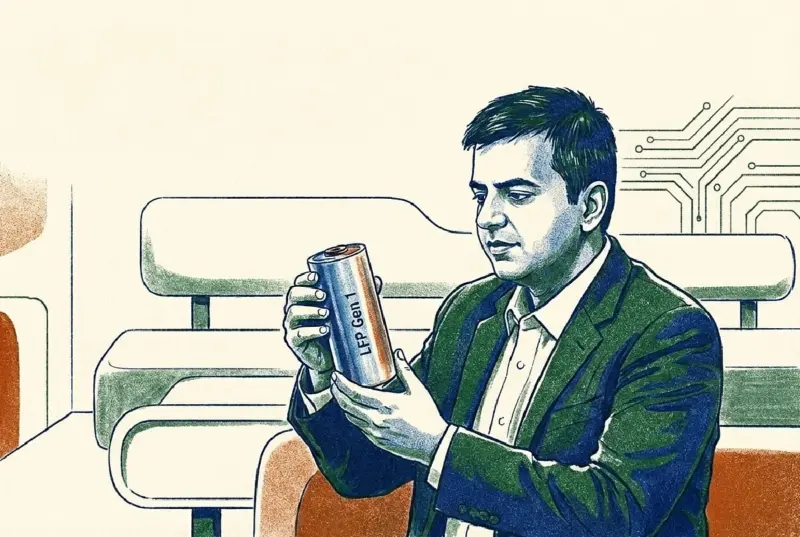

Ola Electric says it has built an indigenous LFP battery cell at its Tamil Nadu gigafactory - a claim that, if validated, would mark a genuine first for Indian manufacturing.
But cell manufacturing is among the most punishing industries in the world, and the distance between a working prototype and a competitive product is where the real story begins.
On 7 April 2026, Bhavish Aggarwal posted a photograph on X of a gleaming silver cylinder - 46mm across, 100mm tall, catching the studio light like a piece of sculpture. "Guess what!" he wrote.
The stock rose. Ola Electric, his listed electric vehicle company, followed with a filing to Indian exchanges: it had developed an indigenous lithium iron phosphate battery cell, in-house, at its gigafactory in Tamil Nadu.
Some hailed a Make in India breakthrough. Aggarwal, who has built three billion-dollar companies and kickstarted India's electric two-wheeler market, is not a man whose announcements go unnoticed.
But battery cell manufacturing is one of the most technically demanding industrial processes in the world - a domain where the distance between a working prototype and a commercially viable product is measured not in months but in years, and where companies far better resourced than Ola have stumbled catastrophically. That reality, rather than one's priors about Aggarwal, is probably the more useful place to start.
What was announced, and what was not
Ola disclosed a 46100-format cell - 46mm in diameter, 100mm in height - using lithium iron phosphate chemistry. It said the cell was developed in-house at its Battery Innovation Centre and Gigafactory in Pochampalli, Tamil Nadu, and that it would begin entering Ola's products from the next quarter, targeting affordable scooters, three-wheelers, and its Ola Shakti home energy storage system.
How do we evaluate and understand the claims?
It would be useful to have the energy density figure - the single most important performance metric for any battery cell. Also other data points to look for are the cell's capacity rating, cycle life data and charging rate.
There can also be third-party test results, and in the long term BIS or ARAI certification. In an industry where CATL and BYD routinely publish detailed specifications when announcing new cells, Ola will also have to publish the same sooner than later. So far Ola has not divulged these details.
Ola's Q3 FY26 shareholder letter, published in February 2026, stated the 46100 LFP cell was "12 to 24 months away." Two months later, it was declared ready. Either the company made remarkable progress in eight weeks, or the word "ready" is being used loosely - perhaps describing a functional lab-scale prototype rather than a cell prepared for mass production in commercial vehicles.
To be sure though none of this makes the announcement hollow. But it does mean we cannot yet evaluate the claim on its technical merits, because the company has chosen not to provide the information needed to do so.
Without the technical data points the next thing we could try is to understand the genuine complexities involved. Let's begin with the chemicals and manufacturing process.
Why making a battery cell is exceptionally hard
A lithium-ion battery cell is a precision electrochemical device. Manufacturing one involves at least ten tightly interdependent steps, each of which can undermine the entire product if executed poorly.
The process begins with electrode preparation: lithium iron phosphate powder (for the cathode) and graphite (for the anode) must be mixed with binders, solvents, and conductive additives into slurries of precisely controlled viscosity and homogeneity. LFP presents a particular challenge here because it has inherently low electronic conductivity, requiring careful carbon coating of the particles to achieve adequate performance.
These slurries are then deposited onto thin metal foils - aluminium for the cathode, copper for the anode - using slot-die coating machines in a continuous roll-to-roll process.
The Fraunhofer Institute, Germany's leading applied research organisation, identifies electrode coating as the single highest-risk step in battery manufacturing. Thickness must be controlled to micron-level tolerances across coating lines that can run tens of metres long. A variation of a few microns, invisible to the naked eye, can produce cells with inconsistent capacity, shortened lifespan, or dangerous hotspots.
The coated electrodes are calendered under immense pressure, slit to precise widths, and then wound with ultra-thin separator films into a "jelly roll" - the spiral core of a cylindrical cell. This winding must occur in dry rooms maintained at dewpoints below minus 40 degrees Celsius, because even trace moisture degrades performance. Electrolyte is injected, tabs are welded, and the cell is sealed.
Then comes formation cycling - the process of slowly charging and discharging each cell for the first time to create the solid electrolyte interface layer, a nanometre-thin film on the anode surface that is critical to the cell's long-term performance. Formation alone can take days per batch.
The difficulty of doing all of this well at scale comes from the fact that every variable interacts with every other. The particle size distribution of the cathode powder affects slurry viscosity, which affects coating uniformity, which affects calendering density, which affects electrolyte wetting, which affects formation quality, which affects cycle life. Changing one parameter - even slightly - cascades through the system. Battery manufacturing has often been described as closer to pharmaceutical production than to electronics assembly, and anyone who has watched a cell line struggle with yield would not argue with the comparison.
Making a battery cell requires at least ten tightly interdependent manufacturing steps, each capable of undermining the entire product. Electrode coating, identified by the Fraunhofer Institute as the highest-risk step, demands micron-level tolerances across lines running tens of metres long.The yield problem: where ambitions go to die
Even if every individual step is performed competently, there is a further reckoning: yield - the percentage of cells that come off the line meeting specifications. A factory producing 46-series cylindrical cells at meaningful volume turns out tens of thousands of cells per day. At that scale, even vanishingly small contamination rates - a speck of metal dust, a microscopic tear in the separator - can cause internal short circuits. These defects are often undetectable until the cell fails in the field.
New production lines typically achieve yields of 30 to 50 per cent initially, meaning half or more of what they produce is scrap. Even experienced manufacturers report scrap rates of 15 to 30 per cent during the first years of a new cell format. Commercial viability generally requires yields above 95 per cent. CATL, with its decades of accumulated expertise and massive datasets, can reportedly bring a new line to 96 per cent yield within four months. Most newcomers cannot.
Consider Tesla - perhaps the world's most technically ambitious and well-resourced electric vehicle company. In September 2020, it unveiled its 4680 cell at Battery Day, targeting 10 GWh of production by late 2021. What followed was what Elon Musk later called "production hell." Yields dropped to 20 per cent. Calendering problems that never appeared at laboratory scale emerged at production speed. Equipment vendors withdrew from partnerships. By late 2022, Tesla was outsourcing electrode production to Chinese contractors. Yields crept up to 70-80 per cent by late 2023, then to 92 per cent - still below the commercial threshold. Production speed reached 85 cells per minute against a target of 350.
Only in early 2026 - five and a half years after the initial announcement, after billions of dollars of investment and the departure of Drew Baglino, its most senior battery executive - did Tesla confirm that 4680 production had reached a satisfactory state. The cell was finally its lowest-cost option. But the journey to get there consumed resources that dwarf Ola Electric's entire market capitalisation.
Europe's experience is starker still. Northvolt, Sweden's battery champion, raised approximately $15 billion, hired thousands of engineers including veterans from Tesla and Samsung, and built a state-of-the-art gigafactory in Skelleftå. It achieved yields of around 70 per cent - and filed for bankruptcy. The company could not close the gap between what its cells cost to produce and what the market would pay, especially as Chinese manufacturers drove prices relentlessly downward.
Even experienced manufacturers struggle with yield - the percentage of cells meeting specifications. Tesla's 4680 cell took five and a half years and billions of dollars to reach satisfactory production; Northvolt raised $15 billion and filed for bankruptcy at 70 per cent yield.Where Ola actually stands
Against this backdrop, what can be reasonably inferred about Ola's position?
The company's Gigafactory in Pochampalli is real and operational. It currently has approximately 2.5 GWh of installed capacity and is being expanded toward 6 GWh. Ola began commercial production of 4680-format NMC (nickel-manganese-cobalt) cells - its first chemistry - in mid-2025, branded as the "Bharat Cell." These cells are shipping in Ola scooters, and the company claims millions of kilometres of real-world data. The factory reportedly handles electrode production through final assembly in-house, employing over 200 scientists at its Battery Innovation Centre and holding approximately 400 patents.
Most Indian companies aspiring to cell manufacturing have not yet reached this point. Ola appears to have moved beyond pure cell assembly - where pre-made components are simply put together - into actual electrode manufacturing, which is the hard part. If the LFP cell has been developed with similar in-house electrode production, that would be a meaningful step - one worth crediting.
That said, a working cell and a competitive product are separated by a considerable distance. The 46100 format itself is an unusual choice. The global industry's large-format cylindrical standard is converging around the 4680 (Tesla) and 4695 (Samsung SDI, for BMW). No major manufacturer mass-produces 46100 cells today.
Samsung SDI has announced plans to do so, but production has not commenced. Choosing a non-standard format means Ola cannot easily source compatible cans, caps, and winding equipment from established suppliers. It must develop or customise these itself - adding another layer of complexity.
More fundamentally, pairing cylindrical format with LFP chemistry runs against the grain of global practice. The industry overwhelmingly uses prismatic (flat, rectangular) formats for LFP cells.
BYD's Blade Battery is a long, thin prismatic cell specifically engineered to maximise cell-to-pack efficiency, eliminating traditional modules entirely and achieving volume utilisation above 72 per cent.
CATL's Shenxing is similarly prismatic.
The reason is straightforward: LFP's energy density is inherently lower than NMC's, so maximising how much cell material fits into a given pack volume becomes more important. Cylindrical cells, being round, leave gaps when packed together.
For NMC cells, where energy density is high enough to tolerate some packing inefficiency, this is acceptable. For LFP, it is a meaningful handicap that must be compensated through other means - a larger cell, clever pack engineering, or acceptance of lower pack-level density.
Ola may have good reasons for this choice - perhaps manufacturing synergies with its existing 4680 NMC line, or specific thermal management advantages for the Indian climate. But the company has not articulated them.
The technology transfer question
How Ola developed this capability is also worth examining. In November 2025, South Korean media reported that a former LG Energy Solution researcher hired by Ola had allegedly transferred proprietary battery data before being fired and referred for prosecution under South Korea's Industrial Technology Protection Act.
Ola categorically denied the allegations, calling them "misleading and completely baseless" and noting that the technology in question - pouch cell manufacturing - was irrelevant to its cylindrical cell programme. The South Korean investigation reportedly continues.
The episode, whatever its eventual resolution, touches on a broader reality: virtually every cell manufacturing programme outside China and South Korea has relied on some form of technology transfer. Tesla's initial cells were made by Panasonic.
Every credible Indian cell manufacturing effort currently depends on foreign partnerships - Exide with China's SVOLT, Amara Raja with Gotion High-Tech, Tata's Agratas with undisclosed technology partners. South Korea's own battery giants started with Japanese technology decades ago.
Nobody should hold it against Ola if it learned from external sources - almost certainly it did, as any rational organisation would. What actually matters for evaluating the LFP announcement is whether Ola has internalised enough capability to iterate, improve, and manufacture independently at commercial quality.
Now that we know the difficulties in the factory, how about the situation in the market?
The competitive reality
Even a perfectly functioning Ola cell would enter a market where the leaders are playing a different game entirely. CATL, which commands roughly 38 per cent of global EV battery installations, has pushed LFP technology to levels that were considered impossible five years ago.
Its Shenxing PLUS achieves over 205 Wh/kg at the pack level - the first LFP system to breach the 200 Wh/kg barrier - with 4C superfast charging. The second-generation Shenxing supports 12C peak charging. CATL's fifth-generation LFP cell platform delivers energy density rivalling some NMC chemistries.
BYD, with 27 years of continuous LFP development, launched its Blade Battery 2.0 in early 2026 with cell-level energy density of 190 to 210 Wh/kg, over 3,000 cycles, and charging rates above 5.5C. The new cells cost 15 per cent less to manufacture than their predecessors. BYD now supplies not just its own vehicles but Tesla, Toyota, and several other global automakers.
Goldman Sachs forecasts average battery prices reaching $80 per kWh by 2026. Chinese LFP cell prices have fallen from 0.9 yuan per watt-hour to 0.35 yuan. Many Chinese cathode producers are operating at a loss, triggering industry consolidation. A newcomer entering this market faces not just a technology gap but a cost structure shaped by decades of scale, supply chain integration, and relentless learning-curve optimisation.
The question Ola will eventually have to answer is whether it can produce a cell at a cost and quality level that competes with Chinese imports - not merely whether it can produce one that works, though that alone would be a genuine achievement. India currently imports close to 100 per cent of its lithium-ion battery cells, overwhelmingly from China.
If Ola's cell costs significantly more than an equivalent import, the economic logic of indigenous production becomes questionable unless underwritten by tariffs or government subsidies. To be sure, if Ola does pull off the design and manufacturing it would be entirely deserving of the Indian government's benevolence. Some might even argue, given the state of the industry, that even if Ola demonstrates the potential to pull off all that it claims it ought to be backed. It's the right sentiment given the prevailing sentiment in the global markets.
Ola's undisclosed LFP cell enters a market dominated by CATL and BYD, whose latest cells achieve energy densities and charging rates that were considered impossible five years ago. Chinese LFP cell prices have fallen 61 per cent, compressing margins for any newcomer.The Aggarwal factor
Then there is the man himself. Bhavish Aggarwal is a formidable entrepreneur - he built Ola Cabs into India's dominant ride-hailing platform, created three billion-dollar companies, and was genuinely instrumental in kickstarting India's electric two-wheeler market. Ola's achievement of one million cumulative EV sales by March 2026, in a market that barely existed four years earlier, is real.
But the pattern of announcements that outpace delivery is equally real. In August 2022, Aggarwal announced an electric car targeting a 2024 launch and one million units by 2026-27. By mid-2024, the project was shelved.
The Roadster X motorcycle, unveiled with great ceremony in August 2024, suffered repeated delivery postponements and drew regulatory scrutiny when Ola appeared to count undelivered "confirmed orders" in its sales figures. The Krutrim AI venture, declared India's first AI unicorn within weeks of launch in early 2024, has seen three rounds of layoffs, senior departures, and limited commercial traction.
Meanwhile, Ola Electric's core scooter business has deteriorated sharply. Market share fell from over 35 per cent in 2024 to approximately six per cent by early 2026. Monthly sales dropped from a peak of 53,000 to under 8,000.
The Central Consumer Protection Authority received over 10,600 complaints in a single year, covering issues from software malfunctions to wheels detaching. The stock has fallen roughly 82 per cent from its post-IPO peak, destroying approximately ₹56,000 crore in market value.
A company can have serious operational problems in one area while making genuine progress in another, and none of this proves the battery announcement is wrong. But the announcement does arrive from a source where the gap between declaration and delivery has been wide and recurrent, and the burden of proof sits, fairly, with the company.
Given all this, what should an observer watch for in the coming months?
Several specific milestones would convert this announcement from a claim into a demonstrated capability.
Published specifications - energy density, capacity, cycle life, and charging rate - ideally validated by an independent testing body. No credible cell manufacturer launches a product without this data.
BIS and ARAI certification, confirming the cell meets Indian safety and performance standards. The announcement itself carries the caveat "subject to regulatory approvals."
This is medium to longer term but actual vehicle integration at volume - not a handful of demonstration units but thousands of scooters or Shakti storage systems shipping with 46100 LFP packs to paying customers.
Some indication of manufacturing yield and throughput. Even directional disclosure - "above 90 per cent," for instance - would distinguish genuine production from an extended pilot line.
And most importantly, sustained field performance over 12 to 18 months. Given Ola's well-documented quality problems with its existing scooter range, the cells need to prove themselves in the hands of real consumers through an Indian summer and monsoon before the technology can be considered validated.
Ola's announcement draws its deeper significance from what it reveals about India's position in the global battery value chain.
China produces over 80 per cent of the world's lithium-ion cells. India's PLI scheme for battery manufacturing, launched in October 2021 with an ₹18,100 crore outlay targeting 50 GWh of domestic capacity, has achieved just 2.8 per cent of its goal - and the 1.4 GWh that has been commissioned came entirely from Ola itself. Zero incentives have been disbursed. Of the original PLI awardees, Hyundai withdrew its 20 GWh allocation entirely. Rajesh Exports has progressed only to land acquisition.
The broader Indian landscape offers cautious reasons for hope but little comfort on timelines. Tata's Agratas is constructing a 20 GWh facility in Sanand, Gujarat - a genuinely large-scale effort - but production is not expected before 2027. Exide Industries, partnered with China's SVOLT, expects trial operations at its Bengaluru plant by the end of this fiscal year.
Amara Raja, partnered with Gotion High-Tech, has already delayed commissioning of its first phase. Reliance, which acquired UK sodium-ion specialist Faradion for £100 million in 2022, has been building at Jamnagar but has not announced production milestones. Every one of these companies relies on Chinese or Korean technology partnerships.
The cautionary tale of Log9 Materials - India's most prominent battery startup, which raised tens of millions of dollars, launched a commercial cell line in 2023, and spiralled into insolvency by late 2025 - illustrates the brutal difficulty of the undertaking.
India imports close to 100 per cent of its lithium-ion cells, overwhelmingly from China, and has minimal presence in the upstream supply chain that underpins cell production: cathode precursors, electrolyte salts, separator films. China's export restrictions on graphite have further tightened the constraints.
The government's National Critical Minerals Mission and recent customs duty exemptions signal awareness. But building a domestic supply chain from near-zero is a decade-long project, not a quarterly deliverable.
India's PLI scheme for battery manufacturing has achieved just 2.8 per cent of its 50 GWh target, with Ola as the sole operational producer. Every other Indian cell manufacturing effort relies on Chinese or Korean technology partnerships and faces repeated delays.Against this backdrop, any Indian company that has progressed from importing finished cells to manufacturing electrodes and assembling cells in-house - even imperfectly, even at modest scale - has taken a step that counts industrially and strategically.
If Ola has genuinely done this for LFP chemistry, it deserves recognition as a real, if early, accomplishment.