

When Manmohan Singh said Mumbai should learn from Shanghai, Zhejiang - where private enterprise flourished and personal incomes actually grew - was not on anyone's itinerary.
Huang's book is the most important book about China that India's policymakers still have not read.
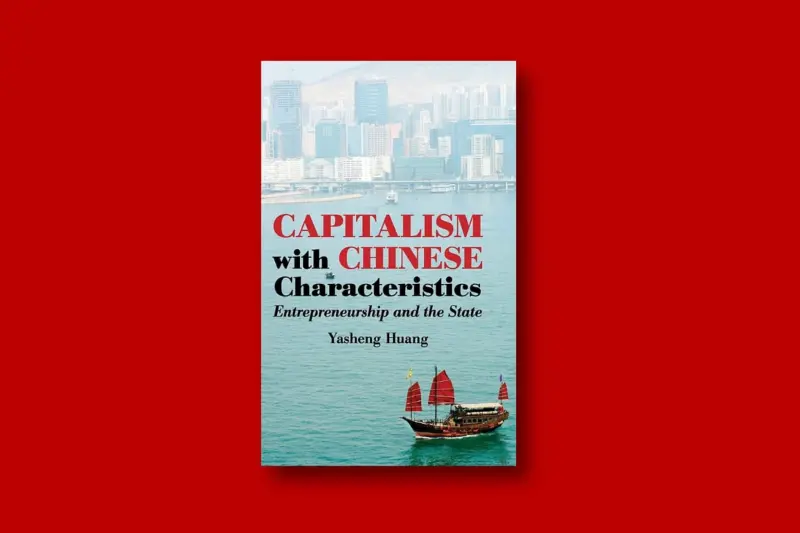
Capitalism with Chinese Characteristics, Entrepreneurship and the State.Yasheng Huang.Pages: 348. Price: Rs 3489.
There is a particular kind of intellectual courage in writing a contrarian book about a country the entire world admires. In 2008, when Yasheng Huang, a professor at MIT's Sloan School of Management, published Capitalism with Chinese Characteristics: Entrepreneurship and the State, the dominant narrative about China had rarely been challenged with such empirical rigour.
Since Deng Xiaoping's ascent to power in 1978, China had grown significantly. Its GDP had expanded at nearly double-digit rates for three consecutive decades, lifting millions out of poverty. Western economists, business school professors, and policy analysts had lined up to declare the "China model" - authoritarian capitalism guided by a technocratic state - as perhaps the most consequential development story in modern economic history.
Huang differed.
Eighteen years later, his book reads less contrarian and more predictive.
A disconcerting argument for economists
Huang's central thesis is deceptively simple: China did not grow because of its state-led capitalism. It grew, especially in the 1980s, despite the state, because of rural private entrepreneurship that the state had not yet managed to suppress. In the 1990s, when the state reasserted control by redirecting capital towards cities and restricting rural credit, GDP figures continued to rise, but household income growth fell sharply behind.
To understand why this matters, one needs to appreciate a basic demographic fact that Huang keeps returning to: at the start of Deng Xiaoping's reforms in 1978, roughly 80 per cent of China's population was rural. The moral centre of the entire argument is that when a state systematically defunds the sector that houses 80 per cent of its people to build an impressive urban showcase, it is not promoting development but extracting from the majority to impress the minority.
Huang has organised this book around a proposition of "two Chinas": an entrepreneurial, market-driven rural China and a state-controlled, politically connected urban China. In the 1980s, rural China had the upper hand. In the 1990s, urban China triumphed. That shift, invisible in the GDP data, explains everything that followed.
Lenovo: a microeconomic parable
Huang's argument is anchored in Lenovo. When Lenovo acquired IBM's personal computing division in 2004, the world interpreted it as proof of China's entrepreneurial vitality. Business professors wrote books about it. McKinsey consultants declared China had the "best of all possible models." Huang argues that Lenovo was not a Chinese company.
Legally, operationally, and financially, Lenovo was a Hong Kong company. Its real corporate control resided not in Beijing but in Hong Kong, operating under British rule of law, independent courts, and genuinely competitive capital markets. Lenovo raised capital on the Hong Kong Stock Exchange, incorporated as a foreign-invested enterprise, and entered computer manufacturing in China only because its Hong Kong legal status gave it regulatory access that the Chinese state flatly denied to domestic private firms.
Lenovo was denied a production licence in computer manufacturing by the Ministry of Electronics, which handed that same licence to the Great Wall Group, a state-owned enterprise. The Chinese state was simultaneously the regulator and the competitor, writing the rules of the game while playing in it. For domestic private entrepreneurs, this was a rigged market.
The result was predictable: rent-seeking behaviour. Entrepreneurs found that the most efficient path to success was not innovation or productive investment but acquiring the right legal status, the right political connections, or the right foreign registration. Lenovo's founders had a family connection to Hong Kong, but for the millions of rural entrepreneurs, no such escape valve existed.
Huang documents that virtually every major "Chinese" corporate success story - Sina, Haier, UTStarcom, Wahaha - shared this identical structure. Their owners were Chinese; their legal domicile was foreign. The only reason their business model worked was that they operated under Hong Kong's British-inherited system of rule of law, independent courts, and open capital markets.
In 2002, Forbes compiled a list of the most dynamic small firms in the world, four of which were run by Chinese entrepreneurs deriving most of their revenue from China operations, yet each was headquartered in Hong Kong.
The most celebrated examples of Chinese capitalism were, institutionally speaking, not Chinese at all.
The 1980s: the decade that built China
To understand what China lost in the 1990s, one must first understand what it had in the 1980s.
The Solow growth model provides a useful framework here. Its core insight is simple: long-run economic growth cannot be sustained by endlessly piling on capital and labour due to diminishing returns. The only engine capable of sustaining growth in the long run is efficiency - how well an economy combines its inputs through innovation, entrepreneurship, and institutional quality.
Economists measure this efficiency through Total Factor Productivity (TFP), essentially how much output an economy generates for every unit of capital and labour it puts in. China's TFP, however, is one of the most contested numbers in development economics.
Depending on the data source used, China ranks either 6th or 83rd in the world - a discrepancy that exists almost entirely because of disagreements over the reliability of China's official GDP figures. This measurement problem is central to Huang's argument. An economy whose most basic statistics cannot be trusted is precisely the kind of economy Huang warns us about.
By that measure, the 1980s were China's most important decade. TFP's contribution to GDP growth stood at 40 per cent between 1985 and 1993, before declining to 33 per cent in the period that followed. The numbers confirm what Huang's evidence suggests: the 1980s were a story of genuine efficiency, whereas the 1990s were a story of brute-force investment.
When Deng Xiaoping's reforms began, the changes that mattered most happened not in the gleaming coastal cities but in the impoverished rural interior. The Household Responsibility System returned land control to farmers. Rural credit began flowing to private entrepreneurs.
Township and Village Enterprises (TVEs), which the world later celebrated as proof of China's genius for collective institutional innovation, were, as Huang shows empirically, overwhelmingly private in character. Of 12 million TVEs operating in 1985, only 1.57 million were collectively owned. These enterprises collectively drove rural employment, manufacturing output, and income growth across China's countryside at a scale no state programme had achieved.
That was the TVE miracle, and it was a private sector miracle mislabelled for decades.
Huang highlights Nian Guangjiu, a poor farmer from Anhui, one of China's least developed provinces, who made salted sunflower seeds under the self-deprecating brand name "Idiot's Seeds." By 1986, his business was earning an annual profit of one million yuan, surpassing the average profit of state-owned enterprises that year.
He had not benefited from state capital, political connections, or industrial policy. He had a good product, access to credit, and the freedom to act. He stands in sharp contrast to Lenovo, proving that when the institutional playing field was level, genuine entrepreneurship thrived without the need for Hong Kong, familial connections, or foreign registration.
In 1985, 50 per cent of rural private firms reported receiving formal bank loans. Household income grew faster than GDP. The labour share of national income was rising.
These indicated an economy where the Keynesian multiplier was working as intended: rural credit reached small entrepreneurs who spent it locally, generating demand that circulated through the village economy, creating employment, and compounding into genuine, broad-based growth. The consumption base was expanding because the people at the bottom of the income distribution were, for the first time, genuinely participating in the economy's gains.
1989: China's turning point
In September 1989, Nian Guangjiu was arrested. The charges - corruption and embezzlement of state property - were dismissed by Chinese courts. He was eventually convicted of "hooliganism" and sentenced to three years for allegedly having immoral relationships with ten women. His firm was shut down.
His arrest was not coincidental in its timing. 1989 was the year of Tiananmen, when pro-democracy protests in Beijing were crushed by the military, triggering a conservative political backlash that would reshape not just China's politics but its economic architecture.
Most analysts treat Tiananmen as a political rupture followed by a brief economic pause. Huang argues that this is fundamentally wrong. 1989 was not a pause but a pivot. The conservative leadership that emerged from Tiananmen completely reversed the direction of reforms. The consequences for rural China were severe and lasting.
The reversal had three defining features: capital was redirected towards cities, foreign investors were given preferential treatment over domestic private entrepreneurs, and industrial policy began favouring large state-linked enterprises over small private businesses. It was a systematic dismantling of everything that had made the 1980s successful.
The most visible consequence was the rural credit collapse. In 1985, one in every two rural private firms could access a formal bank loan. By 2001, that number had fallen to one in eight. The banks had turned their backs on rural entrepreneurs and redirected credit towards state-preferred borrowers. Those left behind turned to moneylenders, paying higher rates, on shorter terms, with no legal protection. Rural entrepreneurship became unnecessarily costly to sustain.
The welfare consequences were severe: education and healthcare became more expensive in rural areas, income inequality widened sharply, and between 2000 and 2005, the number of illiterate Chinese adults increased by 30 million, reversing decades of human capital accumulation. That last statistic received almost no coverage in the Western press.
Huang pays considerable attention to Sun Dawu and Zheng Lefang - two rural entrepreneurs who, like Nian, built successful businesses from scratch in China's countryside. Both met the same fate: their businesses were shut down. The pattern was unmistakable. The Chinese state did not merely neglect rural entrepreneurship; it found it threatening.
And through all of this - the credit collapse, the dismantling of rural enterprise, the systematic urban bias - the GDP continued to grow. This is precisely Huang's point. GDP measures the volume of output, not its quality or distribution. An economy growing by piling on capital investment while suppressing the efficiency gains of private entrepreneurship is, in Solow's framework, consuming its future.
What is wrong with Shanghai?
In 2006, India's Prime Minister Manmohan Singh said Mumbai should learn from Shanghai. He was not alone - not just among Indians, but across the world.
Huang mentions Jayant Patil, the Finance Minister of Maharashtra, who had questioned why India could not build high-speed trains like the one connecting Shanghai and Pudong. The only issue was that the train in question was a Maglev, not a bullet train; it ran not between Shanghai and Pudong but entirely within Pudong, covering 30 kilometres in under eight minutes. Patil had never looked closely at the city he so admired. But then, neither had most of the world.
By the early 2000s, Shanghai was attracting $6.5 billion in FDI annually, equivalent to India's entire FDI inflow at the time. Some 300 global MNCs had invested in the city, with 30 per cent contemplating making it their regional headquarters. Shanghai accounted for just 5.5 per cent of China's GDP in 2004, yet contributed 12 per cent of its exports. On paper, it looked like the most successful city in the developing world.
The numbers hide the truth about Shanghai. The city grew through state control and foreign investment, not through individual entrepreneurship. As GDP increased, personal incomes did not keep pace, and private businesses remained weak. This growth mostly benefited a small group at the top, while ordinary citizens were left behind.
Zhejiang province, right next door, tells the other story - and it is the one India should actually be studying. Zhejiang continued through the 1990s on something closer to the 1980s model: small private businesses, credit flowing to local entrepreneurs, and a state that largely stayed out of the way. Two provinces sharing the same geography and time period but with different institutional choices - and Zhejiang outperformed Shanghai in personal income growth and poverty reduction by fostering private enterprise rather than relying on state control.
When Indian politicians admired Shanghai, they were unknowingly admiring the wrong decade and the wrong model. Zhejiang, the province that should have been the benchmark, was not on anyone's itinerary.
The prophecy that came true
The book was written before Xi Jinping, before the technology regulations, and before Hong Kong's transformation. Huang could not have known what was coming. And yet the institutional logic he identified - the state's structural discomfort with private entrepreneurship that grows independent of political control - describes with uncomfortable precision what has unfolded over the past eighteen years.
In 2021, Alibaba was fined $2.8 billion, and Jack Ma retreated from public life after criticising financial regulators. Ant Group's IPO was cancelled. China's tech sector lost over a trillion dollars in market value as regulatory actions swept across industries from fintech to education to gaming. The justification was "common prosperity." The mechanism was identical to what Huang described in the 1990s: the state reasserting control over private entrepreneurship that had grown too powerful and too independent.
Jack Ma's fate closely parallels that of Nian Guangjiu. A successful entrepreneur, grown too visible, brought down by a state that treats independent economic power as a political threat. The pattern Huang identified did not disappear after the 1990s; it waited for the right political moment.
Hong Kong tells its own version of the same story. The territory whose institutions had made Lenovo possible - whose rule of law had provided a safe harbour for Chinese entrepreneurs locked out of their own country's financial system - was fundamentally transformed by the National Security Law of 2020, decades before the "One Country, Two Systems" arrangement was due to expire in 2047. The institutional advantages that Huang argued were central to China's corporate success stories are precisely what Beijing spent the following years dismantling. The escape valve that Lenovo had used is now closed.
Huang in 2026
Not everyone agreed with Huang when the book was published, and some criticisms deserve a fair hearing.
Joseph Stiglitz, in his defence of the China model, argued that TVEs proved public enterprises could succeed where private ones could not - that China had found a genuinely new institutional path. Huang dismantles this directly, pointing out that Stiglitz had simply misread what TVEs actually were. Of 12 million TVEs in 1985, only 1.57 million were collectively owned. The public enterprise miracle Stiglitz celebrated was, in practice, a private sector miracle wearing a collective label.
Huang's argument was never about labels. It was about what happened to ordinary Chinese people when the policy model changed. On that question, the data is unambiguous: the 1980s reached people. The 1990s did not.
The stronger challenge to Huang concerns not the 1980s but the 1990s. The infrastructure built during that decade - ports, highways, power grids, manufacturing clusters - created the physical foundation for China becoming the world's factory. This should not be dismissed. But Huang's point was never that the 1990s produced nothing. It was that what they produced did not reach the people who needed it most. A port that efficiently moves goods while the surrounding city stagnates in personal income is not a success in development but a disparity in distribution.
Huang argues that political liberalisation is vital for sustainable development. While this view seemed ambitious in 2008, by 2026, with youth unemployment in China surpassing 20 per cent and a struggling property sector, it appears prophetic.
China's 2026 GDP growth target has been trimmed to 4.5-5 per cent - the lowest since 1991 - as Beijing scrambles to restructure an economy built on exactly the foundations Huang warned against. Meanwhile, defence spending has been raised to 1.94 trillion yuan, and the Five-Year Plan prioritises state-directed technological innovation over the private entrepreneurship that once drove genuine, broad-based growth.
Beijing has refused the cure, and the symptoms have worsened on schedule. Huang may not be a perfect diagnostician, but the economy he warned about has arrived - despite the state, exactly as he said it would.
Can India afford to look away?
Huang rarely addresses India, but when he does, it challenges the notion that liberal democracy cannot support rapid development. In 2008, he viewed India as a nation with early momentum and untapped potential, demonstrating that a chaotic, coalition-driven democracy could foster growth without stifling private entrepreneurship - a stark contrast to China's authoritarian regime. By 2026, that proof has only strengthened. India has validated Huang's thesis by avoiding China's mistake of systematically suppressing private entrepreneurship.
The IT boom, the startup ecosystem, and the rise of a consumption-driven middle class in India were not state-directed like Shanghai. Much like China in the 1980s, India's growth has occurred largely despite government intervention. Brands such as Amul, Bikaji, and Waghbakri emerged from small private enterprises and became nationally significant. The pattern is familiar: enterprise flourishing not because of state regulation but despite it.
But India has only learned half the lesson. It has absorbed the political lesson from China: do not concentrate power so intensely that dissent becomes impossible. The economic lesson, however, has not been fully grasped.
The key issue is not whether urban areas will receive more funding - they will and should; India requires its ports, highways, and smart cities. The real question is whether the Rs 2.73 lakh crore allocated for rural development is being utilised in a way that fosters private enterprise, or whether it is simply being absorbed by the same bureaucratic apparatus that Huang identified as problematic in the first place.
The issue is not that the state is absent from small enterprises; it is that it is present inappropriately. Despite contributing 29 per cent of GDP and employing 60 per cent of the workforce, India's MSMEs face a compliance burden disproportionate to their capacity. Businesses face multiple registrations, frequent filings, and inspections that increase costs without improving productivity.
The reforms that exist are designed for businesses large enough to navigate them. Instead of supporting these enterprises, the state is burdening them with excessive paperwork. This is not the same as rural China's credit crisis, but the result is similar: even urban entrepreneurs hesitate to grow because growth means more visibility, which leads to compliance costs they cannot manage.
The evidence can also be seen in the credit gap. MSMEs contribute roughly 45.79 per cent of the country's exports, yet as recently as FY2021, only 19 per cent of MSME credit demand was formally met. Micro-enterprises, which make up 99 per cent of the MSME sector, often borrow from moneylenders at excessive rates, for short durations, and without legal protections. This is an enterprise problem, not a rural or urban one. The formal banking system has turned its back on the very businesses that, if freed, could produce what India currently imports - bottle caps, textiles, small components - reducing import dependence and expanding the total pie rather than redistributing a fixed one.
India has tools China never had. UPI and the India Stack allow creditworthiness to be assessed through transaction data rather than collateral. A vendor with two years of UPI transaction history can now access formal credit that was impossible a decade ago. But technology without financial literacy and without political will is infrastructure without users. The question is not whether the tool exists - it does. It is whether the state will stop treating small enterprises as a compliance target long enough to let those tools work.
India does not need to choose between its skylines and its small enterprises. It needs to stop treating the latter as a compliance target and start treating them as an engine.
The lesson worth learning
Yasheng Huang set out to get the facts right about China. In doing so, he produced a book that is, beneath its economic technicality, a straightforward moral argument: growth that does not reach the people is not development.
For India, the book carries a specific and urgent relevance. Huang's central finding - that the 1980s worked because rural entrepreneurs had credit, property rights, and the freedom to act - is not a historical observation about China but a live policy question for any developing country that has not yet got this right. India has the democratic institutions to protect private enterprise, the digital infrastructure to extend credit to those the banking system ignores, and eighteen years of Chinese economic history to learn from.
We need our Shanghai. But Shanghai without Zhejiang is a photograph without a foundation - impressive to look at, hollow underneath.
Capitalism with Chinese Characteristics is not a comfortable book. But discomfort, in this case, is the point.