





Researchers have identified a new way to generate and control spin currents using sound waves, a breakthrough that could help lower energy consumption, support quantum computing applications and advance next-generation communication technologies.
As demand rises for faster, smaller and more energy-efficient devices, scientists are looking beyond conventional electronics, which depend on the movement of electric charge and consequently produce heat and energy losses.
One alternative being explored is spintronics, where information is transmitted through spin rather than electric charge.
In this field, magnons, or waves of magnetic disturbances within materials, are gaining attention as potential information carriers because they can function with significantly lower energy loss than electrons.
Scientists at the Institute of Nano Science and Technology (INST), Mohali, an autonomous institute under the Department of Science and Technology (DST), have proposed a new method to create and regulate magnon-based spin currents, or spin wave excitations, through the use of surface acoustic waves (SAWs).
Mr. Shivam Sharma, a PhD scholar, and his supervisor, Prof. Abir De Sarkar, recognised a missing link in previous studies that had demonstrated how surface sound waves affect electron dynamics and how magnon dynamics can be influenced by quantum geometric properties.
They then formulated a new theoretical framework to bridge this gap.
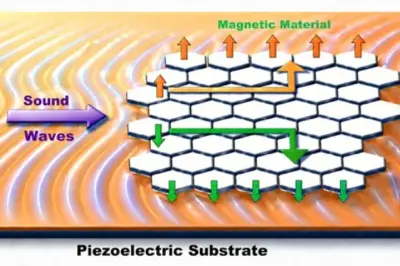
The researchers built an analytical model from the ground up using an ultra-thin two-dimensional magnetic material (antiferromagnets) with a graphene-like structure placed on a piezoelectric substrate.
Through this model, they examined how surface sound waves affect magnon transport.
Their findings showed that as SAWs move through a material, they produce minute distortions that act as effective forces, known as pseudogauge fields, influencing magnon motion. This creates a novel route for generating spin currents in two-dimensional magnetic materials using surface sound waves.
The study, published in the journal Physical Review B, highlights new opportunities for developing low-power and highly efficient technologies.
With potential uses in low-power information processing and strain-engineered devices, where mechanical deformation is used to control electronic or magnetic properties, the research could play an important role in future computing systems, where cutting energy consumption remains a key objective.