




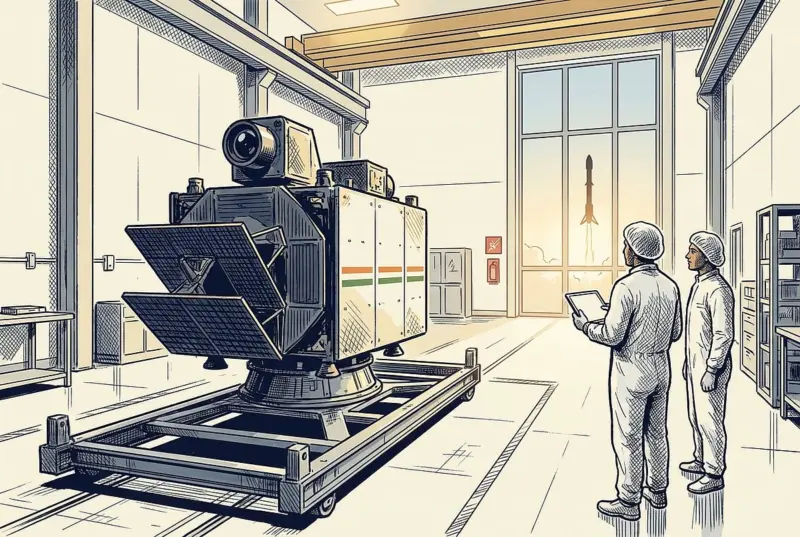

The Indian satellite industry is pulling ahead. The Indian launch industry is falling behind.
At 12:29 in the afternoon, India Standard Time, on Sunday, May 3, 2026, a Falcon 9 lifted from Space Launch Complex 4E at Vandenberg Space Force Base on the Pacific coast of California, carrying forty five satellites to sun synchronous orbit.
Among them was a 190 kilogram microsatellite called Drishti, designed and built by [GalaxEye](https://galaxeye.space/?utm_source=chatgpt.com) in a Bengaluru clean room.
Drishti is the heaviest satellite ever built by a private Indian company. It is also, on its operators' claim, the world's first commercial satellite to fuse synthetic aperture radar with multispectral optical imagery on a single bus.
GalaxEye was founded in 2021 by five engineers from Indian Institute of Technology Madras who had met as members of Avishkar Hyperloop, the Indian team in [SpaceX](https://www.spacex.com/?utm_source=chatgpt.com)'s 2019 Hyperloop Pod Competition. The Drishti satellite they have just put in orbit produces all weather imagery with radar and optical data fused at sub pixel registration at the moment of capture, at resolutions competitive with the best foreign commercial Earth observation systems. Its data distribution will be handled globally by NewSpace India Limited, ISRO's commercial arm, under a reseller agreement signed in February 2026. Its anchor customer is the Indian Air Force under an iDEX contract from June 2024.
Drishti was originally manifested for an Indian launcher. By the time it was ready to fly, two consecutive PSLVs had failed. PSLV C61 in May 2025 and PSLV C62 on 12 January 2026 were both lost to third stage anomalies, dropping PSLV's lifetime success rate to 93.7 per cent and growing NSIL's commercial backlog. GalaxEye made the decision any rational private company would have made. It moved the mission to the launcher offering the highest operational reliability and the timetable certainty its commercial commitments required.
Pixxel is not the first to follow this trajectory. The Bengaluru hyperspectral company flew its Firefly Phase One satellites on Falcon 9 from Vandenberg Space Force Base in January and August 2025. Digantara's space domain awareness satellite SCOT rode the same January manifest. Dhruva Space's LEAP 1 went up on SpaceX in August 2025. Each had a tactical reason. Together, they constitute a strategic pattern. India is entering the second half of the 2020s with a maturing satellite engineering industry and a launch industry that cannot carry the work on the timelines the satellite industry needs.
Drishti was originally manifested for an Indian launcher. Two consecutive PSLV failures eight months apart pushed the heaviest satellite ever built by a private Indian company to Vandenberg.In calendar 2025, Indian Space Research Organisation launched five rockets from Satish Dhawan Space Centre, one of which failed. SpaceX conducted around one hundred and sixty five orbital launches in the same period. By January 2026, with PSLV C62 added to the failure column, the gap had widened further. If the trend holds, an increasing share of the satellites India's best engineers design will reach orbit on vehicles India had no part in operating, from spaceports thousands of miles away, under the commercial regulation of foreign governments. The satellites will be Indian. The sovereign access to space will not be.
Reusability produces meaningful cost reduction only at cadence. The fixed costs of running four launch families, two pads, and a standing workforce amortise differently across five flights and across one hundred and sixty-five.That trajectory follows from choices, and the central choice is a decision the Indian state has not yet taken. It has still not sanctioned the 140 satellite sovereign low Earth orbit broadband constellation that ISRO's own Satellite Application Centre has scoped and costed. The proposed network would be sufficient for sovereign government and defence communications, along with broadband coverage for priority urban and strategic use cases on a five year refresh cycle.
The scale is proportional to India's strategic requirements rather than the mega constellation ambitions of Starlink or Guowang. A 140 satellite fleet would be comparable to Iridium and OneWeb and could likely be funded within roughly ₹30,000 crore over five to seven years.
Without such a programme, Indian launch cadence is likely to remain below ten flights a year. The private launch sector risks following the Virgin Orbit pattern. The supplier base that Next Generation Launch Vehicle will need in the early 2030s could become too hollow to support it. The pattern of Indian satellites flying on foreign rockets could then calcify into the permanent structure of Indian space activity.
Launch sovereignty in this decade is a cadence problem. Cadence is a demand problem. And the demand decision India still has not taken is the constellation decision.
Start with cost, because every conversation about Indian launch ends there and most should begin there.
SpaceX sells rideshare on its Transporter missions at roughly $5,500 per kilogram to sun synchronous orbit, which is the pricing companies such as GalaxEye, Pixxel, Digantara and Dhruva have effectively bought into. A dedicated Falcon 9 mission priced at around $67 million for roughly 17 tonnes to low Earth orbit works out to under $4,000 per kilogram. These economics are driven as much by launch cadence as by engineering.
A first stage reused twenty times is vastly cheaper than one discarded after a single mission because its manufacturing cost is amortised across repeated flights while refurbishment costs remain comparatively low. Reusability produces meaningful cost reduction only at cadence. The more frequently a launch system flies, the more its fixed manufacturing, refurbishment and operational costs are spread across missions, steadily driving down the per kilogram price to orbit.
The PSLV-XL lists around $30 million for 1,750 kilograms to SSO, roughly $17,000 per kilogram, three times what GalaxEye paid on Falcon 9. The LVM3 is more competitive on paper at perhaps $5,000 per kilogram, but LVM3 flew twice in 2025 and averages two to three flights a year, which kills the amortisation the bigger vehicle could theoretically deliver. The rockets themselves are fine. PSLV is one of the most reliable vehicles ever built, LVM3 delivered Chandrayaan-3 and NISAR on world-class science budgets, SSLV's 72-hour turnaround is a genuine responsive-launch capability.
The problem is the denominator. The fixed costs of running four launch families, two pads at Sriharikota, a standing workforce and a distributed supplier base get amortised across five or six flights a year rather than a hundred and seventy. The system is simply too small, and nothing about running it harder will fix that.
Low cadence also erodes institutional discipline. The three failures across 2025 and early 2026 - NVS-02's apogee-thruster valve failure in January 2025, EOS-09's third-stage performance issue in May 2025, and EOS-N1's third-stage anomaly in January 2026 - fall into categories of error that launch operations catch when quality checks run at the rhythm of a flying programme. Two consecutive PSLV failures eight months apart, with overlapping third-stage signatures, is not a noise-level outcome. Flight rate builds institutional muscle; its absence lets that muscle atrophy.
Reusability is the structural fix, and India is roughly a decade behind. The only sanctioned reusable-class vehicle India has in development is the Next Generation Launch Vehicle, branded Soorya, for which the Cabinet approved ₹8,240 crore in September 2024, targeting first flight in 2032. On an Indian public-programme schedule that means 2033 or 2034. The three development flights are expendable. Operational reusability is a 2034 or 2035 proposition, with mature refurbishment economics probably arriving in 2037 or later. NGLV is a programme India should have sanctioned in 2015. Sanctioning it in 2024 means the cost frontier of the mid-2030s will be reached with the cost structure of the mid-2020s. That door is closed, and the right conclusion is that India should stop organising its launch strategy around a commercial-services game it cannot win.
The strategic game is cadence, and cadence is a demand problem more than an engineering problem.
ISRO Chairman V Narayanan, speaking at Sriharikota after the November 2025 CMS-03 launch, revealed that the Prime Minister has set the agency a target of fifty launches over the next five years - an average of ten annually, a doubling of current cadence. Ten is well short of what the existing payload programme demands. The Space-Based Surveillance Phase-III programme, sanctioned in October 2024 at ₹26,968 crore, commits India to fifty-two defence surveillance satellites between 2026 and 2029 - roughly four to five dedicated launches a year on top of existing commitments. Gaganyaan has slipped; Chandrayaan-4, the Venus orbiter, Mangalyaan-2 and the Bharatiya Antariksh Station's early modules each add launches over the late 2020s and 2030s. Even the PM's ten-a-year target clears only two-thirds of the existing workload, and none of it yet includes the LEO broadband constellation.
Work the arithmetic. A 140-satellite Indian LEO fleet on a five-year refresh cycle generates about 28 satellites a year of launch demand, which is five to eight additional launches annually, depending on the mix of SSLV, PSLV and LVM3 slots. Added to sovereign-payload overflow, total steady-state demand reaches twelve to eighteen launches a year, sustained through the 2030s. That is roughly three times current cadence, enough to amortise the fixed costs of the system meaningfully, and enough to keep a Skyroot or an Agnikul alive as a commercial business.
ISRO's Satellite Application Centre has scoped and costed the constellation - 140 satellites, roughly ₹30,000 crore over five to seven years. Eight months after the proposal, no cabinet note has been tabled.It is also a cadence for which India does not yet have the physical infrastructure to fly. Sriharikota has two operational pads, both flying close to their limits; a third has been sanctioned but will take four years to build. A second launch complex at Kulasekarapattinam is under construction. Neither will be fully operational before 2028. Demand and infrastructure have to be committed together, or the infrastructure arrives just in time to be under-utilised.
None of this is hypothetical. China sanctioned Guowang in 2020 with 12,992 satellites planned and added G60 Thousand Sails for another 14,000, a combined demand pipeline of around 27,000 satellites across fifteen years that has subsidised a dozen commercial reusable launch programmes into existence. In 2025 China flew ninety-two orbital missions across twenty-five rocket families. The constellation is the industrial policy; the launch industry is the consequence. Europe reached the same conclusion with IRIS² in 2022; the United States reached it by accident through Starlink.
India has reached the conclusion in public statements and has even done the costing. In August 2025, speaking at ISRO's National Meet on the eve of National Space Day, Nilesh Desai, then director of ISRO's Satellite Application Centre, told delegates: "It is high time that India goes for its own LEO constellation, whether for civilian or for strategic sector. We have already worked out a constellation of 140 satellites, and that will solve the purpose on an immediate basis, taking care of the broadband requirement of the important urban areas."
Eight months later, no cabinet note has been tabled, no funding envelope announced, no launch schedule published. Desai himself superannuated on 31 March 2026. The work has been done; the official who did it has retired; the decision has not been taken. The studying has taken longer than China took to build and begin deploying Guowang.
There is a serious counter-case. Several voices in Indian policy and finance ministry circles, and in much of the English-language space commentariat, hold that the indigenous-constellation proposition is dirigiste fantasy India should resist. Launch is a commodity market; SpaceX sells rideshare at $5,500 per kilogram, and any Indian buyer can purchase these services as openly as any American customer - GalaxEye and Pixxel both did. A broadband constellation in particular, on this view, is the kind of project India should avoid: Starlink, OneWeb and Kuiper are all available or deploying in India, and a sovereign constellation would duplicate capacity at higher cost with taxpayer money that could fund schools, hospitals, the fiscal deficit.
It is a serious argument. It rests on three assumptions that the evidence no longer supports.
The first is that commercial launch services will remain available to India regardless of the geopolitical weather. The Crimea-Starlink episode has since been joined by several further cases of American commercial space services modulated in line with American policy. SpaceX acts in good faith as an American company whose services are licensed and regulated by an American administration that can, and does, shape them - and any national security policymaker should assume as much of any foreign commercial provider. Indian defence payloads and any constellation carrying traffic the Indian state considers essential cannot be routed through foreign commercial services whose continued availability the Indian state cannot guarantee.
The second is that the Indian private launch ecosystem survives without anchor demand. It does not. The global cemetery of small-launch startups - Virgin Orbit bankrupt in 2023, Astra delisted by 2024, Relativity's pivot away from small launch, ABL Space's pivot out of orbital launch entirely by 2025 - is the empirical answer. Rocket Lab survives on enough defence anchor contracts to build Neutron; Firefly survives on NASA lunar contracts. Skyroot's Vikram-1 has slipped from 2024 to 2026; Agnibaan is on the same drifting schedule; EtherealX is still at the propulsion-development stage. Without the anchor they fail in the same pattern as Virgin Orbit, and India loses the private launch layer it has spent half a decade building.
The third is that NGLV can be delivered on its announced schedule regardless of what the rest of the launch industry is doing. It cannot. NGLV depends on the same suppliers, workforce, testing infrastructure and mission-management experience that the existing fleet exercises. If that fleet flies five times a year for the next eight years, the supplier base hollows, the workforce ages out, institutional discipline atrophies - a drift already visible in the back-to-back PSLV failures of 2025 and 2026 - and when NGLV flies in 2033 it flies into an industry too thin to deploy it at rate. Low cadence today is the path to a failed reusable vehicle tomorrow.
The commercial-providers argument has one correct premise and one flawed conclusion. The correct premise is that India should not attempt to match SpaceX on cost in commercial services; that game is lost. The flawed conclusion is that the alternative is to buy commercial, retain a small sovereign launcher, and hope. Every other strategic power's choices - China's deliberate commitment, Europe's belated one, America's accidental path into Starlink - suggest the alternative is to commission sovereign demand at scale, accept that the resulting launch industry will be less cost-competitive in the 2020s than the commercial frontier, and use that cadence to keep the private sector alive, keep NGLV deliverable, and produce the minimum industrial base India will need in the 2030s. This is industrial policy, and its proponents should make the argument without flinching from the label.
What the policy looks like in practice is a small set of decisions. First: a Cabinet note tabling the 140-satellite constellation ISRO has already scoped, with a published deployment schedule over 2027-2031 and a five-year refresh commitment through 2045. Second: the procurement and infrastructure machinery - IN-SPACe empowered with real purchasing authority, a published ten-year launch calendar committed across ISRO, the PSLV-NGC consortium under Ananth Technologies and at least two private launch providers, and Kulasekarapattinam plus the third Sriharikota pad accelerated to operational status before 2029. Third: anchor-demand commitments to the private launch layer, so Skyroot, Agnikul and EtherealX have contracts to price their programmes against, alongside the slots GalaxEye, Pixxel and Digantara's expanding constellations need. None of these is exotic; every one is actively discussed in the Indian space policy community. What is missing is the political decision.
GalaxEye is now in orbit. Drishti will be followed, the company says, by two more by the end of 2027 and six or seven additional satellites through the end of the decade - a ten-satellite all-weather constellation selling imagery to Indian Air Force ISR cells, to international customers in the United States, Europe and Africa, and to the Indian state through NSIL. Pixxel's Phase Two Fireflies - eighteen more satellites - are scheduled for 2026 and 2027. Digantara is building space-domain-awareness satellites that will require precise dedicated orbits the SSLV cannot yet reliably deliver. None of these expanding Indian constellations, on current trajectories, will fly on Indian rockets at the rate they need them.
GalaxEye is flying on the vehicle that meets its schedule at the price its business can bear; any rational company would do the same. The failure would be if the Indian state accepted the arrangement as the permanent shape of Indian space. That acceptance would be a decision about sovereignty, made by default. It would mean that when the next Crimea-class episode arrives and a foreign commercial provider declines to carry an Indian payload, India has no indigenous capacity at the cadence required to carry it instead. It would mean Skyroot and Agnikul close down for want of anchor demand, and NGLV - when it finally flies in 2034 - enters an industrial base too atrophied to operate it. A country whose best minds build the hardware but whose launch industry cannot carry it is a country that has already made a sovereignty choice, whether or not it has acknowledged the choice.
The choice is avoidable. It requires the Indian state to sanction the 140-satellite sovereign constellation its own agency has already scoped within the next eighteen months, commit the infrastructure decisions that follow, give IN-SPACe the purchasing authority to translate the demand into contracts, and protect NGLV and its successor from the slippage that will kill them if political will wavers. None of it is exotic. All of it is discussed. None of it has been done.
The five engineers from IIT Madras who founded GalaxEye met as members of the Indian team in SpaceX's Hyperloop competition. Seven years later they have built India's heaviest privately-engineered satellite and put it in orbit on a SpaceX rocket. Mission Drishti's data will flow back to Indian customers from a satellite that India's best minds designed, that India's clean rooms manufactured, that ISRO's commercial arm will distribute globally - and that, for want of a working Indian rocket on the day it was ready to fly, rode American fire to American orbit. That is a powerful proof of how far the Indian satellite industry has come. It is also the question this decade in Indian space policy has to answer: whether the rockets that carry the next generation of these satellites will be rockets India's own industry flies from India's own soil, or whether the May 2026 pattern becomes the permanent geometry of Indian space.
Sovereignty in space is not bought with cheaper rockets. It is bought with more of them.