




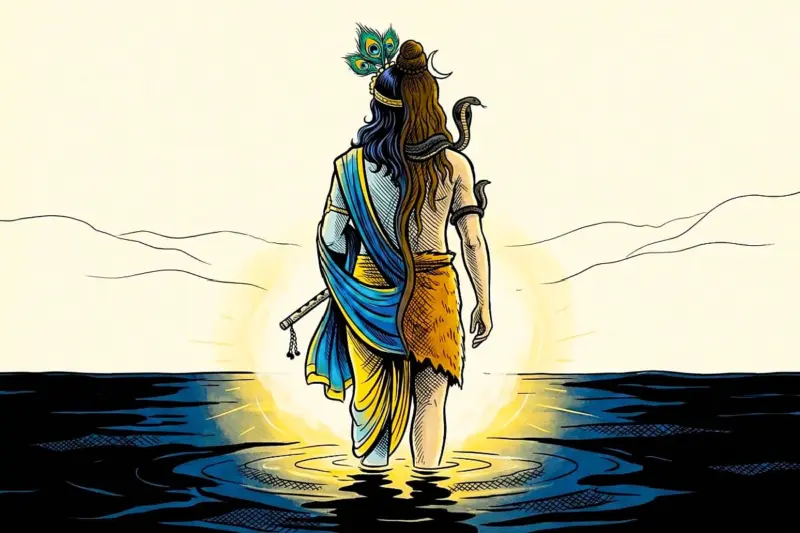

A close reading of Shankar Rajaraman's Mathurābhyudaya reveals Kashmiri Śaiva philosophy woven quietly into the narrative of Kṛṣṇa - where the playful god and cosmic consciousness point towards the same infinite reality.
Akrūra had entered the waters of the Yamunā to perform his afternoon ablutions (mādhyāhnika). While immersed in the river, he suddenly beheld something extraordinary: an unknown and mysterious effulgence manifesting within the water.
The vision puzzled him. The Yamunā was renowned for her deep dark colour, darker even than the finest collyrium. Could that striking darkness somehow be connected with the strange radiance he was seeing? As this thought arose in his mind, the poet Shankar Rajaraman describes the moment in a remarkable verse from his Sanskrit mahākāvya, Mathurābhyudaya:
उदेति नद्यास्तपनोद्भवायाश्छाया किमस्माज्जितकज्जलश्रीः । स इत्थमन्तर्विमृशन्नपश्यत्तद्धाम बद्धाद्भुतपुंविवर्तम् ॥
As he was reflecting inwardly whether the dark splendour of the Yamunā, surpassing even the beauty of collyrium, arose from this radiance, he beheld that very effulgence assume a wondrous human form.
॥ 2.22 ॥
The verse begins with a moment of curiosity. Akrūra wonders about the colour of the river. Within a moment, the scene turns into revelation. The mysterious light itself becomes embodied as a human form.
At first sight, this appears to be a poetic retelling of a well-known episode from the Bhāgavata Purāṇa. Yet the poet introduces a deeper philosophical suggestion. Beneath the narrative, one can sense ideas that resonate with the Kashmiri Śaiva tradition, particularly the Pratyabhijñā school.
The poet's interest in this philosophical tradition is visible in a short independent verse (muktaka) composed by him:
स्वमेव स्वात्मना बध्नन् स्वात्मना स्वं विमोचयन् । स्वातन्त्र्यैकरसो जीयाच्छक्तिचक्रवृतः शिवः ॥
Binding himself by himself and freeing himself by himself, may Śiva, surrounded by the circle of powers and of the essential nature of singular freedom, be victorious.
This verse expresses the central insight of the Pratyabhijñā philosophy. According to this tradition, ultimate reality is a single universal consciousness identified with Śiva. That consciousness possesses absolute freedom (svātantrya). Through this freedom, it manifests the universe, sustains it, and withdraws it again. The same consciousness both binds and liberates.
Seen in this light, the vision in the poem becomes more suggestive. The mysterious radiance appearing in the Yamunā is not simply a physical light. It hints at a deeper principle: the divine consciousness that reveals itself in forms.
The poet develops this idea further through another striking image:
स्वच्छेन केनाप्यमुना रसेन स्वच्छन्दसम्पादितपोषणानि । क्षेत्राणि कालत्रितयेऽपि मैत्रीं बोधाङ्कुरैर्बिभ्रति नव्यनव्यैः ॥
Fields, nourished through the freedom of his will by some pure essence from him, maintain friendship even across the three times with ever-new sprouts of awareness.
॥ 2.37 ॥
Here the poet turns to the imagery of agriculture. Fields receive nourishment from a subtle essence and continuously produce new growth. Yet the sprouts mentioned in the verse are not ordinary plants. They are "sprouts of awareness" (bodhāṅkura).
The metaphor suggests that the universe itself is like a field nourished by divine consciousness. From that source arise ever-new manifestations of awareness across past, present, and future. Reality becomes a living process in which consciousness continually expresses itself in fresh forms.
An even more surprising philosophical hint appears in another verse:
स्वेन स्वमेवैष निराकरिष्णुश्चार्वाकतामाश्रयते स्वतन्त्रः । स्वेन प्रमाणीकुरुते स्वमेवच्छन्दोऽनुकूले पथि वर्तमानः ॥
This one, being independent, by himself refutes himself and even takes refuge in Cārvāka philosophy; by himself he establishes his own self as valid authority, proceeding along the path favourable to his will.
॥ 2.40 ॥
The reference to the Cārvāka school - the classical materialist philosophy of India - is striking. Even the denial of spiritual reality, the poet suggests, arises within the same freedom of consciousness.
From the perspective of Pratyabhijñā, every viewpoint in the world, whether belief or disbelief, devotion or scepticism, appears within the play of the same ultimate consciousness.
When these verses are read together, a deeper layer of the poem begins to appear. The narrative of Kṛṣṇa continues, but it quietly carries philosophical reflections within it. The mysterious radiance seen by Akrūra, the sprouts of awareness arising across time, and even the diversity of philosophical views all point towards a single underlying principle: the boundless freedom of consciousness.
In Kashmiri Śaivism, that consciousness is called Śiva.
Within the poetic world of Mathurābhyudaya, the divine appearing as Kṛṣṇa can therefore also be understood as the same cosmic consciousness celebrated by the Śaiva philosophers. The poem never states this directly. Instead, it allows the reader to glimpse it through imagery and suggestion.
Hidden within the graceful movement of Sanskrit poetry lies a quiet insight. The playful Kṛṣṇa of the narrative and the cosmic Śiva of the philosophers may ultimately point towards the same infinite reality: the luminous consciousness that freely manifests the universe.