




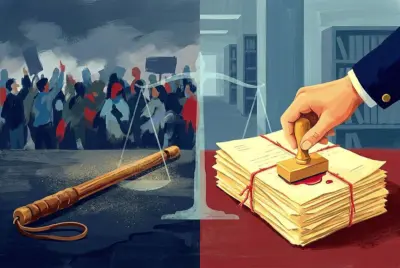

India's state has vast coercive instruments, yet its most durable wins come from restraint without creating a martyr. Lee Kuan Yew's model shows that the real weapon is not the punitive act but the institutional rebuild that makes the same challenge impossible to repeat.
The incumbent government projects an image of assertive, unapologetic right-wing rule. So why has it left Umar Khalid merely entombed in the slow-moving machinery of UAPA proceedings and nothing more? This is the same man who, on a central university campus funded by Indian taxpayers, openly chanted "Tum kitne Afzal maroge, har ghar se Afzal niklega", directly provoking the state and the public that paid for his studies.
The instinctive Indian nationalist response would probably be something like: "Why is such a person still breathing freely, still getting bail hearings, still commanding prime-time debates? Why not make an example?"
But when one sits with that instinct a little longer, something interesting emerged. The government hasn't been soft. It has been precise. And precision, it turns out, is a far more devastating instrument than spectacle. The current establishment has hit multiple targets with a single, quiet shot, without pulling the trigger, without creating a martyr, and without handing the opposition the one thing it has always needed but never quite managed to manufacture on its own - a clean story.
There is a question that political observers in India regularly avoid asking with any seriousness: why, in a country where the state possesses formidable coercive instruments, from the UAPA to the NSA, from the ED to the CBI, does the most durable political authority tend to emerge not from their most aggressive deployment, but from their most disciplined restraint?
This is not a rhetorical question. It has a traceable answer. And to find it, one has to understand a concept that one of Asia's most consequential statesmen practised quietly for five decades, and that India's current political establishment has, largely by instinct and design, begun to absorb.
The Theory Nobody Admits To
When political scientists discuss state power, the conversation usually centres on what instruments a government possesses. The more interesting question, the one that separates durable governments from brittle ones, is how much of those instruments they choose not to use.
The logic runs as follows.
Every authoritarian or semi-authoritarian action the state takes generates two outcomes simultaneously. One is the immediate suppression of the threat, and the other is a residual emotional reaction in the public, a kind of sympathy ledger that gets credited to the target, not the government. When this reaction is modest and dispersed, the state wins cleanly. When it is intense and concentrated, the state wins the battle and ignites a war. The history of political collapses (Marcos in the Philippines, Suharto in Indonesia, Ben Ali in Tunisia) follows this grammar almost without exception.
What calibrated coercion proposes is something more sophisticated. The goal of state action should not be the maximum punishment of a challenger but the minimum force sufficient to neutralise them, followed immediately by structural reforms that prevent the same challenge from recurring. The punitive act is the trigger; the institutional redesign is the actual weapon.
Lee Kuan Yew and the Architecture of Invisible Power
Singapore under Lee Kuan Yew is the most documented case study in calibrated coercion as a governing philosophy. Lee was no stranger to hard methods. The Internal Security Act, which allowed detention without trial, was used to neutralise labour activists, student leaders, journalists, lawyers, and church workers across four decades of PAP rule. Some detainees were held for years without a hearing. He was direct, even relish-laden, in describing his willingness to fight, famously saying that anyone who took him on needed to "put on knuckledusters".
But the knuckledusters were mostly kept in the drawer.
What distinguished Lee from many of his authoritarian contemporaries was his consistent discomfort with excess. When China cracked down on Tiananmen Square protesters in 1989, Lee's concern was not the moral weight of the crackdown but its spectacular visibility, the grand show staged for television cameras. He had, he told Li Peng, handled student sit-ins differently: by cordoning off campuses, cutting water and electricity, and letting the situation deflate on its own. No batons. No images. And no martyrs.
Similarly, when Malaysia's Mahathir Mohamad had Anwar Ibrahim arrested by special forces and displayed in custody with a black eye, Lee's quiet counsel was that a straightforward criminal charge would have served better. The arrest energised Reformasi. A quieter method might have buried the movement.
Lee's instinct was consistent. Never create the image that your opponent can use to reverse the narrative.
But the more important pattern in Singapore was what came after the coercive moments. When the government detained labour activists in the 1960s, it did not stop there. It restructured the entire framework of industrial relations, creating the NTUC as a tripartite body that tied union leadership to government and business interests. The effect was that militant unionism became institutionally impossible, not because it was banned outright but because the space it would have occupied was filled with something else.
When student activism became disruptive in the 1970s, the government went beyond punishing protest leaders. It overhauled campus funding laws, restructured student organisations, imposed security vetting for academic appointments, and, crucially, built up a meritocracy so attractive that ambitious students found career advancement more rewarding than political agitation. The Nanyang University was shut down; a highly competitive scholarship system was expanded. The result was a generation that redirected its competitive energies inward.
When the press challenged the government in 1971 through Chinese-language newspapers that Beijing found dangerous, the state shuttered the papers. But the lasting instrument was not the shutdown: it was the Newspaper and Printing Presses Act of 1974, which gave the government effective control over the appointment of editors and directors. The act replaced the need for repeated confrontations with a system of structural alignment. Editors who knew how the system worked had no incentive to test it.
This is the model - shock, redesign, co-opt. The shock creates the opening. The redesign closes it permanently. The co-optation converts potential opponents into possible supporters.
India In The Last 10 Years
India's political context is vastly more complex than Singapore's, a federal democracy with a raucous press, an independent judiciary, a tradition of street politics, and a public whose tolerance for even the slightest of state coercion is near zero. The current government's governance has had to work within these constraints. But the pattern of calibrated coercion, operating just below the threshold of moral outrage, is discernible across several domains.
The most systematic example is the treatment of civil society and foreign-funded advocacy organisations. Rather than conducting mass arrests of activists or ordering dramatic raids, the government moved methodically through the Foreign Contribution Regulation Act. FCRA licences were cancelled for thousands of problematic NGOs, over 16,000 between 2015 and 2024, through an administrative process. Most of these organisations had been instrumental in generating international criticism, specifically (and in many cases, only) of the BJP-led government's policy on issues ranging from environment to minority rights.
The cancellations received coverage, but because they were executed as regulatory non-renewals rather than prosecutions, the imagery was bureaucratic rather than repressive. There were no visuals of activists being dragged away. There were simply organisations that one day found they could no longer function.
The instrument was the FCRA. The redesign was the tightening of its compliance architecture: shorter renewal windows, SBI account centralisation, restricted utilisation provisions. The co-optation took the form of visibly non-problematic civil society organisations receiving FCRA clearance with relative ease. The result was a significant reshaping of the civil society ecosystem without producing a single image that could serve as a rallying point for opposition.
A second example is the handling of Article 370, the provision that gave Jammu and Kashmir its age-old special status. The move was legally contested and deeply symbolic to a significant portion of the population. But its execution was notable for its clinical precision. The abrogation was done through a legislative resolution, not through military declaration. Broad preventive detentions were used, but targeted mostly at political leaders rather than general civilians. Internet restrictions were imposed administratively.
The framing was that of constitutional normalisation, not conquest. Critics were given plenty to argue with legally and politically. But the government was careful to deny them the kind of images (of mass civilian suffering, of spectacular military excess) that could have internationalised the issue to a degree that constrained follow-through.
In the media domain, the pattern is also visible, though it operates through economic incentives rather than administrative fiat. India has not shut down a major national newspaper or arrested a senior editor of a large publication in the last decade. What has changed is the ecosystem.
Media consolidation, advertiser behaviour, and the informal influence that comes from the government's role as India's largest advertiser have reshaped editorial environments without requiring formal intervention. Individual journalists and smaller portals have faced prosecutorial action, in most of the cases over legitimate concerns about incitement, but the application has been selective enough to function as a deterrent to mischief rather than a blanket ban.
The ED and CBI, meanwhile, have been deployed not as instruments of mass prosecution but as precise targeting tools, used against specific opposition leaders at specific moments. The criticism that this represents selective enforcement persists among the left. But selectivity is precisely the point. The goal is not to prosecute everyone who might qualify: it is to establish that the instruments exist, that they can be activated, and that cooperation with the prevailing system is safer than confrontation.
And that is what happened with Khalid as well. And perpetrators of Bhima Koregaon violence. And numerous other activists who could, in the past, get away in such cases either with their sympathisers in the government or the resultant image of "martyrs" post coercive activities of the state.
Why the Indian Left's Method Fails
The contrast with how the Indian left exercises pressure is instructive. The dominant opposition playbook in contemporary India relies on street mobilisation, protest aesthetics, and moral narrative. The tools are public assemblies, bandhs, symbolic marches, and, increasingly, social media spectacle.
This approach, however, has visible weaknesses.
First, it is expensive. Sustained street mobilisation requires organisational resources and risks depleting activist energy without corresponding political outcome.
Second, it consistently produces the wrong narrative for a swing voter. Bandhs that close shops and disrupt ordinary life impose costs on exactly the population whose sympathy the opposition needs. The instinctive response of the middle-class voter to the image of burning buses or blocked highways is not solidarity with the cause, but irritation at the disruption.
Third, and this is the structural problem, it invites the government to demonstrate restraint. When Chee Soon Juan in Singapore deliberately violated public assembly laws to provoke a repressive response he could use politically, the government sent soft-spoken, plain-clothes officers to handle him. There were no riot batons. No dramatic arrests. The government then settled the score in the courts, on its own timeline. The images Chee needed, of a decent man being brutalised by the state, never materialised. The same dynamic operates in India. When the government responds to street mobilisation with measured law enforcement, it denies the opposition the moral theatre it needs.
The Shaheen Bagh protests of 2019-20 are an illuminating case. The movement may have been dear to the masses who largely refuse to get themselves educated. But the prolonged occupation of a public road, the implicit disruption to daily commuters, and the failure to articulate a clear political ask beyond symbolism meant that by the time the movement ended, dispersed quietly during the COVID lockdown, its practical outcome was near zero. The government had outlasted it without producing a single episode of excess that would have crystallised mass opposition.
The Argument Against Maximal Punishment
There is a body of opinion in India (found across ideological lines, though more commonly on the nationalist right) that the solution to political violence, terrorism, and social disorder lies in harsher sentences, faster executions, and more visible punishment. The argument is intuitive - make the cost high enough and deterrence follows.
However, this approach largely backfires. And there is a strong reason for it.
Extreme punishment creates martyrs. It turns the person being punished into a symbol, and symbols are more dangerous to governments than individuals. Afzal Guru's execution in 2013 settled a legal case; it also kept the case alive politically for years. Yakub Memon's hanging prompted more discussion about Kashmir and Muslim marginalisation in mainstream media than any number of Memon's own statements had. The government that executes a political prisoner transfers moral capital to that prisoner's cause with a finality that no court verdict can undo.
More broadly, the correlation between the severity of punishment and the deterrence of political violence is remarkably weak. Countries that rely heavily on capital punishment for terrorism-related offences do not demonstrably produce less terrorism than those that do not. What they do produce is a narrative environment in which grievance, real or manufactured, is easier to sustain.
Calibrated coercion works on a different theory: that the goal is not the punishment of an individual but the permanent transformation of the environment in which challengers operate. Lee Kuan Yew did not need to imprison every would-be student radical in Singapore. He needed to restructure universities so that radicalism was individually costly and institutionally impossible. He succeeded. The last significant student protest in Singapore was in 1974. Not because students fear jail, but because the incentive architecture of Singaporean society routes ambitious young people away from politics and towards careers.
This is the distinction that advocates of maximum punishment consistently miss: the spectacle of punishment satisfies a demand for justice in the short run, but it does nothing to alter the structural conditions that produced the challenge. A calibrated system addresses those conditions. It is less satisfying to watch, but more durable in effect.
Most Powerful Move
The phrase "calibrated coercion" sounds technical, even bloodless. Its practitioners have never publicised it as a philosophy, which is part of why it works. The Singapore government maintains that it has never coerced anyone. Its opponents say there is nothing calibrated about what the PAP does. Both positions serve the same function: they prevent an honest accounting of a strategy that is genuinely sophisticated.
In India, the debate has a similar character. The government's critics accuse it of authoritarianism; the government's defenders deny that any of its actions constitute coercion at all. Neither position grapples with what is actually most interesting: that a state with the instruments of significant coercive power has, in most of its major moves, chosen to deploy those instruments in ways that stop just short of generating the backlash those instruments would provoke if used maximally.
This is not naivety, and it is not restraint in any sentimental sense. It is a rational understanding of what power is actually for. Power is not for punishment. Punishment is one tool among many, valuable in specific contexts and counterproductive in others. Power is for the creation of stable conditions in which the government can continue to govern, and in which challengers find the cost of confrontation higher than the cost of accommodation.
The state that masters this distinction (that can shut down an organisation without creating a martyr, restructure a profession without declaring war on it, and answer a street protest with a court case rather than a baton) has found something genuinely rare - a method of governing that is both effective and self-renewing.
The most powerful move in the repertoire is often the one that leaves no visible mark.