
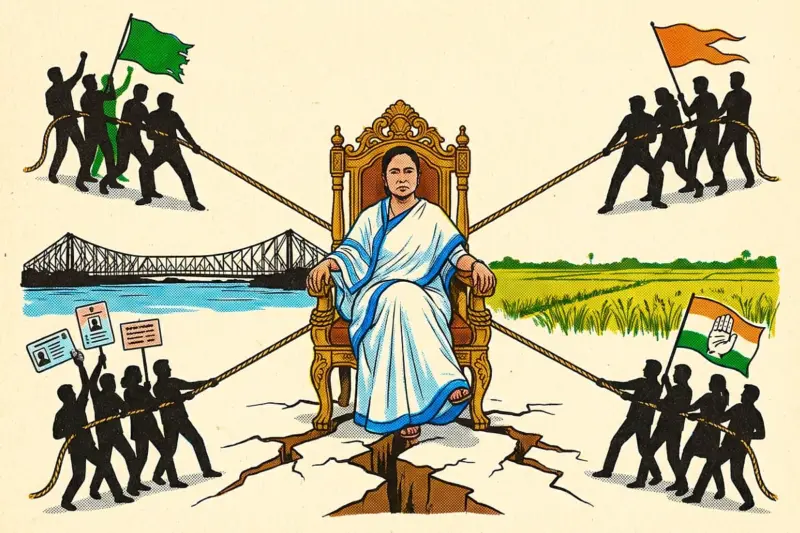

The 2026 West Bengal election is not Mamata Banerjee vs. the BJP. It is Mamata Banerjee vs. a configuration - five simultaneous erosions of her 2021 coalition.
On the morning of 17 March, Mamata Banerjee stood at her Kalighat residence and released the names of 291 candidates for West Bengal's assembly election.
The list bore the imprints of fifteen years in power by including 47 Muslim candidates, 95 SC/ST nominees, 52 women.
But 74 sitting MLAs were quietly dropped in what amounted to an acknowledgment that the party knew something was wrong.
"This is the fight of astitva - the fight for Bengal's very existence," she told reporters. "Dilli ka laddu will not win." This kind of framing was familiar. What was new, and what the candidate list could not disguise, was the arithmetic closing around her.
In the weeks that followed, the temperature rose considerably.
In the same week, Humayun Kabir, a former TMC MLA who had been suspended for announcing he would "inaugurate a Babri Masjid in Murshidabad", formally allied with Asaduddin Owaisi's AIMIM, the two parties together targeting roughly 190 seats across the Muslim-majority districts of Murshidabad, Malda, and Uttar Dinajpur. (Although latest reports indicate the alliance is now over).
And the Indian National Congress, for the first time in thirty years, announced it would contest all 294 seats independently, without the Left or TMC, shredding what remained of the opposition coordination that had once given Bengal's anti-incumbency votes somewhere coherent to go.
On 2 April 2026, Suvendu Adhikari filed his nomination papers from Bhabanipur, Mamata's own constituency, with Amit Shah standing beside him at Hazra Crossing. Saffron flags lined balconies that have for years voted overwhelmingly for the Trinamool Congress. Police intervened as party workers gathered near Kalighat, indicating that a secure political space was entering contested territory.
On election day, all these developments are destined to work as pressure vectors.
They revealed a structural shift. This is the first Bengal election where Mamata Banerjee is not facing a single opponent but a configuration.
Five simultaneous fractures, one collapsing equilibriumThe particular difficulty of 2026 is that the strategic response to each erosion directly contradicts the response demanded by the others.
The coalition itself was a work of considerable political craft. Muslims, who constitute over 27 per cent of the state's population and exercise decisive influence in upward of 120 assembly constituencies, were the load-bearing wall. In 2019, when the BJP swept 18 of 42 parliamentary seats and 118 assembly segments shifted towards it, Muslim fear of the BJP drove a historic consolidation.
In 2021, the Trinamool Congress won 58 of 61 Muslim-dominated seats. Lokniti-CSDS surveys found TMC's Muslim vote share rising from 51 per cent in the 2019 general election to 75 per cent in the 2021 assembly contest.
Simultaneously, Mamata cultivated the women vote through direct transfer schemes - Lakshmir Bhandar, which now reaches over 2.2 crore women with monthly cash payments, supplemented by Kanyashree and Rupashree - while managing her Hindu flank through Bengali sub-nationalism, the argument that every governance failure was in fact a contest between Delhi and Bengal.
It was not a subtle formula, but it worked. TMC won 213 of 294 seats in 2021 with nearly 48 per cent of the vote.
In 2026, each of these pillars is under pressure at the same time.
The Muslim consolidation is up for fragmentation, which suggests its architects studied the Bihar elections of 2020 with some care. In Seemanchal, the Muslim-majority belt of north-eastern Bihar where Muslims account for 40 to 68 per cent of the population across four districts, AIMIM won five seats - Amour, Baisi, Jokihat, Kochadhaman, and Bahadurganj - all carved from constituencies where the Grand Alliance had previously dominated.
In Bengal, the arithmetic is sharper because the seats at stake are greater in number. The three districts AJUP is targeting - Murshidabad, where Muslims constitute 66 per cent of the population, Malda at over 51 per cent, and Uttar Dinajpur at nearly 50 per cent - together encompass scores of seats where a three-to-five per cent shift in the minority vote is enough to alter outcomes.
In Bengal 2026, even a 3-5 per cent shift can redraw the map.The fuel for this split is real and specific.
The grievances behind this shift are concrete. In May 2024, the Calcutta High Court cancelled about five lakh OBC certificates issued to Muslims since 2010, ruling that religion had been used as the sole criterion. In January 2025, the National Commission for Backward Classes recommended removing 37 Muslim groups from OBC lists. Subsequent revisions altered category placements for several communities.
Owaisi has pointed out that only about 7 per cent of the state's Muslim population is represented in government jobs, while Kabir has framed the issue as betrayal.
At the same time, the erosion is uneven.
In constituencies where the BJP is the principal challenger, Muslim voters are still likely to consolidate behind the Trinamool Congress. The fracture may be partial, but even that works in the BJP's favour: Muslims disillusioned with the TMC are unlikely to shift to the BJP, so any division in the incumbent's vote base becomes a practical advantage for the saffron party.
The Indian Secular Front adds a second layer of fragmentation, and its trajectory suggests it is not a transient force. The ISF was founded in 2021 by Abbas Siddiqui, the cleric of the Furfura Sharif shrine in Hooghly - one of Bengali Islam's most venerated sites - and its sole MLA, Naushad Siddiqui, holds Bhangar in South 24 Parganas, the only seat any opposition alliance partner won in 2021.
Bhangar's defection from the TMC was rooted in a specific grievance of a land acquisition dispute over 13 acres seized for a power grid project in 2013, which killed two protesters in 2016 and created a permanent anti-TMC constituency that the ISF absorbed wholesale. In the 2023 panchayat elections, the ISF fielded candidates in over 1,300 seats and won gram panchayat positions across Bhangar, Kulpi, Bankura, Howrah, and Hooghly - well beyond its original stronghold.
A TMC senior leader admitted to the Indian Express: "Those who fought against land acquisition are now with the ISF. Almost all the CPI(M) members are also now with the ISF… In many villages of Bhangar, we don't even have a footing now."
In 2026, the ISF is contesting 33 seats in alliance with the Left Front, concentrated in minority-heavy belts of South and North 24 Parganas. Together with AJUP, it creates multi-cornered contests where the Muslim vote, once a monolith, now fractures along at least three lines.
If the Muslim vote is fragmenting, the women's vote is differentiating. On the women's vote, Mamata faces a structural problem that welfare transfers alone cannot resolve.
In September 2023, Sandeshkhali broke - sexual assault and land-grab allegations against local TMC strongman Sheikh Shahjahan, whose party connections were well known. The following year, a junior resident doctor was raped and murdered at RG Kar Medical College, and the state government's response was widely criticised as inadequate and insensitive.
The BJP has converted both incidents into candidacies. Rekha Patra, the face of the Sandeshkhali protest movement, is contesting from Hingalganj. Ratna Debnath, the mother of the RG Kar victim, is on the BJP list from Panihati, and has said she entered politics to seek justice for her daughter and raise issues related to women's safety.
For rural women, whose support for the TMC remains anchored in welfare, the BJP has done something ideologically remarkable. Having spent 2021 attacking Lakshmir Bhandar as dole politics and dependency culture, the party has in 2026 simply outbid it.
State BJP president Samik Bhattacharya announced an Annapurna Yojana promising Rs 3,000 per month - triple the current Lakshmir Bhandar rate - alongside a Rs 5,700 crore package for women.
The welfare floor Mamata built is now the battlegroundMamata Banerjee's response effectively shows how much of a dent it can make. "I know a lot of money comes in during elections. Mothers and sisters, stay alert - the BJP people will come to your homes in the name of the West Bengal government, in the name of the TMC government, and ask for your bank account number, saying they'll give you money. Don't give them your account number, even by mistake; they'll take away the money from your Lakshmi Bhondar. This is their trick," she said at a rally.
The welfare terrain, once TMC's exclusive architecture, is now a bidding floor that any party with sufficient resources can enter.
In 2024, despite Sandeshkhali and RG Kar, the TMC won 29 of 42 parliamentary seats, largely because rural women anchored their votes to transfer predictability. Whether that anchor holds when the BJP is offering three times the amount is the central uncertainty of the 2026 election among pollsters who will speak on background.
The Matua collision is the most structurally interesting because it damages the BJP simultaneously with the TMC while creating an exploitable opportunity that Mamata Banerjee is actively pursuing.
The Matua community, roughly 17 per cent of the state's population and decisive in around 45 constituencies, shifted towards the BJP in 2019 on the promise of the CAA, which would have regularised the citizenship status of Hindu refugees from Bangladesh.
The Special Intensive Revision of electoral rolls, pushed by the Election Commission in late 2025, was designed in part as an anti-infiltrator mechanism. However, of the ten constituencies with the highest number of struck-off names, six are BJP strongholds with large Matua and refugee populations. In Bagda, Gaighata, Bongaon North, and Bongaon South, most of the deleted names belong to the Matua community.
Analysts estimate that if half of the affected Matua communities face exclusions, the BJP could lose 10 to 15 seats in North Bengal alone, where it won 30 in 2021. Mamata staged a two-day sit-in protest at Metro Channel in central Kolkata on 6 and 7 March over the SIR deletions, framing the issue as constitutional desecration. "BJP has made it their life's mission to dismantle Babasaheb Ambedkar's Constitution brick by brick," she said.
The Bhabanipur constituency alone has seen over 40,000 voter deletions from the final list.
On the Hindu flank, the BJP has executed what might be called a patient recalibration. The Brigade Parade Ground rally of 14 March mixed 'Jai Shri Ram' with 'Jai Ma Kali' and 'Jai Ma Durga' - a signal that the party understands the difference between north Indian Hindu consolidation and Bengali Hindu identity.
PM Modi received a portrait of Bankim Chandra Chattopadhyay from Samik Bhattacharya and an idol of Goddess Durga from Suvendu Adhikari. Bhattacharya has taken to emphasising that he is a fish-loving Bengali, countering the outsider tag that has historically defused Hindutva messaging in the state.
Bangladesh, where Hindu temples and homes have been attacked since the July 2024 uprising, provides an emotional infrastructure that did not exist in 2021. Reports claim that BJP-sympathetic organisations are planning to educate and mobilise over three crore people.
The TMC's counter-moves appear reactive and, in many ways, self-defeating. It doesn't have a universal alternative to the BJP-RSS's Hindu-first framing, so invoking a sub-national Bengali identity becomes the go-to move.
Historian Chandranath Basu coined the term Hindutva in Bengali in 1892, a decade before Savarkar deployed it elsewhere. The BJP is now trying to reclaim that indigenous tradition, and the TMC cannot harden its Hindu identity without alienating its Muslim base, and cannot soften its stance without conceding ground to the leaders like Kabir and Owaisi.
It is a strategic vice grip.
The pressure vectors interact in ways that compound the difficulty. Congress contesting all 294 seats independently - the first time since 2006 - and the Left fielding over 200 candidates despite holding zero assembly seats splits anti-incumbency in urban constituencies, which historically benefits the incumbent.
But in Muslim-majority belts, the same fragmentation intersects with AJUP and the ISF's 33-seat presence, increasing the probability that divided opposition votes translate into BJP gains not through the BJP's own strength but through an arithmetic gift.
Congress's solo run is not, however, without a positive case.
Adhir Ranjan Chowdhury, contesting an assembly election for the first time in thirty years, is running from Berhampore in Murshidabad - his parliamentary citadel, where he was a five-time Lok Sabha MP before losing to TMC's Yusuf Pathan in 2024 by 85,000 votes in what he attributes to communal polarisation.
Former Malda MP Mausam Noor, niece of the powerful A.B.A. Ghani Khan Choudhury, is contesting from Maltipur. The party holds one Lok Sabha seat from Malda South.
Professor Maidul Islam of the Centre for Studies in Social Sciences has estimated that Congress could win two to three seats from the Malda South Lok Sabha segment alone, where its 2024 recovery suggests residual ground strength.
But as a Congress insider told journalists after the party's decision was announced: "Left drains funds of our candidates. There is no transfer of votes from the Left to us." The logic of going alone was defensible. Its electoral consequences may prove otherwise.
All of which compresses, finally, into one constituency and one contest. Bhabanipur - 205,553 voters, 100 per cent urban, and over 40,000 names struck from the rolls - is where Mamata Banerjee will face Suvendu Adhikari directly for the second time.
After the 2021 by-election, Mamata herself noted that "46 per cent of the population is non-Bengali and everyone has voted for me." That 46 per cent - largely Hindi-speaking - is the constituency Adhikari is now targeting, and the base Shah's roadshow at Hazra Crossing was designed to activate.
In Nandigram in 2021, Adhikari defeated her by 1,956 votes. In the 2021 by-election, she subsequently won in Bhabanipur and took over 71 per cent of the vote. The 2024 parliamentary result in Kolkata Dakshin, which includes Bhabanipur, showed her margin over the BJP had narrowed to roughly six percentage points.
Amit Shah's instruction to Adhikari was recorded and widely published: "I told him, not just Nandigram. You have to enter Mamata Banerjee's home and defeat her there." Shah told a rally: "If the people of Bhabanipur make us win this one seat, change will happen automatically."
This election is not defined by a single opponent. It is shaped by five independent erosions arriving simultaneously, each requiring a strategic response that cancels the others.
Dominance built by being all things to all communities becomes, at the moment of maximum pressure, the source of maximum vulnerability. Every pillar she raised now has someone pulling at it, and they are not coordinating with each other - they do not need to.
The structure itself has become the central actor.