




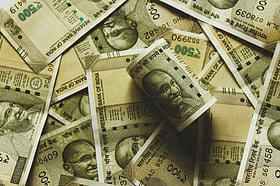

The Reserve Bank of India has revived a decade-old plan to introduce polymer banknotes as the country grapples with soaring printing costs and rising demand for physical currency.
The proposal was discussed at the central bank's last two board meetings held in Patna and Mumbai, with a pilot project involving plastic banknotes for public use expected to be announced soon.
The move comes as expenditure on printing currency notes rose to Rs 6,372.8 crore in FY25 from ₹5,101. 4 crore in the previous year, largely due to increased demand for banknotes.
Adding to the burden, 23.8 billion pieces of soiled banknotes were disposed of in FY25, rising 12.3 per cent from 21.24 billion pieces in the previous year.
Despite rapid digital payment growth, currency in circulation continued to rise at a sharp pace, increasing 11.5 per cent year-on-year to touch Rs 42.86 trillion.
Polymer notes, made from a thin, flexible plastic substrate, last three to four times longer than existing notes and are more resistant to dirt, moisture, and tearing.
The decision was taken in view of perceived advantages in the cost of production and the higher shelf life of such currency notes. Sources indicated that automated teller machines (ATMs) would be enabled to dispense polymer-based notes.
India had attempted a similar initiative in 2012, when the Centre approved a field trial of one billion Rs 10 polymer banknotes in selected cities with varied geographical and climatic conditions.
However, the project was shelved due to technological challenges. Today, sources emphasise that the said technology is no longer a challenge, and solutions have been arrived at in order to ensure that ATMs can identify such notes.
Globally, about 60 countries in the world have introduced polymer banknotes into circulation so far. Australia was the first country to introduce polymer banknotes, starting with a ten-dollar note in 1988, followed by countries including Singapore, Canada, the United Kingdom, Malaysia and Romania.
The RBI is likely to begin with lower denomination notes such as Rs 10 and Rs 20, as these notes circulate more frequently and wear out faster than higher-value denominations.