
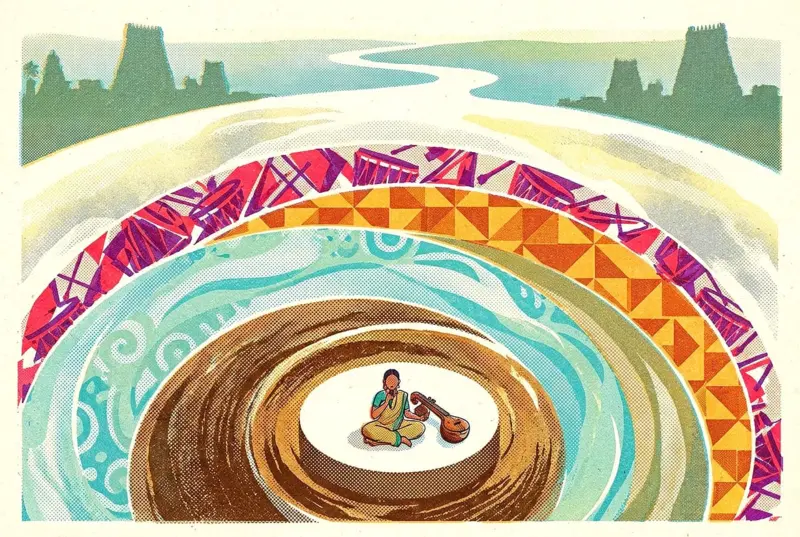

From Purandara Dasa's Kannada pedagogy to MS Subbulakshmi's Tamil rebellion, the South's classical tradition grew not by choosing one tongue but through a chorus of tongues, by making peace with each it touched.
On the screen, KJ Yesudas, ghost-singing for Sivakumar's JK Balaganapathy, launches into a complex, high-velocity Tyagaraja kriti in Ilaiyaraaja-inspired raga Saramathy (Mari Mari Ninne). At the end of the rendition, in the audience of K Balachander's Sindhu Bhairavi (1985), the heroine, Suhasini as Sindhu, stands up. She challenges the high priest of the stage to translate the Telugu liquid gold he is pouring out into the common salt of the local tongue.
"What is the point of a song," she effectively asks, "if the listener cannot understand the lyrics?"
It is among the most famous confrontation scenes in the history of Tamil cinema, a scene that distilled a century of ivory-tower tension into five minutes of celluloid drama. But while Balachander used that moment to bridge the gap between a distant artist and a disconnected audience, he also accidentally reinforced the myth that Carnatic music's relationship with language is a zero-sum game. The scene suggests a choice must be made between the divine mystery of Telugu and the emotional clarity of Tamil.
But the reality is far more nuanced, far more smartly written than a movie script. Good music, we all know and have experienced, can exist beyond the ken of language. In any case, the history of Carnatic music is not a story of one language conquering another. It is a saga of how the tradition has made peace with every tongue it touches.
To see the dominance of Telugu and Sanskrit as a cultural imposition is to misread the natural flow of history, as if the Musical Trinity were political conquerors rather than mere conduits for a specific, vowel-heavy resonance.
How it all began
According to various historical sources, the origins of Carnatic music can be traced to the ancient musical traditions of South India, whose theoretical foundations were shaped by classical treatises such as the Natya Shastra (2nd century BCE-2nd century CE), attributed to Bharata Muni. While the text discussed broader principles of Indian music and performance, its ideas on raga (melodic frameworks), tala (rhythmic cycles), and rasa (aesthetic emotion) deeply influenced the musical practices that later evolved in the southern regions of the subcontinent.
Over time, these principles interacted with the vibrant temple culture of South India, devotional poetry in regional languages, and local performance traditions. From this confluence emerged the distinct classical system that came to be known as Carnatic music.
Between the 14th and 16th centuries, the Vijayanagara empire is believed to have played a crucial role in consolidating this musical culture. Temple rituals, court patronage, and the bhakti movement created a fertile environment for composers and musicians. A key figure of this period was Purandara Dasa, who systematised the teaching of music and composed hundreds of devotional songs in Kannada. Because he established the pedagogical framework still used to train students today, he is widely regarded as the Father of Carnatic Music.
The merchant who became music
Purandara Dasa is said to have been born around 1484 in present-day Karnataka, most likely in the town of Purandara Gada or nearby regions associated with the Vijayanagara empire. His birth name was Srinivasa Nayaka. His family belonged to a prosperous merchant community dealing in precious metals and jewellery.
Stories about his transformation have acquired the glow of legend. One tale recounts how a poor Brahmin approached Srinivasa Nayaka seeking charity. He turned him away repeatedly. Later, the same man returned disguised and asked Srinivasa Nayaka's wife for help. She quietly gave away her nose ring. The Brahmin is said to have unwittingly taken the ornament back to the very shop of its owner. Recognising it as his wife's, the suspicious Srinivasa Nayaka locked the nose ring in his safe and rushed home to confront her. Terrified and trapped, the wife prayed for a miracle, and the nose ring reportedly materialised in her palm. When she handed it to her stunned husband, he raced back to his shop only to find that the original ornament he had just locked away had vanished from his secure vault.
The shock of the event, interpreted as divine intervention, changed his life. He renounced his wealth, distributed his possessions among the poor, and devoted himself to a life of spiritual wandering. He became a disciple of the philosopher-saint Vyasa Tirtha, a towering figure in the Vijayanagara court and a proponent of the Haridasa devotional movement. From that moment, Srinivasa Nayaka disappeared, and Purandara Dasa was born.
The Haridasa tradition
Purandara Dasa belonged to the Haridasa movement, a devotional wave that spread across Karnataka during the Vijayanagara period. The movement emphasised personal devotion to Vishnu and was expressed through simple, accessible songs.
Unlike the elaborate liturgical music of temples or courts, Haridasa compositions spoke directly to ordinary people. They used everyday metaphors, humour, moral instruction, and philosophical reflection. Purandara Dasa's chosen deity was Vithoba, the form of Krishna worshipped at Pandharpur. His songs, known as Devarnamas, were composed largely in Kannada. They travelled from village to village through wandering singers, carrying spiritual ideas in melodic form.
But while these songs were devotional in purpose, they were also quietly shaping the foundations of a classical music system.
Purandara Dasa's most enduring contribution was not just his compositions. It was the systematisation of musical education. Before his time, the teaching of South Indian classical music was largely unstructured. Students learnt directly from gurus, often memorising compositions without a clearly graduated curriculum.
Purandara Dasa, thePitamah
He is believed to have designed a systematic sequence of lessons that gradually trained both the voice and the musical mind of the student. The learning process began with Sarali Varisai, simple exercises that taught students how to move steadily up and down the scale. This was followed by Janta Varisai, which emphasised paired notes and helped strengthen vocal control and pitch stability. Students then progressed to Datu Varisai, patterns that required jumping between notes and thereby developed agility and confidence in navigating the scale.
After these foundational steps came Alankaras, structured exercises set to different rhythmic cycles or talas, allowing students to internalise the relationship between melody and rhythm. The sequence culminated in Geethams, simple songs that introduced melodic expression and musical phrasing. Every Carnatic student today walks the path Purandara Dasa laid nearly five centuries ago. This achievement alone would have secured his place in musical history.
Purandara Dasa also made an important pedagogical decision that continues to shape Carnatic music even today. He chose the raga Mayamalavagowla as the foundational scale for beginners. The symmetrical structure and the presence of all seven swaras in this raga make it particularly suitable for learning pitch relationships and voice control. It is why the earliest exercises of Carnatic training are still taught in this raga. It remains one of the most striking examples of how a 16th-century musician continues to influence the daily practice of students in the 21st century.
Tradition attributes more than 475,000 compositions to Purandara Dasa, though scholars believe that only around 1,000 survive today. Even this surviving corpus represents a monumental body of work. His songs range widely in theme, encompassing philosophical reflections, devotional surrender, social satire, moral instruction, and playful imagery.
Some compositions criticise hypocrisy in religious life, while others express deep spiritual longing. Written in deliberately simple language, they were meant to reach ordinary people rather than remain confined to elite circles. Among his most well-known compositions are Jagadoddharana (Kaapi), Krishna Nee Begane Baro (Yaman Kalyani), and Venkatachala Nilayam (Sindhu Bhairavi), each carrying a melodic charm that has ensured its survival across centuries. Purandara Dasa died around 1564, leaving behind a musical tradition that would only grow richer with time.
The pedagogical foundations laid by Purandara Dasa ensured that music in South India was no longer an unstructured inheritance passed sporadically from guru to disciple, but a disciplined tradition with a clear method of learning.
Over the next two centuries, this framework nurtured generations of musicians across temple towns and royal courts, particularly under the cultural patronage of the Vijayanagara empire and its successor kingdoms in Thanjavur and Mysore. By the 18th century, Carnatic music had acquired both a stable grammar and a vibrant devotional ethos, creating the ideal environment for a remarkable flowering of creativity. But make no mistake about it: without the Kannada core of the Haridasas, the emerging Carnatic music creators would have had no grammar to write with.
The bloom of the Telugu resonance
As is well known, by the late 18th century, the cultural centre of Carnatic music had shifted decisively to the fertile Cauvery delta. Thanjavur, under the shadow of the Vijayanagara legacy and later Maratha patronage, became a remarkable cultural hub.
Though located in Tamil country, its courtly and literary prestige carried strong Telugu influences, a legacy of centuries of migration from the Vijayanagara heartland. In this unique environment, the Musical Trinity - Tyagaraja, Muthuswami Dikshitar, and Syama Sastri - emerged, each leaving behind a body of compositions that would come to define the modern concert canon and elevate Carnatic music to new artistic heights. Their compositions expanded the possibilities of the kriti form, deepened the expressive power of ragas, and demonstrated how language itself could shape musical texture.
Tyagaraja and Telugu, the inseparables
Among the Trinity, Tyagaraja stands as perhaps the most prolific and emotionally direct composer. Born into a Telugu-speaking Brahmin family in Thiruvarur but raised in nearby Tiruvaiyaru, Tyagaraja wrote almost entirely in Telugu. In doing so, he found a linguistic medium that matched his musical imagination.
Telugu, with its open vowels and flowing phonetics, lends itself naturally to the gamakas that are central to Carnatic melody. In compositions like Chakkani Raja in Kharaharapriya or Nagumomu in Abheri (we have chosen mainstream examples advisedly), the syllables seem to glide effortlessly along the melodic arcs. The language, it would seem, allows the raga to breathe. The phrases stretch gracefully without abrupt consonantal interruptions. The sonic elasticity of the language allows the singer to move fluidly through the contours of a raga. Tyagaraja's kritis thus feel almost inseparable from the language in which they were written.
Muthuswami Dikshitar, the scholar of Sanskrit
Muthuswami Dikshitar's linguistic preference was largely Sanskrit, and the choice was again deliberate. Sanskrit allowed him to evoke a cosmic, almost architectural grandeur in his compositions. His kritis often read like miniature hymns, dense with philosophical and religious symbolism and references to temple iconography. In works such as the celebrated Navagraha Kritis, each composition dedicated to a planetary deity, the Sanskrit phrasing gives the music a sense of symmetry. The syllables fall into place like carefully hewn stones in a temple wall, creating a majestic and meditative structure.
Dikshitar demonstrated that Sanskrit, often associated with liturgical chanting, could serve as the skeletal framework of a complex raga composition. In pieces such as Vatapi Ganapatim (Hamsadhwani) or Sri Subrahmanyaya Namaste (Kambhoji) (again, we have gone with popular songs), the language becomes part of the larger aesthetic, reinforcing the gravitas and philosophical depth of the raga.
Syama Sastri, the rhythm of the Goddess
The third member of the Trinity, Syama Sastri, brought yet another dimension to the evolving tradition. A devout worshipper of the goddess Kamakshi, Sastri was known for his mastery of rhythm and his inventive use of talas such as Misra Chapu. Like Tyagaraja, he composed largely in Telugu, but his treatment of the language had a distinctive rhythmic vitality.
In compositions such as Marivere Gati in Ananda Bhairavi or Saroja Dhala Netri in Sankarabharanam, the Telugu text seems to pulse with the rhythmic structure beneath it. The syllables interact dynamically with the tala, creating an almost percussive dialogue between word and rhythm. The oldest of the Trinity, Sastri's music demonstrated how language can become an integral part of the rhythmic architecture of a composition, ensuring that poetry and pulse move together with a distinctly South Indian sensibility.
Together, the Trinity transformed Carnatic music from a disciplined system of learning into a luminous concert tradition. Drawing upon the pedagogical foundation laid by Purandara Dasa, they expanded the expressive horizons of ragas while revealing how Telugu and Sanskrit could bring different colours to the same musical canvas.
Telugu brought fluidity and emotional immediacy. Sanskrit provided grandeur and philosophical weight. And the rhythm-bound poetic expression gave the music its pulsating vitality. Through their works, Carnatic music found not only its enduring repertoire but also its remarkable ability to accommodate multiple linguistic voices within a single melodic universe.
Tamil rings a bell
Yet history has a way of unsettling even the most harmonious arrangements. By the early decades of the 20th century, Carnatic music had travelled far from the temple towns of the Cauvery delta into the bustling, modern sabhas of Madras. (With the decline of princely patronage in places like Thanjavur and Mysore, musicians increasingly migrated to Madras, which grew into the cultural and administrative capital of South India under British rule.)
The repertoire of the Trinity, rich in Telugu and Sanskrit, had by then hardened into the backbone of concert performances. But the new audience sitting in those halls was overwhelmingly Tamil-speaking, and an uncomfortable question began to surface: how does the classical music of Tamil Nadu have very little to offer in Tamil?
What had once been the organic outcome of history was suddenly recast as imbalance, even injustice. Out of that unease emerged one of the most spirited cultural debates in South Indian music - the Tamil Isai movement, a controversy that would challenge institutions, unsettle musicians, and reopen the question of language in Carnatic music.
Institutions such as the Madras Music Academy, which had become the most influential arbiter of Carnatic orthodoxy, were seen by critics as guardians of a repertoire dominated by Telugu and Sanskrit compositions. The Academy itself believed it was defending the classical core of Carnatic music. In its view, the Trinity's compositions formed the bedrock of the tradition, and any attempt to displace them with language-based demands risked diluting musical standards.
Purists, led by figures like TV Subba Rao and Musiri Subramania Iyer, denounced singing Tamil songs in the serious first half of a concert as sacrilege. They even termed the demand a Tamil vyadhi (Tamil disease).
MS leads a rebel movement
This triggered a rebellion. On one side was the muscle of Sir Annamalai Chettiar, who founded the Tamil Isai Sangam in 1943. But the heart of the movement was fuelled by a group of prominent Brahmins like the writer Kalki Krishnamoorthy and C Rajagopalachari (Rajaji).
Among senior performers of the era, there were varying degrees of hesitation towards expanding the Tamil offerings in concerts. The influential concert architect Ariyakudi Ramanuja Iyengar, whose format had largely standardised the modern kutcheri structure, believed strongly in the centrality of the Trinity's compositions. For him, they represented a tested musical inheritance, and radical alteration seemed unnecessary.
Similarly, stalwarts such as Semmangudi Srinivasa Iyer, though not hostile to Tamil compositions, often leaned heavily on the canonical Telugu and Sanskrit kritis that had long formed the backbone of the concert tradition. Their position was less about linguistic resistance and more about musical continuity.
The Tamil Isai movement's secret weapon, however, proved to be MS Subbulakshmi. Often remembered as the super-conservative upholder of tradition, MS was, in fact, a musical rebel. She risked the ire of her own gurus and seniors to join the other side, as it were. When the Academy effectively banned her for five years for singing Tamil songs in the major sections of her concerts, she didn't blink.
She worked, as she always did, on improving the variety of Tamil songs that could be sung in concerts. Kalki Krishnamurthy reportedly crafted the song Vandadum Solai Tanile (Harikamboji) specifically to provide MS with the lyrical meat required for elaborate niraval, thereby proving that Tamil could be as intellectually expansive as any Telugu masterpiece. It was around that time that MS also introduced in her concerts the song from Silappadhikaram, Vadavaraiyai Mathakki (Ragamalika). In the concluding segment, when she goes, "Kariyavanai kanatha kannenna kanne, kan imaithu kaanpar tham kannenna kanne", even the most atheistic Tamil heart would become a believer.
Her guru Semmangudi Srinivasa Iyer, though initially sceptical of the movement, eventually lent his monumental craftsmanship to the cause. He set Manickavachakar's ancient, soul-stirring verses Artha Piravi in majestic Sankarabharanam. MS eventually returned to the Academy on her own terms, and her musical satyagraha proved that Tamil could be as euphonious as Sundara Telugu.
Those who batted for Tamil
What made this episode historically fascinating is the coalition that batted for Tamil isai. It disrupts the simplistic narrative, which later hardened into political rhetoric, that Brahmins as a community were opposed to Tamil music. In reality, some of the most articulate advocates for Tamil compositions in Carnatic concerts came from within the Brahmin intellectual world itself.
The controversy, on the whole, revealed something more nuanced than a simple cultural clash. It merely showed the inevitable tension between tradition and adaptation that every classical art form must eventually negotiate. Carnatic music had inherited a magnificent body of compositions in Telugu and Sanskrit because of the historical circumstances in which it had flourished. But its audiences were changing, its geography was shifting, and its emotional vocabulary was expanding.
The debates themselves helped broaden the repertoire, and the Tamil Isai movement gave renewed attention to composers such as Arunachala Kavi, Marimutha Pillai, Subramanya Bharati, and Gopalakrishna Bharati. Sabhas began slowly accommodating more Tamil pieces within concerts. Musicians realised that the emotional immediacy of a language understood by listeners could create a powerful connection.
The Tamil Tyagaraja: Papanasam Sivan
While the institutional battle lines were drawn by the elite and the intelligentsia, the actual musical ammunition came from a wandering mystic who had spent a lifetime proving that the language of the soil was every bit as regal as the language of the courts.
We are talking of Papanasam Sivan. Born Polagam Ramaswamy Iyer, Sivan's life spanned a transformative century for Indian art. The period of his creative output lasted from the 1920s through the 1960s, but it was the era between 1930 and 1950 where he fundamentally altered the DNA of the South Indian concert.
Sivan spent his formative years wandering the temple towns of the Cauvery delta, participating in Bhajana Sampradayas. This deep immersion in street devotion gave his music a visceral, genetic connection to the local listener. However, his true emergence as a cultural titan happened when he bridged the gap between the sabha and the silver screen.
In the 1930s and 40s, Tamil cinema was the great equaliser. Sivan began composing for films, achieving the impossible: writing songs technically rigorous enough for the purist but linguistically accessible for the masses.
Sevasadanam (1938) was a landmark film in which Sivan wrote and composed for a young MS Subbulakshmi. He helped craft her early identity as a proponent of Tamil classicism. A year earlier, in 1937, in Ambikapathy, Sivan composed for the legendary MK Thyagaraja Bhagavathar (MKT) and brought complex ragas like Navroj and Charukesi to the common man. When MKT sang Sivan's Manmadha Leelaiyai (Haridas, 1944), people who had never stepped into the Music Academy were suddenly humming highly classical Charukesi in pure, evocative Tamil.
Sivan's influence on the concert stage was monumental because he solved, in a sense, the phonetic problem. He proved that Tamil was not just for folk or devotional chanting. It could, when needed, hold up the ceiling of a three-hour classical performance. Sivan proved that the hard consonants of Tamil could be softened by a master poet to allow for the same gamakas found in Telugu.
In Ka Vaa Vaa (Varali) or Enna Thavam Seidhanai (Kapi), the Tamil syllables do not just sit on the melody. They are the melody. Or take Kana Kan Koti(Kambhoji), which is often used as a major piece in concerts. This composition rivals the grandest Telugu kritis in its architectural scale and its demand for vocal prowess. That is essentially Sivan's musical and linguistic prowess.
By the time Sivan's career reached its zenith, he had composed over 2,500 songs. He made the Tamil kutcheri authentic, ensuring that the local listener could finally decode the heart of the music.
The Arunagirinathar turning point
The Tamil-in-Carnatic evolution reached its rhythmic acme, in a manner of speaking, in a 1964 film that provided the ultimate musical proof. For centuries, the poetry of the 15th-century saint Arunagirinathar was considered outside the Carnatic mainstream due to its complex, tongue-twirling sandam (rhythmic metre).
The 1964 film Arunagirinathar perhaps shattered this myth. The music was initially helmed by the legendary G Ramanathan, who passed away during production, leaving the mantle to TR Paapa. Together, they proved that Tamil poetry with immense heft and rhythmic complexity could be seamlessly integrated into the high-classical musical fold.
The turning point has to be the song Muthaitharu. Under TR Paapa's inspired musical direction, the mouthful lines were set to a melody (Shanmukapriya) that retained its classical dignity while embracing the explosive rhythmic energy of the verse. When TM Soundararajan belted it out with his booming, authoritative resonance, it was not just a film song. It showed Carnatic musicians that if you could navigate the labyrinth of Arunagirinathar, you could sing anything in Tamil. Today, Arunagirinathar's verses and his famed Thirupugazh are regular features in Carnatic concerts.
And even unmusical lines of Thirukkuralare sung in Carnatic strain.
Malayalam and the melting pot
While Chennai is the de facto headquarters, Carnatic music, by definition, belongs to the entirety of the South, bolstered by a myriad of tongues, including Malayalam, that provide the art form its multi-dimensional texture.
Malayalam's contribution to Carnatic music may appear modest when measured purely by volume of compositions, but its influence has been distinctive and culturally rich. The Carnatic tradition spread naturally into Kerala through temple culture (Sopanam music), royal courts, and travelling musicians from the Tamil and Kannada regions. Over time, Kerala developed its own ecosystem of composers, scholars, and performers who absorbed the Carnatic idiom while shaping it through the cadence of Malayalam poetry and the region's devotional traditions. Though underrepresented in Chennai sabhas (often less than 5 per cent of repertoires), it enriches the tradition with lyrical nasals, rolling 'r's, and a monsoon-like lilt, suiting gamakas in ragas like Nattai or Kedaram.
Among the earliest and most influential figures is Swathi Thirunal Rama Varma, the 19th-century ruler of Travancore whose court became a major centre of music and dance. Swathi Thirunal composed prolifically in Sanskrit, Manipravalam, and Malayalam. While many of his famous kritis such as Kripaya Palaya and Deva Deva Kalayamiare in Sanskrit, he also created Malayalam compositions that reflected the devotional and literary sensibilities of Kerala.
His patronage drew leading musicians to his court and ensured that Carnatic music flourished in the region alongside dance traditions such as Mohiniyattam. His true genius lay in the padams used for Mohiniyattam and Bharatanatyam. In compositions likeAlarsara Paritapam in Suruti orPanimathi Mukhi Bale in Ahiri, the Malayalam language provides an evocative, sensory experience.
Malayalam meant for music
Beyond the royalty, the 20th century saw the emergence of composers like Irayimman Thampi, whose immortal lullabyOmanathinkal Kidavo (set in raga Kurinji or Navroj) remains perhaps the most recognised Malayalam melody in the world. Irayimman Thampi (1782-1856), Swathi Thirunal's uncle and court poet, added over 50 gems integral to the Carnatic padam repertoire. His padams fuse drama with swara precision, perfect for dance. Thampi's work, along with the contributions of Kuttikunju Thankachi, ensured that Malayalam was not just a language for the tail-end of a concert (thukkadas), but a vehicle for sophisticated musical thought that could carry the weight of a major classical piece. Further, Shadkala Govinda Marar (1857-1930) innovated konnakol rhythms, while Maharaja Kartika Tirunal echoed Swathi Thirunal's style.
What Malayalam ultimately brought to Carnatic music was a lyrical softness and devotional intimacy shaped by Kerala's poetic tradition. The language's musicality lends itself particularly well to lullabies, bhakti poetry, and contemplative kritis. While Telugu and Sanskrit may dominate the canonical repertoire, Malayalam compositions continue to remind listeners that Carnatic music has always been a shared cultural inheritance of the entire southern peninsula.
The eclectic tail: Abhangs and Bhajans
If the South provided the four pillars, the modern concert has become a musical and cultural melting pot that defies borders. Carnatic music is eclectic enough to colonise, and be colonised by, languages far beyond the Vindhyas.
Consider the Marathi Abhang. The migration of the Maratha kings to Thanjavur did not just bring administrative papers. It perhaps brought the ecstatic, rhythmic fervour of Vitthala worship. When a vocalist today Abhangas likePandhari Nivas orPandhari Che Bhoota Mothe, they adopt a specific vocal styling that is distinct from the rigid kriti format. The Marathi language, with its sharp, explosive consonants, gives the raga a folk-like vitality that breaks the sobriety of a concert in an agreeable way.
Then there is the Hindi bhajan. Figures like Swathi Thirunal composed extensively in Hindustani-adjacent styles, but it was the 20th-century masters who truly integrated Hindi into the concert's tail-end. When MS Subbulakshmi sang Meera bhajans likeHari Tum Haroor Tulsidas'sBhajamana Ram Charan, she was not just trying out a language. She was bringing the North's emotional, linear narrative into the South's cyclical, geometric framework.
Even theBraj Bhasha of the Ashtachap poets or the Sanskrit ofJayadeva's Ashtapadis find a home here. When a dancer or singer interpretsPralaya Payodhi Jale from the Gita Govinda, the language acts as a bridge to a pan-Indian aesthetic.
The inescapable canon
Despite this expansion, the Telugu and Sanskrit core remains the inescapable reality. A student cannot skip Tyagaraja any more than a scientist can skip Newton. The pedagogical structure and the Varnams, mostly in Telugu, are the scaffolding. The building was formed by its shape.
It can be understood through a simple comparison. Operas across the world are most often performed in Italian, even in countries such as Germany or France. This is not because Italian is inherently superior as a language, but because many of the great composers who shaped the operatic canon were Italian, and over time the form became established in that language. The same analogy works for Telugu and Carnatic music.
But let it be clear: chauvinism, in any form, is a contraction of the heart. The Telugu purist who sneers at a Tamil padam is as narrow-minded as the Tamil activist who wants to scrub Sastri from the syllabus.
In the modern concert hall, a kutcheri is a masterclass in peaceful coexistence. It recognises that every language has its cadence. Sanskrit is the mountain, Telugu is the river, Tamil is the soil, Kannada is the forest, and Malayalam is the cool breeze.
Beyond the linguistic border
Ultimately, the debate over language in Carnatic music seems a distraction from a more profound truth. Languages in this tradition are not mere containers of meaning. They shape, as we argue all through this piece, the very sound of the music.
The Kannada of Purandara Dasa carries the earthy pulse of the Haridasa movement. The Telugu of Tyagaraja flows with vowel-rich fluidity that allows ragas to breathe. The Sanskrit of Dikshitar rises with architectural grandeur, while Sivan's Tamil brings a devotional immediacy that reaches listeners with disarming clarity. Each language bends the raga slightly differently, like light passing through different prisms.
Carnatic music has survived precisely because it has refused narrow arithmetic. Its stage has gradually become a space where many voices coexist. The canon may have crystallised in certain languages, but the concert platform has always been capable of widening its embrace. In its spirit, Carnatic music is polyglot.
And perhaps that is the quiet genius of the tradition. A Carnatic concert is not a linguistic manifesto. When the tambura fades and the final note dissolves into silence, no listener walks away counting languages. What remains instead is the emotional geography of the South itself - temple towns and riverbanks, poets and saints, royal courts and wandering minstrels - all briefly gathered inside a single raga.
Carnatic music endures not because it chose one language over another, but because it gives space to all to sing.