




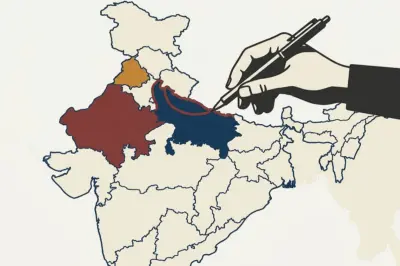

The party now blocking BJP's delimitation exercise drew India's last electoral map - and won its greatest modern mandate on it.
When Congress won 206 seats in 2009, up from 145 in 2004, it did something that Indian electoral history had rarely seen. A 61-seat jump for an incumbent government - a 42 per cent increase in its tally - had only two precedents.
In 1984, Congress went from 353 to 415 seats, a 62-seat jump, on the back of a sympathy wave following Indira Gandhi's assassination. It remains the largest mandate any single party has won in a Lok Sabha election.
In 1971, Indira Gandhi took Congress from 283 to 352 seats, a 69-seat jump, on the force of Garibi Hatao and a direct populist appeal that the party had not attempted before. Both surges had an identifiable trigger of extraordinary magnitude.
In 2009, no such trigger was visible. Every major exit poll agency had predicted a hung Parliament with a neck-and-neck battle between the Congress-led UPA and the BJP-led NDA.
It was only after the results that explanations arrived. MNREGA's rural reach, the 2008 nuclear deal, and Manmohan Singh's stable stewardship of a coalition government were cited. These were real but they were not sufficient to explain a victory of this scale. None of them, individually or together, constitutes the kind of singular mobilising force that delivered 1971 and 1984.
The missing variable was the map. In 2008, India completed its first full delimitation exercise since 1973, redrawing every parliamentary constituency in the country. The election that followed was the first fought on that new map.
Now, when the ruling BJP wanted to conduct a similar delimitation exercise, Congress helped defeat the Constitution (131st Amendment) Bill in the Lok Sabha, blocking the BJP's attempt to expand the House. The party that killed the bill is the same party that drew the last map and enjoyed its leverage at the ballot box the following year.
The Surge From States
In 2009, Congress won 20 seats in Rajasthan, while the BJP managed just four - a complete reversal from 2004, when Congress won four and the BJP won 21. This reversal cannot be read as the Rajasthan syndrome of alternating state governments expressing itself at the national level, because assembly results in Rajasthan do not reliably carry into Lok Sabha elections, even when the two polls fall months apart.
In the 2008 assembly elections, Congress did form the government, but the result was far from one-sided: Congress won 96 seats with 36.8 per cent of the vote, while the BJP won 78 with 34.3 per cent.
In 1998, too, Congress formed a government in Rajasthan with a landslide victory of 153 assembly seats. Yet in the 1999 Lok Sabha elections, the BJP resurged to win 16 seats against Congress's nine.
The 2018-to-2019 sequence was still more emphatic: Congress won the assembly with 99 seats, and the BJP-led NDA swept all 25 Lok Sabha seats the following year.
The 2009 Lok Sabha victories did not carry forward the momentum of the 2008 assembly election. They came from breaking into the BJP fortresses the party had held for a decade.
11 seats that the BJP won consecutively in 1999 and 2004 went to Congress because of boundary restructuring. Those 11 seats were Ajmer, Bharatpur, Bhilwara, Chittorgarh, Ganganagar, Jaipur, Jodhpur, Kota, Pali, Sikar and Tonk.
Ajmer Parliamentary Constituency (PC) was redrawn to include Pushkar and Nasirabad, which have a high concentration of Gurjar and Rawat voters. Combined with the Muslim-majority population in Ajmer North and Ajmer South, this created a demographic dividend for Congress's Sachin Pilot, who hails from the Gurjar community.
More directly, the assembly constituencies (AC) of Beawar and Bhinai, which gave the BJP 25,000-vote leads each in 2004, were removed from the Ajmer PC, while two ACs from the old Tonk PC, which gave the BJP thinner leads, were added. Pilot won with the two newly added ACs comprising over half his total margin.
Bharatpur PC, which had mostly sent members of the royal family to the Lok Sabha, was declared a Scheduled Caste (SC)-reserved seat in 2008, barring the three-time incumbent BJP MP Maharaja Vishwendra Singh from contesting.
The two ACs of Deeg and Kumher, which had given the BJP its highest leads in the seat, were merged into one. The ACs of Weir and Bayana from the old Bayana SC constituency, which had historically witnessed closer BJP-Congress contests, were added, tilting the arithmetic. Congress tapped its traditional SC voter base and won comfortably.
Bhilwara was redrawn to remove urban pockets and include rural segments more aligned with Congress, disrupting the local equations that had sustained the BJP's two-time Rajput MP. Congress's C P Joshi won.
The Chittorgarh PC shifted south-west, absorbing two ACs from old Udaipur and one from old Salumber. This benefited Girija Vyas, a former Congress MP who had won from Udaipur twice, while disadvantaging sitting BJP MP Shrichand Kriplani, whose base lay in Nimbahera on the seat's eastern side.
In Ganganagar, the redraw reduced the influence of urban Sikh and Baniya voters who had leaned toward the BJP, while prioritising rural Dalit and farmer-heavy segments. Congress's Bharat Ram Meghwal unseated the two-time incumbent.
Jaipur underwent the most visible transformation: Jaipur Rural was carved out as a separate PC and Jaipur itself became a purely urban seat, with city wards replacing its older mixed composition. The BJP had won the seat in the previous six elections; it lost it by a margin of just 16,000 votes, which the new boundaries made possible.
Jaipur Rural, assembled from segments like Phulera, Shahpura and Kotputli - Jat and Yadav-dominant areas - gave Congress's Lalchand Kataria, himself a Jat, a constituency shaped for his win.
Jodhpur PC absorbed more rural Thar territory, which favoured Congress's Rajput candidate Chandresh Kumari Katoch over incumbent BJP MP Jaswant Bishnoi. The Pali-adjacent segments where the BJP had been strong were stripped away, while high Muslim and Dalit turnout in the city segments completed the shift.
Kota was redrawn toward rural agrarian pockets, allowing Congress to deploy Ijyaraj Singh of the Kota royal family with a "Kisan" support base and the new boundaries delivered the outcome in favour of Congress.
Pali witnessed the most structurally revealing change. Three of its ACs, up from one, were declared SC-reserved. The two-time BJP MP Pusp Jain, a general-category candidate, lost by 1.96 lakh votes; 93,000 of that deficit came from the two SC-reserved constituencies alone.
The seat's character shifted further: Osian and Bhopalgarh, absorbed from old Jodhpur, made it a Jat-dominant seat rather than the Baniya-Rajput BJP bastion it had been, easing Congress's Badri Ram Jakhar, a Jat himself, to victory.
The old Tonk and Sawai Madhopur seats were abolished and merged into Tonk-Sawai Madhopur. Phulera, Dudu, Todaraisingh and Kekri - ACs that had given the BJP large leads - were removed. Most of the new PC came from the old Sawai Madhopur PC, which the BJP had lost in 2004.
The resulting constituency had a large combined Meena and Muslim population. Congress's Namo Narain Meena won by 317 votes over Kirori Singh Bainsla, the Gurjar agitation leader. In a more Gurjar-centric seat, Bainsla would almost certainly have prevailed.
In Uttar Pradesh (UP), Congress won 21 seats, a feat the party had not achieved since the 1984 wave, when it had won 83 of 85 seats in the then-undivided UP that included Uttarakhand. The scale of the collapse in between tells the story: 15 seats in 1989, five each in 1991 and 1996, zero in 1998, and 10 each in 1999 and 2004.
Of the 21 seats won in 2009, 10 were seats Congress had last won in the 1984 wave; three were newly created constituencies that had not existed before. The disruption that made this possible ran seat by seat through the changed delimitation map.
Akbarpur was the most dramatic single transformation. The BSP had won the seat consecutively since 1996; Mayawati had won it herself three times, in 1998, 1999 and 2004.
The 2008 delimitation revoked the seat's SC-reserved status, converting it to a general-category constituency, and reoriented it entirely around segments adjacent to Kanpur, where Congress had organisational strength.
Congress led in three of the newly added ACs - Bithoor, Maharajpur and Ghatampur - while the BSP could not adapt to a seat whose competitive logic had been dismantled.
The logic ran in reverse in the Bahraich PC. That seat, previously general, was reserved for SCs. Three ACs, where Congress had received only two to three thousand votes each in 2004, were removed; newly formed ACs of Balha, Mahasi and Matera were added in their place. BSP contested hard in three ACs and SP led in Bahraich town, but Congress maintained evenly distributed influence across all five ACs, which proved decisive.
Barabanki retained its SC-reserved status but became a more urban seat when Barabanki town was added as an AC. Sidhaur, Masauli and Nawabganj were removed. The urbanisation gave an outsider candidate, an IAS officer hailing from Haryana who had taken voluntary retirement to join politics, the foothold he needed to win a seat where established rural patronage networks had previously shut out Congress.
In Unnao, rapid-growth areas around Kanpur and Lucknow were added, generating a Congress margin of over 3 lakh votes, the highest in the state after Rae Bareli and Amethi, largely carried by the newly configured urban and middle-class segments.
Bareilly's urban weight increased. Congress had demonstrated strength in these areas through the 2004 AC-wise results. The addition of Meerganj AC helped Congress, while the removal of Kawar AC stripped the BJP of a segment it had used to hold the seat since 1989.
Sultanpur PC became more urban-centric, breaking the rural caste-blocks BSP and BJP had used to keep Congress out for 25 years. The restructuring consolidated Muslim votes in segments like Isauli and diluted BSP's Dalit base, tipping the seat.
In Domariaganj, Congress candidate Jagdambika Pal was already established in Shohratgarh AC. The redrawn boundaries of Bansi and Itwa shifted the demographic balance toward a Muslim and upper-caste combination, away from the Muslim-Dalit bloc BSP had relied on.
In Faizabad PC, Dariyabad, a Muslim-majority AC from the Kaiserganj side, was absorbed, and Milkipur AC was reserved for SCs. This diluted the religious polarisation that had historically benefited the BJP and disrupted SP-BSP's caste arithmetic simultaneously, clearing space for Congress.
In Farrukhabad, the three ACs that had given SP its maximum leads, Kamalganj, Bhongaon and Mohammadabad, were removed. SC status was added to Kaimganj, further eroding SP's voter base, and Congress won.
In Gonda, the BJP-favouring ACs of Katra Bazar and Colonelganj were removed. Mujehna, which had favoured SP, was also removed; its Muslim population was merged into Utraula. Two new ACs, Mehnaun and Gaura, were added, areas with no established patronage networks and no SP strongmen, and Congress won a seat that had rotated between SP and BJP for two decades.
The Kheri disruption illustrates how precisely the instrument could be applied. SP had held the seat for three consecutive terms through the influence of Ravi Prakash Verma, whose Kurmi vote-bank was the structural foundation of the wins.
The delimitation divided that base: part of Verma's loyal voters were moved into the newly carved Dhaurahra PC. Srinagar AC was given SC status, redirecting BSP's entire organisational focus toward a single AC while haemorrhaging votes elsewhere. The urban population of Lakhimpur town was made decisive, benefiting Congress's Zafar Ali Naqvi, a former Lakhimpur MLA.
BJP too faced disruption. Pankaj Chaudhary had won Maharajganj four consecutive times; the new boundaries increased the weightage of Brahmin, Muslim and Dalit voters in the electorate, pushing him to third place. The SP fortress of Lakshmipur AC was removed, and Congress's Harsh Vardhan, who had a prior MLA base in Pharenda AC, won.
In Moradabad PC, major portions of the old PC moved to new Sambhal, dissipating three-time SP MP Shafiqur Rahman Barq's established advantage; new ACs of Barhapur, Kanth and Thakurdwara, which leaned towards the BJP, created a multi-corner fight that benefited Congress.
The three new constituencies tell their own story. Dhaurahra witnessed a one-sided Congress victory; no other party had time to build organisation in a seat that had not previously existed. Shrawasti combined segments with high Brahmin and Muslim populations, suiting Congress's Brahmin candidate.
In Kushinagar, BSP gave a tough fight to the Congress but lost due to the inclusion of Congress-favouring Hata AC in the new PC. Congress's biggest lead came from Ramkola AC, which was declared SC reserved.
Delimitation effect on 2009 Lok Sabha elections.After Rajasthan and UP, the highest jump for Congress came from Punjab. The standard explanation, voter dissatisfaction with the ruling SAD-BJP alliance, does not hold up against the assembly election record.
After winning in 2007 with 67 seats, the SAD-BJP alliance increased its tally to 68 in 2012. The 2009 Lok Sabha election, falling between these two state victories, was an outlier that the alliance's continuing health in Punjab cannot explain. Congress won eight seats, up from two; the SAD-BJP alliance won five.
The SAD-BJP partnership had been built on a geographic division of labour: BJP held the urban Hindu constituencies and SAD held the rural Sikh belt. The 2008 delimitation disrupted this arrangement by creating seats with mixed urban-rural compositions where the division no longer held.
Anandpur Sahib was carved from the abolished Ropar (SC) and parts of old Hoshiarpur. Its inclusion of the rapidly growing urban segments of SAS Nagar (Mohali) and Kharar was decisive - those two ACs alone accounted for 50,000 of Congress's 67,000-vote margin, while SAD gave a competitive fight everywhere else. Removing the SC tag from Ropar and replacing it with an urban middle-class base made the seat winnable for Congress's Ravneet Singh Bittu.
Ludhiana was redrawn to shed its rural pockets in favour of urban concentration. Ludhiana Rural AC was abolished; city ACs increased from three (North, West and East) to five (North, West, East, South and Central). The Akali-leaning rural votes were redistributed into Fatehgarh Sahib, leaving Ludhiana dominated by the city itself. Congress's Manish Tewari won by over 1.1 lakh votes.
Punjab has the highest proportion of Dalits in India, close to 32 per cent as per the 2011 census, and a second set of Congress victories came from consolidating that vote.
Fatehgarh Sahib was created as a new SC seat by drawing SC-heavy segments from Ropar, Patiala and Ludhiana, concentrating the Ravidasia and Ramdasia Dalit communities, traditional Congress supporters, into a single constituency. Congress's Sukhdev Singh Libra won.
Hoshiarpur PC was converted from a general to an SC-reserved seat by removing several Rajput-heavy segments that had leaned BJP and adding Dalit-dominant rural blocks. Incumbent BJP MP Avinash Rai Khanna was barred from contesting; the BJP fielded a relatively unknown face, Som Parkash, while Congress's Santosh Chowdhary, a credible Dalit leader, won comfortably.
Gurdaspur had been a BJP stronghold, won consecutively in 1998, 1999 and 2004. The bastion fell in 2009, and the arithmetic is precise: the biggest Congress leads came from the newly added ACs of Batala and Qadian. Remove either of those two, and the BJP would have held Gurdaspur.
Sangrur, which Congress had last won in 1991, was the Panthic heartland, a rural, Jat Sikh-dominated seat where SAD or SAD (Mann) had been effectively unbeatable.
The 2008 redrawing removed Raikot, the most deeply rural pro-Akali segment, and added the municipal towns of Sangrur, Barnala and Sunam, diluting the hold of the Akalis.
Dirba was redrawn to reduce the Akali surge; Malerkotla was reconfigured to become the only Muslim-majority assembly segment in Punjab, concentrating minority votes where Congress could count on them. Congress ended an 18-year absence from the seat.
Jalandhar, long a Congress stronghold, was further consolidated by converting it to an SC-reserved PC and increasing the number of SC-reserved ACs within it from two to three. Sultanpur AC, which had traditionally favoured SAD, was removed. In Patiala - already Congress territory - the newly added Patiala Rural AC alone gave Congress a 30,000-vote lead, widening Preneet Kaur's margin.
The Surge From Reserved Seats
Reservation status was rotated to bar incumbents and clear the path for Congress candidates.The Congress tally on SC-reserved seats rose from 17 to 33, almost doubling; on Scheduled Tribe (ST)-reserved seats, from 14 to 21. This happened alongside an expansion in the total number of reserved seats nationally - SC seats increasing from 79 to 84, ST seats from 43 to 49 - and a systematic rotation of which constituencies carried reserved status.
In Andhra Pradesh (AP), Congress won nine of the 10 reserved seats as the redrawing consolidated Dalit and tribal populations into newly configured reserved blocks.
A new PC, Araku, was carved by clustering seven assembly segments from mountainous regions to create a new ST seat; Mahabubabad was re-established to consolidate tribal populations across the Warangal and Khammam regions. Both voted for Congress.
Warangal PC was converted from general to SC-reserved by incorporating mandals and villages with the highest Dalit concentrations; Congress won there by 1.25 lakh votes, the highest margin among SC-reserved seats in the state. The newly created Araku delivered Congress the highest ST-reserved margin in AP at 1.92 lakh votes.
In Rajasthan, Congress won three of four SC seats and two of three ST seats in 2009, having won no SC seat and only one ST seat in 2004.
Both newly created SC seats, Karauli-Dholpur and Bharatpur, went to Congress as the redrawn Dalit-heavy boundaries broke the local patronage networks BJP incumbents had built. In Ganganagar, the increased weightage of Dalit votes in the redrawn seat reinforced the Congress win.
Udaipur was declared an ST seat for the first time, barring incumbent BJP MP Kiran Maheshwari from contesting. The new map had seven tribal-heavy rural segments and only one urban segment, and Congress veteran Raghuveer Meena defeated the BJP's tribal candidate with ease.
Banswara, already an ST seat, was redrawn to concentrate the most Congress-loyal Bhil and Meena pockets into the new PC, producing a Congress sweep of the rural tribal belt.
In Maharashtra, Congress had not won a single SC-reserved seat in 2004. In 2009, it won three of five. Amravati, Latur and Ramtek were converted from general to SC-reserved; Congress won two of the three.
In Latur, the ACs of Omerga and Her, which had given BJP its leads, were removed, while Latur AC, where Congress held a large advantage, was split into two ACs, Rural and City, amplifying Congress's share.
Ramtek was redrawn as a semi-urban seat encircling Nagpur's periphery with a significant SC population, dismantling the rural Vidarbha hinterland that had sustained Shiv Sena.
Solapur was assembled from the city ACs of old Sholapur and the Mohol and Pandharpur ACs of old Pandharpur SC; Congress won by nearly 1 lakh votes, ending its absence from both predecessor constituencies.
Madhya Pradesh (MP) followed the same pattern. Congress had won no SC-reserved seat in 2004; in 2009, it won two of four, both of which it had last won in the 1984 wave. Old Shajapur SC was relocated and reconstituted as Dewas SC, with Congress leading in five of eight ACs. With a similar lead, Congress also won Ujjain SC.
Congress got 23 additional seats from the reserved category in 2009.On ST-reserved seats, Congress climbed from one to four in MP. It won Ratlam, a reconfiguration of old Jhabua, which Congress had held in 2004, and two seats it had not won since 1996.
In Shahdol, the delimitation increased the number of ST-reserved ACs within the constituency from four to seven, by removing three general segments and adding three from interior tribal pockets where Congress had traditional support.
In Mandla, reconfiguration helped Congress break the bastion of BJP MP Faggan Singh Kulaste, who had won this seat four times consecutively since 1996.
In Dhar, which had a long-standing demographic split between the Bhil and Bhilala tribal groups, the redrawing concentrated Bhil-dominated areas, historically more aligned with Congress, while moving pro-BJP pockets out. Congress won both.
Overall, Congress won 12 seats in MP, a feat not achieved since 1996; half those victories came from reserved seats.
The Urban Surge
In urban seats, the delimitation helped Congress neutralise opposition pockets by adding areas where its own base was stronger, and to consolidate that base in seats where it already led.
In 2009, Congress won all seven Lok Sabha seats of Delhi, up from six in 2004. In Mumbai, the UPA increased its seat count from five to all six. The new gains, South Delhi and Mumbai South Central, both underwent the most extensive restructuring in their respective cities.
South Delhi absorbed large slum clusters, including Sangam Vihar, which shifted the seat's electoral balance away from the BJP's middle-class base. Old ACs - Hauz Khas, Malviya Nagar, Tilak Nagar, Hari Nagar, Janakpuri and Kasturba Nagar, all favourable to BJP - were dispersed into New Delhi, East Delhi and West Delhi.
New ACs from the southern urban fringe - Bijwasan, Chhatarpur, Sangam Vihar and Badarpur - replaced them, along with two SC-reserved ACs, Deoli and Ambedkar Nagar. Those two SC seats alone accounted for nearly half of Congress's victory margin.
Three new Delhi constituencies were created from abolished or reorganised PCs.
West Delhi was assembled from Outer Delhi (Madipur SC, Najafgarh), South Delhi (Tilak Nagar, Rajouri Garden) and Delhi Sadar (Moti Nagar, Karampura), a mix of unauthorised colonies, slum clusters and middle-class localities that delivered Congress a win.
North-West Delhi was formed from Outer Delhi and Delhi Sadar, with three SC-reserved ACs, Bawana, Sultan Pur Majra and Mangol Puri, consolidating the Dalit vote in an SC-reserved seat where Congress was well-placed to benefit.
North-East Delhi was carved with two SC-reserved ACs, Seemapuri and Gokalpur, alongside areas with large Muslim populations: Seelam Pur, Mustafabad and Karawal Nagar. Congress won with a margin of 25.3 per cent with the support of minority and Dalit votes.
New Delhi was expanded to include the SC-reserved assembly segments of Karol Bagh and Patel Nagar. Middle-class residential areas were added to the seat's bureaucratic profile. Congress's Ajay Maken increased his victory margin from 6.3 per cent in 2004 to 24.5 per cent in 2009.
Old East Delhi, previously the most populous PC in Delhi, was made more compact; Sheila Dikshit's son Sandeep Dikshit leveraged his mother's development record in the reconfigured territory, increasing his margin from 19.3 per cent to 28.1 per cent.
Mumbai South Central had been a Shiv Sena seat since 1991. Its restructuring created a crescent running from the atomic energy township at Anushakti Nagar through the working-class eastern belt to Dharavi and Mahim, which traditionally favoured Congress.
It split Sena's Marathi heartland of Dadar and Parel between other constituencies. Congress's Eknath Gaikwad, a former MLA from the Dharavi SC AC, won on the strength of the reconfigured geography.
Mumbai South retained its 'elite' character but acquired the Worli and Shivadi ACs from old South Central, adding the textile mill worker belt; Milind Deora's victory margin rose from 3.7 per cent to 17.6 per cent.
In Mumbai North Central, the entire seat was rebuilt, absorbing Bandra from old North West and Vile Parle from old North West, mixing affluent western suburbs with Muslim-majority Bandra East and the Chandivali-Kurla industrial belt. Congress's Priya Dutt won with a margin 10 times that of 2004, from 2.6 per cent to 26.3 per cent, as her celebrity factor was well-suited to the new character of the seat.
The most striking peripheral restructuring involved old Thane, one of India's most populous constituencies at over 32 lakh voters, which was split into four seats: Thane, Palghar (ST), Kalyan and Bhiwandi. The Shiv Sena-BJP alliance had held Thane since the year the alliance was formed, 1989.
The new Thane stripped away Kalyan, Ambernath and Ulhasnagar - the inland industrial belt - retaining only the Thane municipal area and Mira Bhayandar. Nationalist Congress Party (NCP), Congress's ally, won the reconfigured seat.
Shiv Sena won only Kalyan among the four new constituencies carved from its stronghold. The Palghar seat was ST-reserved. Bahujan Vikas Aghadi won there.
Bhiwandi, which was a communally sensitive area and a BJP-Sena stronghold, went to Congress as the textile town's large Muslim weaving population and rural tribal pockets created a seat that the Sena-BJP axis was not structured to contest. Raj Thackeray's MNS compounded the damage by splitting the Hindutva vote across the region.
Reconfiguration helped Congress to win two of the four parts of the old PC.While the 2008 delimitation balanced many of the overpopulated constituencies - old Thane with over 32 lakh voters, old Outer Delhi with 33 lakh electors, old East Delhi with 26 lakh electors - it also drew many overpopulated urban constituencies in their place.
The Hyderabad-Secunderabad belt, previously three constituencies - Hyderabad, Secunderabad and Siddipet SC - became six: Medak, Malkajgiri, Secunderabad, Hyderabad, Chevella and Bhongir.
The aim was to reduce the concentration of voters in two of the most populated PCs in AP. Greater anomalies emerged instead. Malkajgiri became the highest-populated Lok Sabha constituency in the country at 37.8 lakh electors. Chevella, on the belt's southern arc, has 29.3 lakh voters, the second-highest in Telangana.
Hyderabad and Secunderabad saw only minimal increases. If we see the 2024 election results of these six constituencies, where the BJP won five, the effect, whether intended or not, has been to keep the Hyderabad PC confined to the old city belt where the Owaisi family has won continuously since 1984.
Bengaluru and its periphery, too, went from four constituencies (Bangalore North, Bangalore South, Chikballapur and Kanakapura) to six: Bangalore Rural, Bangalore North, Bangalore Central, Bangalore South, Chikkballapur and Kolar SC.
Bangalore Central was assembled from parts of old North and South; Bangalore Rural absorbed the old Kanakapura PC. Yet the problem of overpopulation was not resolved.
Earlier, Kanakapura and Bangalore North were the most populated Karnataka constituencies. The new PCs are still the most populated, Bangalore North with 32 lakh electors; Bangalore Rural with 28 lakh; Bangalore Central and South have 24 and 23 lakh electors respectively.
The constituency map bends Bangalore North unnecessarily southward despite its name and overcrowding, and gives Bangalore Rural some urban areas of South Bangalore and Rajarajeshwari Nagar that dilute its character.
Ghaziabad is another one of the most populated Lok Sabha constituencies with 29.5 lakh voters, the highest in UP. It was also created in 2009 by absorbing parts of the old Hapur PC and parts of the Meerut-Gautam Buddha Nagar belt.
The BJP has been winning here since 2009. It is possible that the BJP could have won additional seats if, instead of concentrating such a high population into one seat, a better balance had been maintained in the 2008 delimitation.
In effect, the delimitation did not solve the problems that earlier constituencies had. The biggest reason for this failure was that the 2008 delimitation exercise was not politically neutral.
The evidence across Rajasthan, Uttar Pradesh, Punjab, Andhra Pradesh, Maharashtra, Madhya Pradesh, Delhi and Mumbai is too consistent in its direction to be coincidental. In seat after seat, the same instruments were applied: SC reservations converted to break incumbents, AC compositions redrawn to dissolve established vote-banks, urban weights adjusted to advantage Congress's organisational strength in growing cities, new constituencies created in belts where Congress had nascent but unrealised support. The party that benefited, in most cases, was Congress.
This is not an argument that delimitation alone explains 2009. MNREGA was real. The national mood was real. The weakness of the BJP's campaign was real. But the 61-seat swing, the number that separates 2009 from a routine incumbent performance, required a structural foundation. The map provided it.
Congress drew a map that disrupted Mayawati's own constituency. It carved new seats in belts where it had no prior footprint and won them on the first attempt, because no opposing party had time to build organisation in a geography that had not previously existed.
It converted general seats to SC-reserved in states where its candidates were better placed to contest them, and converted SC seats to general where removing that barrier suited its purposes. It reconfigured Hyderabad so comprehensively that a Muslim family's unbroken electoral dominance of the old city was effectively codified into the constituency's design. It split a 32-lakh-voter Shiv Sena stronghold into four pieces and took two of them.
The same party now alleges that the BJP's proposed delimitation was an instrument of political manipulation cynical enough to warrant defeating a constitutional amendment.
That position is not without merit as an abstract principle. As a political stance, it strains credibility from a party that drew the last map, won 61 additional seats on it, and governed for a decade without revisiting it.
Congress defeated the 131st Amendment knowing, better than anyone, what delimitation can deliver. It knew because it had delivered it.