

Korea's cumulative FDI in Vietnam is 13 times its stock in India. Delhi's trade deficit with Korea has tripled. Two chaebols have extracted $4.7 billion in value in twelve months.
Issues like these and more explain why the fifteen-year-old CEPA Agreement is untenable and what Delhi is now negotiating towards.
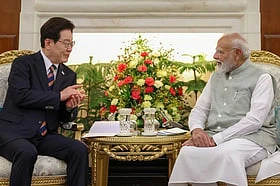
On the afternoon of 20 April 2026, a day before President Lee Jae-myung's aircraft touched down at Palam, the Ministry of External Affairs held its customary pre-visit briefing at South Block. The Secretary (East), P Kumaran, walked reporters through the agenda: agreements to be signed, MoUs to be initialled, the Joint Strategic Vision to be released. Midway through, he made an unusual disclosure.
"Bilateral trade is close to $27 billion," Kumaran said. "But it is quite unbalanced. Our exports are in the range of about $6.5 billion, while Korea's is about $18.5 billion. So there is a need to rebalance the CEPA."
The sentence was short, on-record, and deliberate. It was not a leak. It was the Indian government publicly naming an asymmetry that had gone diplomatically unspoken since the Comprehensive Economic Partnership Agreement between the two countries took effect in January 2010. That Delhi chose to put the numbers on the table before Lee landed, rather than after in the bland language of a joint communiqué, signals a shift. The imbalance is now a negotiating topic, not a footnote.
The figures behind Kumaran's statement are stark. India's trade deficit with South Korea has roughly tripled since CEPA came into force, rising from about $5 billion to $15.2 billion in the 2024-25 fiscal year. India exports less to Korea today than it did a decade ago, at $5.82 billion in FY25 (down from above $8 billion in FY22), while Korean shipments to India have climbed to $21 billion. Indian exports to Korea contracted at an 11 per cent compound annual rate between FY22 and FY24, according to Rubix Data Sciences. Korean imports grew 10 per cent a year over the same period.
Fifteen years of CEPA have tripled the gap the 2030 trade target will have to close.The $50 billion bilateral trade target Modi and Lee announced for 2030 is not new. Moon Jae-in and Modi set the same goal in 2019. What is new is Delhi's public acknowledgement that hitting that number without fixing the ratio would simply enlarge the gap.
The architecture of the imbalance becomes clearer when read through the balance sheets of the three Korean companies that dominate the bilateral flow: Samsung, Hyundai, and LG. Each has run a distinct strategy in India over the last five years, and the cumulative effect of the three explains why Delhi has now moved to reopen CEPA.
What Delhi is addressing: Samsung's royalty and tax architecture
Samsung is the single largest contributor to the bilateral flow. Samsung India Electronics reported FY25 revenue of Rs 1.11 trillion (about $13.3 billion), making it the only consumer-electronics firm in India to cross the trillion-rupee mark. In FY24, net profit doubled to Rs 8,188 crore (about $970 million) on revenue of Rs 99,541 crore. Mobile phones generated Rs 71,158 crore of that total; home appliances Rs 11,350 crore. Market share stands at around 18 per cent in smartphones, with leadership in premium segments.
The transfers back to Seoul are visible in the annual filings. Royalties paid by Samsung India to its South Korean parent rose 50 per cent to Rs 3,322 crore ($394 million) in FY24, a figure equivalent to roughly 40 per cent of net profit and climbing faster than either revenue or operating expenses.
The episodic flows are larger. Following Korea's 2023 corporate-tax reform exempting inbound foreign dividends, Samsung Electronics collected 29.1 trillion won (about $22 billion) in dividends from its overseas units in the first nine months of that year alone. The prior-year figure was roughly 165 billion won. Samsung India was among the largest tributaries. Korean companies collectively repatriated $38.2 billion in that nine-month window, against roughly $3 billion a year earlier.
The Noida plant, inaugurated in 2018 as "the world's largest mobile factory," remains central to Samsung's Indian presence. A substantial share of components - displays, memory, advanced processors, optics - is imported from Samsung's own network in Korea and Vietnam.
In March 2025, the Directorate of Revenue Intelligence issued a $601 million tax demand, alleging that Samsung misclassified Remote Radio Heads supplied to Reliance Jio's 4G network as duty-free components instead of transceivers carrying 10-20 per cent duty. The DRI said $784 million of imports escaped duty over three years. Samsung is contesting with four expert opinions arguing the classification was correct. The case is the largest customs action against a Korean company in recent memory, and its timing - coinciding with the CEPA review window - is not coincidental. Delhi is actively testing whether the existing agreement's classification rules have been used as intended.
What Delhi is addressing: Hyundai's repatriation sequence
Hyundai's strategy in India shifted decisively in 2024. On 22 October, Hyundai Motor India Ltd listed on the Bombay and National Stock Exchanges after raising Rs 27,870 crore (about $3.3 billion), the largest initial public offering in Indian history. Every rupee went to the Korean parent. The issue was a 100 per cent offer-for-sale by Hyundai Motor Company, which reduced its holding from 100 per cent to 82.5 per cent. Hyundai Motor India itself received no capital.
Weeks earlier, in March 2024, Hyundai India had declared a special dividend of Rs 10,782 crore to its then-sole shareholder - 7.2 times its total FY22 payout - draining its cash balance from Rs 17,741 crore to Rs 9,017 crore. The royalty rate on every car sold in India was simultaneously raised from a negotiated 2.25-2.5 per cent to a flat 3.5 per cent of revenue, with SEBI-sanctioned headroom up to 5 per cent without further shareholder consent.
The three moves, executed sequentially - special dividend, IPO offer-for-sale, royalty hike - converted Hyundai's Indian retained earnings into cash for the parent, monetised 17.5 per cent of the subsidiary at a 26x price-to-earnings multiple (against the Korean parent's roughly 5x), and locked in a permanently higher annual royalty flow.
Hyundai Motor India operates real plants. Sriperumbudur has 824,000-unit capacity. The newly acquired Talegaon facility began vehicle production on 1 October 2025 and will expand to 250,000 units by 2028. Local parts content near Chennai is around 93 per cent. But the orientation of the business remains clear: exports accounted for 163,386 units of FY25 production (21 per cent), with the remaining 79 per cent sold into the domestic market. Passenger-vehicle market share has slid from a 17 per cent peak in FY16-FY21 to 14 per cent in FY25, the lowest in 12 years, as Tata and Mahindra push into SUVs.
The related Kia case is consistent. In April 2024, Indian customs issued a notice alleging $155 million in duty evasion on Carnival MPV imports, claiming the company misclassified completely-knocked-down kits as discrete component shipments to avoid the 30 per cent duty applicable to CKDs. Kia has deposited Rs 278 crore "under protest."
Both the Samsung RRH and Kia Carnival cases share a structural feature: they concern the use of tariff classifications under CEPA in ways the Indian revenue authorities now dispute. That pattern, visible across multiple Korean companies in a short window, is among the reasons Delhi has concluded that the agreement's rules-of-origin and classification architecture requires revision.
What Delhi is addressing: LG's listing premium
LG Electronics India, listed on 14 October 2025, followed the Hyundai template with a more striking outcome. The Rs 11,607 crore (about $1.4 billion) IPO was again a 100 per cent offer-for-sale by LG Electronics Inc, which reduced its stake from 100 per cent to 85 per cent without injecting any capital into its Indian operations. The issue was subscribed 54 times over. Shares debuted at a 50.4 per cent premium. LG India's market capitalisation at listing was about $13 billion - 40 per cent above the $9 billion market cap of its Korean parent. By April 2026, the Indian subsidiary still traded at roughly $12.5 billion, on a price-to-earnings multiple near 54x, while LG Electronics Korea remained in single digits.
The subsidiary has become more valuable than the mothership.
The underlying business merits the enthusiasm. LG India commands 33.5 per cent of the offline washing-machine market, 29.9 per cent of refrigerators, 27.5 per cent of panel TVs, and 20.6 per cent of inverter air conditioners; it has led Indian appliances and consumer electronics for 13 consecutive years. FY25 revenue rose 14 per cent to Rs 24,367 crore; EBITDA margin expanded to 12.8 per cent, well above the Korean parent's single-digit global margin; return on equity averaged 36.5 per cent over three years. In Q1 2023 alone, LG Electronics Korea collected 391.6 billion won ($310 million) in dividends from its Indian subsidiary - roughly two-thirds of the parent's overseas dividend receipts that quarter.
LG has a genuine Indian manufacturing footprint: Noida, Ranjangaon near Pune, and a new Rs 5,001 crore plant at Sri City in Andhra Pradesh. It localises approximately 97-98 per cent of finished output. The forex picture is revealing, and is the detail Indian negotiators now cite: imports of Rs 9,323 crore against export earnings of Rs 1,451 crore in FY25 produced a net outflow of nearly Rs 7,872 crore on components and raw materials. Final assembly in India; value chain in Korea and its neighbours.
Each playbook is legal under CEPA. That is the problem CEPA 2.0 must address.The three balance sheets, read together, explain why the Kumaran briefing took the form it did. Hyundai and LG together monetised about $4.7 billion of Indian growth, entirely for the Korean parents, in twelve months - at the precise moment India's trade deficit with Korea was widening and CEPA talks were in their longest freeze since the original agreement took effect. Samsung's royalty tripled in the same window. The Indian government's position, implicit in Kumaran's sentence, is that the current agreement has produced outcomes its architects did not anticipate, and that the review cannot be deferred further.
CEPA talks were in their longest freeze exactly through the window that produced these three monetisations.The comparison Delhi is negotiating towards
The Vietnam and Indonesia cases are instructive because they show what the same three companies look like when a host government structures the terms differently.
South Korea's cumulative foreign direct investment in Vietnam reached approximately $92 billion across 10,137 projects by February 2025, making Korea Vietnam's single largest cumulative investor. Korea's cumulative FDI in India, by contrast, stands at $6.69 billion since April 2000 per DPIIT data, or about $10 billion on the more generous MEA definition dating to 1980. The Indian economy is ten times the size of Vietnam's. The Korean FDI stock in Vietnam is roughly 13 to 14 times the stock in India.
Ten times the economy, a fourteenth of the Korean capital. The gap is what Delhi, until this week, had declined to name.In Vietnam, Samsung runs six plants and one R&D centre, employs 90,000-100,000 people, and exports $54.4 billion annually - 13.4 per cent of Vietnam's entire goods exports. Samsung Display Vietnam received a fresh $1.2 billion capital-increase certificate in January 2025. More than half of Samsung's global smartphones roll out of Vietnamese factories. Vietnam runs a $31.6 billion trade deficit with Korea: a signature of manufacturing integration, because Korean subsidiaries import parents' components as inputs and add value locally before exporting onwards. The deficit looks identical to India's in structure; its composition is different.
Indonesia shows a different mechanism. Hyundai's $1.55 billion Cikarang plant, inaugurated in 2022, is Southeast Asia's largest full-scale Hyundai factory. It exists because Indonesia, the world's largest nickel reserve holder, banned nickel-ore exports in 2020, forcing Korean battery and EV firms to downstream into Indonesia or lose access to the mineral. LG Energy Solution and Hyundai then set up the $1.1 billion HLI Green Power battery cell joint venture in Karawang - Indonesia's first cell plant, operational in 2024. Jakarta offered market access. Seoul brought the supply chain.
The K9 Vajra defence programme is the same pattern in military hardware. Larsen & Toubro manufactures the tracked self-propelled howitzer under licence from Hanwha Aerospace. The first batch of 100 guns was contracted in 2017 for Rs 4,500 crore; a second batch of 100 was ordered in December 2024 for Rs 7,628 crore under the "Buy (Indian)" category, mandating 60 per cent local content.
Three months later, Hanwha Aerospace announced a separate 371 billion won ($253 million) contract with L&T to supply component kits for those 100 howitzers. The subsystems that remain foreign in origin - the 1,000 horsepower MTU MT 881 engine (licence-built in Korea by STX), the Allison X1100-5A3 transmission (licence-built in Korea), the 155mm/52-calibre main gun, the fire-control suite, speciality armour steel - sit at the value-dense centre of the platform. India builds the hull and integrates the system.
A proposed third batch of 200 units at roughly $1.2 billion is under consideration, and Delhi's declared target for that contract is deeper technology transfer, not higher volumes.
What Delhi is asking for
The Modi-Lee declaration announced a 12th round of CEPA upgrade negotiations in May 2026 and a target to conclude CEPA 2.0 in the first half of 2027. Four negotiating vectors have emerged from Indian readouts and ministerial briefings.
The first is services and professional mobility. Indian IT exports to Korea sit at roughly $200 million, against India's $200 billion global services line. The existing CEPA permits only 163 categories of Indian professionals; Korea's KC-mark regime duplicates international testing inside Korean laboratories. Delhi is seeking binding services-sector commitments, visa quotas for Indian engineers in Korean AI and semiconductor projects, and mutual recognition of qualifications.
The second is pharmaceuticals. Indian pharma exports to Korea were $167 million in FY23 despite India being the generic-drug producer for most of the Commonwealth. Korea's 2012 "same-price-as-original" rule strips imported generics of price competitiveness; its Health Insurance Review and Assessment Service favours domestic producers; KMFDS inspections duplicate India's CDSCO certifications. A bilateral regulatory-recognition protocol is on Delhi's list.
The third is conditional market access. The Indonesian precedent demonstrates that access to a large domestic consumer base, tied to rising local-content thresholds for battery cells, displays, chips, and components, can compel integration. Indian negotiators are understood to be seeking 50 per cent local value-addition by year five and 70 per cent by year ten as a condition of incentive eligibility, along with commitments on group R&D centres with Indian engineering headcount and joint IP on technologies developed locally.
The fourth is reciprocal sourcing. For every $1 billion of Korean defence, shipbuilding, or steel contract India awards - the K9 Vajra third tranche, the Hanwha Ocean and HD Hyundai Heavy Industries shipyard joint ventures, the $7.29 billion POSCO-JSW steel plant signed during Lee's visit - Delhi is pushing for equivalent procurement commitments in Indian services, pharma, and components.
The negotiating context favours Delhi more than it has in any previous CEPA round. Korea's population is contracting: total fertility rate 0.72 in 2024, the world's lowest. Its dependence on Chinese demand has fallen from 26.8 per cent of exports in 2018 to under 20 per cent, and Seoul has formally adopted a "3050 Strategy" to cut critical-mineral reliance on any single country to under 50 per cent by 2030, currently around 80 per cent on China. Its semiconductor and AI sectors face chronic engineering-talent shortages. Its shipyards are fully booked to 2028. India is the market, the talent pool, the critical-mineral prospect, and the geopolitical diversification Seoul needs.
The Korean read
The Korean side acknowledges the asymmetry. Korean National Security Adviser Wi Sung-lac, briefing Seoul media during the visit, noted that the two leaders "assessed that although bilateral relations have developed considerably over the past decade, they have still not lived up to their full potential for cooperation." The diplomatic code is unmistakable. The existing relationship has delivered for Korean industry more than it has for India.
The 25 outcomes of Lee's 21 April visit - from the Industrial Cooperation Committee to the Digital Bridge, from the Hyundai-TVS three-wheeler EV joint venture to the POSCO-JSW steel plant to Korea joining the Indo-Pacific Oceans Initiative - create more surface area for rebalancing than the relationship has had since CEPA itself.
What the next fifteen months will test is whether Delhi can convert the Kumaran sentence into CEPA 2.0 text. The chaebol playbook in India over the past five years is legible: Samsung's royalty-and-dividend model, Hyundai's IPO-and-special-dividend model, LG's listing-premium model. All three have operated within the existing agreement's architecture.
The question the review must answer is whether the architecture that produced those outcomes is what India wants to live with through 2030 and beyond - or whether the terms under which Korean companies access the Indian market, and the terms under which Indian companies, services, and professionals access Korea, should be reset to produce a different ratio.
That is the work now underway. The briefing on 20 April was its first sentence in public.