





Venkatesh's book takes us closer to the real issues why our constitution has not delivered on its promises, for these were not based on our own needs.
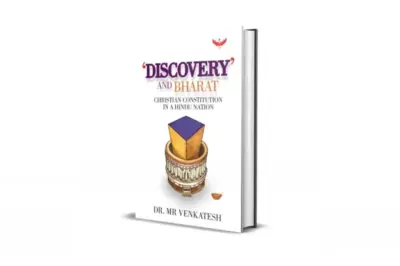
Discovery and Bharat: Christian constitution in a Hindu Nation. Dr MR Ventatesh. Garuda Prakashan. Rs 1,499.
India's constitution has been so much written about that one wonders whether another book will have something new to say. But that would be a mistake, for MR Venkatesh, a chartered accountant and Dharmic public intellectual to boot, asks a simple question: what is really Indian about the Indian constitution? How many ideas does it borrow from the Christian experience? And does it have anything from the Indian civilisational context?
The answer comes right from the book's title: Discovery and Bharat: Christian Constitution in a Hindu Nation.
That the constitution is a legacy from our colonial past is something many others also concede. Arghya Sengupta of the Vidhi Centre for Legal Policy says it in the title of his book, The Colonial Constitution.
But Sengupta does not argue his point from the Bharatiya viewpoint. It's all about freedom and rights, which he says effectively perpetuated the British era laws in the post-independence era. He points out that a third of the constitution produced by the constituent assembly came directly from the Government of India Act, 1935, which was criticised as an instrument of "slavery".
But slavishness does not come only from those parts of the constitution that were borrowed from the colonial era. It comes from minds that are yet to fully shed their colonial legacies. It comes from the fact that 299 members in the constitution assembly spent nearly three years to produce a draft constitution that could borrow from the British, American, German, Irish, Canadian and Australian constitutions, but almost nothing from the Indian civilisational experience or Dharmic sources.
If OpenAI's ChatGPT had been around in the late 1940s when the constitution was drafted, and asked to source the best ideas from Christian constitutions worldwide, it could easily have come up with the Indian constitution in a few minutes. Most ideas built into our constitution came from Christian countries.
Which explains why Venkatesh's book is titled Discovery and Bharat. The Discovery part is obviously a reference to Jawaharlal Nehru's book Discovery of India, a seminal work that largely views India and Indian history through a western lens. Venkatesh brings out Nehru's schizophrenic approach to India in his very first chapter when he quotes from Nehru's 'Tryst with Destiny' speech, where he referred to the "soul of the nation, long suppressed" finding utterance.
Unfortunately, Nehru did not want to discover anything about the soul he spoke about so eloquently. The author believes that our constitution does not represent the soul of the nation, which implies continuity in our civilisational progress, but that of inventing a new nation on 15 August 1947 based on Nehru's disdain for most things in India's past.
Rather, the soul mentioned by Nehru in his Tryst with Destiny speech may have been drawn from another western idea, Plato's The Republic. Plato's soul may not be anything like the Indian equivalent of "Atma", which is an existential idea that includes a manifestation of divinity in each individual.
The author quotes Theodore Shay, an American Jew who wrote a book on the legacy of Lokmanya Tilak as far back as in the 1950s, to emphasise that "The constitution of the Indian republic, the legal basis of the state, is a remarkable document in that it is entirely unIndian in its forms and inspiration. The forms of order, the institutions and laws, the machinery of the government and the repositories of power are almost entirely western in origin, being largely inherited from the British raj."
Of course, during a period of transition from the colonial to the post-colonial period, one does have to use the existing laws and institutions to prevent anarchy, but did the constituent assembly have to so completely abandon its core job of seeking what is truly worthwhile in Indian ideas even while Indianising the ideas that may be borrowed from the Christian west?
As an interim constitution, the final draft may have had some validity, but it clearly does not represent the soul of India. The final draft, which was adopted in November 1949, is not one that Sir Benegal Narsing Rau, who served as constitutional advisor to the constituent assembly, would have seen as substantially different from his own first draft based on the Government of India Act, 1935.
The inescapable conclusion is that we have a constitution rooted in colonial ideas, in part because the moving spirits behind them were too besotted with western ideas of progress to think Indian values had any real merit. The Indian voices, even the ones with strong rootedness in our civilisational values, could not make their impact felt.
This review of Ventakesh' book does not pretend to do full justice to the magisterial work he has produced. It is merely to give the reader a glimpse of what it is about. But a quick look at the titling of some of the chapters will tell you how deeply he has researched the constitution, its writers, and their predilections which landed us with a phony statute that says more about our colonised intellects than us and our history.
Ram Rajya was Gandhiji's inspiration, but what we got was Rome Rajya (chapter 2). Chapters 3 and 4 explain the origins of the constitution, which was substantially borrowed from the Government of India Act and other constitutions (Drafting the Already Drafted, and Cut, Copy, Paste).
In a simple table, the book pastes words from the Government of India Act, 1935, and the Indian constitution, to show how they do not differ on key structures. Chapters 5 and 6 show where India's constitution is heavily built on a Christian values base, with the latter chapter titled 'Catholic collectivism and protestant individualism'.
Chapter 7 points to the vacuous nature of our "secularism", a word which was not there in the original preamble to the constitution but inserted during the emergency, and that too without any attempt to define it. It thus got reduced to a word that can be weaponised against anyone the state does not like, mostly Hindus.
The word originated in Europe when the church and state were in conflict and finally decided to give each other sovereignty in their respective spaces - the religious and the temporal.
In Islam, there is no separation, and among Hindus, the purusharthas talk of men balancing Dharma, Artha, Kama and Moksha, with Dharma being given pre-eminence when it is under threat. Where does secularism come in is difficult to understand, but we have now become so attached to the word that we don't even know how we got into this void.
Chapter 8 develops the theme of a constitution devoid of any civilisational connection. Chapter 9, on Safeguards, Concessions and Tradeoffs tells us how protections extended to minority faiths are effectively denied to the Hindus.
Chapter 10 is an invitation by the author to Revisit, Rethink and Rewrite the constitution based on a civilisational understanding of our people and their needs. He admits that Indians in general prefer piecemeal change rather than a fundamental relook at something that is colonial and Christian in its foundational essence.
It is interesting that during the Emergency, Indira Gandhi could consider a total review of the constitution and make changes to many chapters, including the Preamble, but in today's politics many parties wave the constitution and pretend to be its guardians, when the only things we need to guard against is its own redundancy.
Even the Prime Minister thinks of the constitution as a holy book, when Thomsas Jefferson, as the author quotes him, believed that constitutions should be rewritten for every generation.
India's constitution needs a complete overhaul, an approach based on our history, our genius, our civilisational ethos, not ideas borrowed from the Christian west. Venkatesh's book takes us closer to the real issues why our constitution has not delivered on its promises, for these were not based on our own needs. It was a synthetic idea to begin with, and over the last decades has only gathered more moss.
If one were to not mince words, the constitution was another wound inflicted on the soul of Bharat. We need a profound healing.
About the book
Discovery and Bharat: Christian constitution in a Hindu Nation, by Dr MR Ventatesh, Garuda Prakashan, price Rs 1,499. The book is ready for pre-order.