





The Anaimangalam plates were engraved by Tamils who called their king a descendant of Sibi and Rama, and wrote in Sanskrit and Tamil side by side.
The Dravidian movement's separatist story has held power not because Tamils believe it but because the machinery of patronage rewards its repetition - and the plates make that story harder to keep telling.
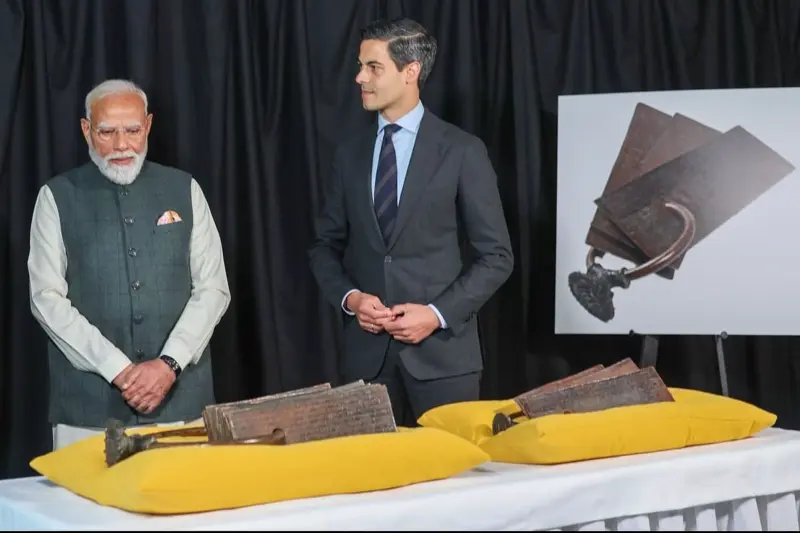
On 16 May 2026, in The Hague, the Dutch government formally returned to India a bundle of twenty-one copper plates, threaded on a heavy bronze ring stamped with the tiger-fish-bow seal of the Cholas. The object weighs about thirty kilograms.
It is, in effect, the world's heaviest book. Engraved in the opening years of the eleventh century during the reign of Rajaraja Chola I and completed under his son Rajendra, the Anaimangalam Tamra Sasanam - the so-called Larger Leiden Plates - had left the Coromandel coast around 1700.
The plates were carried to the Netherlands in 1712 by a pastor, sat in private hands for 150 years, and were gifted to Leiden University in 1862. The exact circumstances under which the pastor acquired the Chola Plates are uncertain. They were likely stolen.
The Anaimangalam Tamra Sasanam was engraved at the Chola court in the early eleventh century, lay buried near Nagapattinam for some six hundred years, and spent the next three centuries in the Netherlands. It returned to India in May 2026.The news has been reported as cultural diplomacy: a line in a joint statement, a photo opportunity, an item in a long list of repatriations that the Modi government has accelerated since 2014.
That framing misses what is unusual about this particular return. Most repatriated antiquities are objects - a Nataraja, an Annapurna, a fragment of a doorway. The Anaimangalam plates are text. They are the Cholas talking. And what they say, in 343 lines of Sanskrit verse and Tamil prose, complicates a story Tamil Nadu has been told about itself for the better part of a century.
That story, in its purest form, runs as follows. There was once a Dravidian civilisation, indigenous to the southern peninsula, with its own languages, its own religion, its own forms of social organisation. Then came the Aryans from the North, bringing Sanskrit, Brahmanism and caste. Tamil culture, the oldest stratum of this civilisation, survived in the south as a distinct and continuous tradition. The Sanskritic overlay was a later imposition; whatever fragments of it now exist in Tamil society are accretions or contaminations to be peeled back.
The political logic that follows from this account is the one E.V. Ramasamy taught the Justice Party in the 1920s and the DMK has spoken in ever since: Tamils are not Hindus in the North Indian sense, Hindi is a colonial language imposed from Delhi, Sanatana Dharma is alien to the Tamil soil, and the project of Tamil self-respect requires the eradication of the Brahmanical, Sanskritic, pan-Indic frame that has been laid over a more authentic Dravidian past.
Udhayanidhi Stalin, until very recently a Tamil Nadu cabinet minister and now leader of the opposition in the assembly after his father's electoral defeat earlier this month, gave the most public expression of this view in September 2023 when he compared Sanatana Dharma to dengue, malaria and coronavirus - things, he said, that we cannot merely oppose, we have to eradicate.
The remark drew criminal complaints and a censure from the Supreme Court. In May 2026, speaking on the floor of the Tamil Nadu assembly, he reiterated it: Sanathanam, that which separates people, must be eradicated.
The Anaimangalam plates were engraved by Tamils more than a thousand years before Udhayanidhi spoke. They were engraved by the bureaucrats and court poets of the most powerful Tamil empire that ever existed. And what they say about themselves is the opposite of what the modern Dravidianist account requires them to have believed.
The plates open in Sanskrit. The first five sheets, 111 lines of high-classical Grantha script, lay out the genealogy of the house of the Cholas. The line is drawn from Surya, the Sun, through Manu - described, in a phrase the inscription itself uses, as the first of kings - through Ikshvaku, Vikukshi, Kakutstha, Mandhatri, the demon-slayer Muchukunda. It reaches Sibi Cakravarti, the king who, in the Mahabharata's Vana Parva, and in the Buddhist Sivi Jataka, cut the flesh from his own thigh to save a dove from a hawk.
K.V. Subrahmanya Aiyer, re-editing the inscription for Epigraphia Indica in 1933, rendered the relevant verse:
the jewel of that prosperous family was king Sibi, the son of Usinara, who, out of compassion in protecting the pigeon which was threatened to be killed by a falcon, gave up attachment for his own body.
The Cholas built their identity around this story. They called themselves Chembiyan, the Tamilised form of Sibi's name. Karikala, Kochengannan and Rajaraja I all bore the title.
The lineage in the plates then runs through Bharata - son of Dushyanta and Shakuntala, eponymous ancestor of the subcontinent the Indian constitution would much later call Bharat - to a mythical king Chola, before reaching the historical revival under Vijayalaya in the ninth century.
The Tiruvalangadu plates of Rajendra, a sister inscription issued shortly after Anaimangalam, push the imagery further still: Rajaraja's general crossing to Sri Lanka is said to have surpassed Rama, who once needed an army of monkeys to build a bridge.
This is not eccentricity. It is the dynastic norm of every great house of the medieval Tamil and Deccan south. The Pallavas of Kanchipuram, on the evidence of the Vayalur, Kasakudi and Velurpalaiyam plates, traced themselves from Brahma through Bharadvaja, Drona and Ashvatthama.
The Pandyas of Madurai, in the bilingual Velvikudi grant and in the Sinnamanur plates, claimed Lunar descent from Pururavas and Nahusha, named Agastya as hereditary priest, and recorded that one of their kings had once compelled Ravana to seek peace.
The Cheras claimed in the Sangam Patirruppattu to have fed both armies at Kurukshetra. Travancore's later rulers traced themselves to Parashurama.
The Vijayanagara emperors, and the Hoysalas before them, claimed Yadava descent from Krishna. Not one of these dynasties claimed an indigenously Dravidian, racially distinct, or non-Puranic origin. Every one of them inserted itself into the same pan-Indic mythological grammar.
Every major dynasty of the medieval Tamil and Deccan south traced its ancestry into Puranic and Itihasic lineage, in its own royal inscriptions. Not one claimed an indigenously Dravidian or non-Puranic origin.After 111 lines of this Sanskrit genealogy, the Anaimangalam plates switch language. The remaining sixteen sheets carry 232 lines of Tamil, recording the actual business of the grant: the village of Anaimangalam, near Nagapattinam, with its revenues and boundaries, transferred to the Cudamani Vihara, the Buddhist monastery on the coast.
The bilingualism is not a concession; it is the design. Sanskrit handled the cosmos, the ancestry, the boast. Tamil handled the field, the boundary stone, the tax. They sat on the same sheets of metal. They were spoken in the same court. They were written by the same hands. The American Sanskritist Sheldon Pollock has called this arrangement the Sanskrit Cosmopolis: a millennium-long zone, stretching from Afghanistan to Java, in which Sanskrit served as the prestige idiom of royal self-fashioning while local vernaculars handled the documentary business of governance. The Anaimangalam plates are a paradigmatic specimen.
The Chicago Sanskritist Whitney Cox has shown, in Politics, Kingship, and Poetry in Medieval South India, how deeply intertwined Tamil and Sanskrit literary cultures were at the Chola court. The Tamil of the Cholas - the language of their court poets and the inscriptions etched into the temples of Thanjavur - belonged to a people who were also fluent inheritors of the Sanskrit cosmopolis, and saw no contradiction in that inheritance.
The monastery being endowed is the third thing the plates say. The Cudamani Vihara was not a Chola foundation. It had been built at Nagapattinam by Cudamanivarman, the Sailendra king of Srivijaya - modern-day Sumatra - and completed by his son Sri Mara Vijayottungavarman.
A Saiva Hindu emperor of the Kaveri delta was endowing the revenues of a Tamil village to a Buddhist monastery built by a Sumatran prince on Indian soil.
The German historian Hermann Kulke, in Nagapattinam to Suvarnadwipa, has called this kind of arrangement Srivijaya's ritual policy: foreign kings winning legitimacy by building temples on the soil of their trading partners.
Less than two decades later, in 1025, Rajendra Chola sent a navy across the Bay of Bengal and sacked Srivijaya itself. Yet the Smaller Leiden Plates of Kulottunga I, dated to around 1090, show that Chola patronage of the Nagapattinam vihara continued for a century after the raid.
The Tamil country of the eleventh century was neither isolated nor parochial. It was a metropole in a maritime system whose other nodes were in Sumatra, in Song China, in Sri Lanka, in the Maldives. The Cholas were imperial.
A Saiva Hindu emperor of the Kaveri delta endowed the revenues of a Tamil village to a Buddhist monastery built at Nagapattinam by Cudamanivarman, the Sailendra king of Srivijaya. Less than two decades later, Rajendra Chola sacked Srivijaya itself - yet Chola patronage of the vihara continued.This is the document the Dravidian movement now has to confront. Not a colonial-era hypothesis. Not a Sanskrit text composed elsewhere and exported into Tamil country. Not a North Indian polemic dressed up as scholarship. A bilingual royal charter, engraved in metal by the Cholas themselves, in which a Tamil emperor calls himself a descendant of a North Indian solar king, writes about himself in two languages on the same sheet, and endows a Sumatran prince's Buddhist monastery on the Coromandel coast.
The interesting thing about the Dravidian story is that Tamil society itself has never fully believed it. The Kamba Ramayanam, the great twelfth-century Tamil reworking of Valmiki's epic, is read and recited in Tamil homes. Srirangam draws Tamil pilgrims in their millions; so do Madurai, Rameswaram, Palani, Thiruvannamalai, Chidambaram. Tamil children are named Rajendra and Lakshmi and Krishna and Sita. The Aadi and Margazhi festivals remain the rhythm of the Tamil year. Carnatic music is built on Sanskrit and Tamil compositions sung in the same concert. The Alvars and Nayanars, the Bhakti poets of the Tamil country, sang of Vishnu and Shiva - the same Vishnu and Shiva worshipped at Badrinath and Kashi - and the philosophy they helped seed, through Ramanuja and Madhva, travelled north and reshaped the religious life of the entire subcontinent.
The Dravidian movement's separatist claim has never matched the actual texture of Tamil cultural life, and the reason it has nevertheless held political power for half a century is not that Tamils believe it. It is that a particular machinery - film-industry patronage, party-controlled local administration, language politics that converts every Hindi signboard into an existential threat, a school curriculum that has been rewritten in a particular ideological key, and an electoral arithmetic in which the cost of dissent inside the dominant parties is high - rewards its repetition. The story persists because the machine that tells it is well-built, not because the audience is convinced.
The Anaimangalam plates do not abolish that machine. But they make its central claim harder to keep telling with a straight face.
When a Tamil emperor of the eleventh century, in a document engraved by Tamils for Tamils, in two languages on the same sheets of copper, calls himself a descendant of Sibi and Rama; when his charter funds a Buddhist monastery built by a Sumatran king; when his court conducts itself simultaneously in Sanskrit and Tamil without anybody at the time finding the combination strange - the proposition that Tamil civilisation was always sealed off from the wider Indic world, and that everything Sanskritic or pan-Indic in Tamil life is a later contamination to be eradicated, becomes very difficult to sustain.
That is what the voice from Leiden is saying, after three centuries away and a thousand years of silence. It is saying that the Cholas knew who they were. They were Tamils. They were emperors. They wrote in two languages. They traced their line to a king who saved a dove. They funded a Sumatran prince's monastery on their own coast. They were part of a wider Indic world, and they said so themselves, in metal, in their own voice, where nobody can edit them. The plates are home. The voice is back. Let us hear what it says.