





India cannot afford to gut conventional air power and blindly chase drones and missiles by copying the wars in Ukraine and Iran.
The conflicts in Ukraine and Iran have put forth several strategic and operational lessons that merit serious study.
At the apex grand strategic level, both Russia and the US at the commencement of the respective conflicts made the cardinal error of expecting several maximalist outcomes, the principal one being the speedy collapse of the adversary regime.
After their inability to orchestrate a regime collapse through military means, both Russia and the US have attempted to achieve differing secondary outcomes through distinctly different military means that reflect their vastly divergent strategic DNAs.
Demonstrating a singular disdain for human life and a willingness to accept heavy battlefield attrition, the Russians have now doubled-down on the capture and retention of large portions of Eastern Ukraine comprising the regions of Luhansk and Donetsk.
Having thwarted Russia's early attempts at capturing Kiev in February 2022, Ukraine's strategic objectives have been relatively straightforward - survival of the Volodymyr Zelenskyy government and preservation to the extent possible of Ukraine's sovereignty and territorial integrity in what has been for the last four years an existential battle for survival for the Ukrainian polity at large.
In a lop-sided strategic match up, Russia, the larger power, has thus far demonstrated strategic over-reach, precipitated to some extent by the failure of the West to honour geo-strategic promises made to the former after the collapse of the Soviet Union that would restrict the expansion of the North Atlantic Treaty Organisation (NATO) eastwards into a region that the Russians have always considered their sphere of influence.
Ukraine's strategic resistance to Russian military might rests on the twin pillars of Western support and the resilient and innovative spirit of the Ukrainian people, both of which have withstood everything that the Russians have thrown at them, ranging from military and cyber-attacks to diplomatic and social coercion.
Both Russia and Ukraine have demonstrated strategic stamina and resilience and it is unclear what the impact of the Iran-US war on the Russia-Ukraine war will be, though there is an emerging consensus that Russia will emerge stronger.
Some questions to ponder over are - Will a fatigued West and a disinterested US draw down on its military support for Ukraine, or will there be a renewed European commitment to Ukraine as part of a larger European strategy to counter Russian hegemony?
The answers to these questions and many more lie in the head of Vladimir Putin and whether he wants to go down in history as a pragmatic statesman or will he continue on a path of hegemonic brinkmanship. In all fairness, it is too early to call his hand.
From an initial maximalist strategic objective of effecting a regime change in Iran to dismantling Iran's nuclear, missile and broader military capability so that the Iranian regime's existential threat to Israel and continued hostility towards the US diminishes, the US-Israel coalition's changing strategic and operational goal posts have made it very difficult to realise the political objectives of war.
From an Iranian perspective, its strategic objectives at the beginning of the conflict were simpler - ensure regime survival at all cost even if it meant 'fighting to the end' and inflicting incalculable misery on its own people.
However, as the war dragged on and Iran survived the coalition's military onslaught against heavy odds, Iran's strategic horizon has moved from regime survival to regional brinkmanship and hard-ball negotiations after it managed to identify and exploit two regional vulnerabilities that resulted in a disproportionate impact across the globe.
The first strategic move that took everyone by surprise was the sustained Iranian attack on Gulf Cooperation Council (GCC) countries such as the United Arab Emirates, Oman and Saudi Arabia, a move that few expected so early in the conflict. The Iranians followed this with applying coercive pressure on transit through the Straits of Hormuz. Both moves sent global oil prices skyrocketing and resulted in the US making several exploratory off-ramp moves that have not yet resulted in any kind of conflict termination beyond a tenuous no-war-no-peace situation prevailing with interludes of escalation and de-escalation.
At the strategic level, there will be no winners in this bloody slugfest in the Middle East. The cost of the war for the US will be disproportionally high considering that it was a war of choice and not one of compulsion. The economic costs imposed on its people could have unintended political consequences given that mid-term polls are due later this year.
There is likely to be a diminishing of US global hegemony and influence post the Iran conflict. Cracks may appear in existing strategic relationships, and there is certain to be a concurrent rise in the global influence of its principal adversaries, China and Russia.
Notwithstanding the grudging admiration worldwide for Iran's resilience in what has literally been a David vs Goliath strategic match up, there is little doubt that Iran will emerge from the conflict considerably bloodied, weakened and alienated, particularly in its neighbourhood where the Islamic regime had thus far managed to carve out an uneasy 'live and let live' relationship with its GCC neighbours. That will no longer be the new normal as the GCC mulls over a new security architecture minus the US to address the military threat from Iran.
Iran's brinkmanship over the Straits of Hormuz cannot last for long and even neutrals such as India, France and other middle powers will start pushing back if their energy interests continue to be threatened.
In the past, Iran's clandestine relationship with Russia, China and North Korea flowered under an ambiguous umbrella of nuclear deterrence that allowed it to repeatedly act as an irrational player and build critical asymmetric capability in the form of proxies, missiles and drones in a severely sanctioned geo-economic environment. That road may now be closed as the US and Israel have crossed the threshold of retaliation and will not allow Iran the flexibility of purpose it enjoyed in the past, particularly in the nuclear and missile domain.
The neutralisation of Iran's existing proxies by Israel with or without the help of the US and the other affected Gulf states will continue for the foreseeable future, though the ravages of the conflicts in Gaza and Lebanon will facilitate the emergence of the next generation of proxies should Iran continue seeing itself as the leader of an 'Axis of Resistance' against western hegemony.
Operational Landscape
Conflicts in the 21st Century have confounded military scholars and strategists across the world for several reasons. Great powers are struggling to accept that notions of victory and defeat are outdated and in their place, it is modest outcomes that will likely lead to conflict termination at best.
Consequently, military commanders in democracies have always struggled to put together viable military strategies in the face of constantly changing political and strategic goal posts. In comparison, military commanders in authoritarian regimes have greater clarity as military objectives rarely extend beyond regime survival or hegemonic expansion.
The wars in Ukraine and the Middle East offer vastly differing operational landscapes that reflect the realities of 'Full Spectrum Conflict,' the rapidly changing character of war and the democratisation of technology at all levels of conflict, all of which create a level playing field for both the weak and the strong.
Russia-Ukraine Conflict
In the Russia-Ukraine conflict, a distinctly more powerful Russia has had to pay a serious price for its initial operational overconfidence and constabulary approach to the linear advance on Kiev in February 2022, the absence of a coherent combined arms strategy, and the complete lack of doctrinal clarity on the use of offensive air power to support its initial war objectives of toppling the regime in Kiev.
Making matters worse for the Russians was the absence of a coherent Plan B that went beyond massing poorly trained troops across a battle front they had not rehearsed for.
Four years down the road, despite the realignment of its military strategy to rely more on drones and missiles as a means of exhausting the enemy, Russia remains stuck in a war of attrition with Ukraine across geographical frontlines that now seem frozen unless the Russians come up with a fresh operational strategy based on manoeuvre.
Given the attrition suffered and exhaustion levels of Russian troops on the ground, the Russian military may be satisfied with the status quo on the ground given that it has captured sizeable portions of Ukrainian territory, unless Vladimir Putin decides that he wants more. Of great interest to military planners in India will be the absence of decisive pay-offs thus far for the Russians after their operational shift to a drone and missile heavy strategy from 2023 onwards and a continued reluctance to commit their air force in a big way.
Ukraine's operational strategy has been nimble, opportunistic and has combined firepower, manoeuvre and the ability to match the Russians in classical attrition warfare on the ground. Backed by the US and NATO with every kind of military equipment and advisory capability to the extent of being a 'proxy campaign,' the Ukrainians have complemented the support from the West with determined nationalism and exceptional resilience in the face of a superior enemy.
Consequently, the Ukrainians have advanced and captured small enclaves whenever the opportunity has presented itself; they have retreated in an organised manner whenever pressed by the enemy; innovatively evolved their own drone and counter-drone and missile strategies and countered every punch that the Russians have thrown.
However, Ukraine's similar shift to a drone-heavy counter-punching strategy has not created any significant operational advantage and can be considered at best a good defensive survival strategy. What has been effective, however, has been Ukraine's layered conventional air defence network provided by Western Surface-to-Air-Guided Weapons (SAGW) that has kept the Russian Air Force at bay and prevented it from establishing any form of air control over Ukraine.
The foundation of Ukraine's military strategy rests on the tenuous life-line thrown to it by NATO and the US and runs the risk of total collapse should this support wane in the months ahead.
The US-Iran Conflict
The operational strategies of both the US-Israel coalition and the Iranians demonstrate a divergence that is striking and worth examining. The US-Israel strategy is a time-tested and well-rehearsed one based on intelligence-driven and technologically superior multi-domain operations. It has not, however, resulted in delivering enduring strategic and geopolitical outcomes thus far.
The offensive element is led by air power, maritime firepower and a limited number of drones. The defensive component is driven by a robust and formidable multi-layered air defence shield comprising the battle-proven Israeli troika of the Arrow, David's Sling and Iron Dome for long, medium and short range interceptions, and the American Theatre High Altitude Air Defence System (THAAD) and Patriot missile batteries. However, given the vast spread of the conflict zone, it has been impossible to provide an impenetrable missile and drone shield.
The coalition's initial targets were restricted to the Iranian regime's political and military leadership, selected high-value military targets and nuclear facilities. However, as the conflict has prolonged, the range of targets has expanded to Iran's Navy and fielded forces and limited attacks against critical infrastructure. This expanded list of targets has come with increased collateral damage.
Despite a stated possibility of the deployment of 'boots on ground' in Iran, the lessons of history - Afghanistan, Iraq and Lebanon - will weigh heavily on both the US and Israel. Iran's geography of being ringed by the sea, desert and mountains is a formidable defensive shield that has rarely been breached in history.
The expanding naval blockade of Iranian ports by the US Navy is the final remaining non-kinetic military means to drag Iran to the negotiating table. It has the potential to either accelerate the ongoing diplomatic process or derail the peace process depending on how the blockade is managed and how resilient the Iranians turn out to be.
Iran's military response has surprised only those who failed to read the DNA, radical entrenchment and resilience of the Islamic Regime and its coercive component, the Islamic Revolutionary Guard Corps (IRGC).
The 'Spray and Spread Mayhem' asymmetric military strategy of the IRGC - unleashing missiles and drones against Israel and the GCC countries - is driven by an acceptance that it would be outgunned and out-muscled by a formidable set of adversaries. Consequently, the Iranians have demonstrated the will and the ability to roll out an alternative military strategy of meeting 'force with force,' albeit with different tools, as well as leveraging the 'fear factor' by indiscriminately targeting the Gulf states.
Despite the relentless targeting of drone and missile storage areas and launchers by the US and Israel, which has resulted in the serious depletion of their availability for operational use, Iran's residual launch capability continues to demonstrate serious harassment potential over Israel and the GCC countries. Informed sources indicate a fair bit of damage to US assets in the region inflicted by Iran's missile spray.
Though Iran's air defence network comprising the Russian S-300 and the Chinese HQ-9 has been systematically dismantled by both electronic and hard kill means by coalition air forces - an eventuality the Iranians would have accepted as a fait accompli - stray Surface-to-Air launches with a couple of hits have dented the coalition's claims of complete air superiority over Iran.
Despite most of the regular Iranian Navy having been destroyed, the strategy of exerting coercive control over the Straits of Hormuz with armed speed boats operated by the 'Mosquito Fleet' of the IRGC has been a game-changer.
At the strategic and operational level this move has surprised the West even though the possibility has always been gamed during any conflict evaluation with Iran. However, it is quite possible that US and Israeli intelligence assessments underestimated the capability of the shadow IRGC navy to exercise coercive control over the Straits of Hormuz in the shadow of a US naval blockade of Iran.
The blockade of the Straits of Hormuz through tactical action by IRGC speed boats has resulted in disproportionate strategic and global effects and indicates a continued possibility of the occurrence of Grey Rhino events - those that are highly probable, high impact, yet neglected threats that are visible and foreseeable and yet ignored by leaders.
Predicting the strategic and operational outcomes of this ongoing conflict will get more difficult as the conflict extends and the new Iranian regime digs in. Militarily, Iran stands no chance against the Israelis and the Americans and is unlikely to be able to sustain its current intensity of operations without any external support.
The establishment of air superiority and maritime dominance, a stated military objective of the coalition, may have been achieved. However, the capability of the Iranians to slip through these cordons and sporadically create mayhem will remain high in a no-war-no-peace scenario, which is why a 'peace deal' is more important for the rest of the world than it is for the Iranian regime.
While the people of Iran remain fearful of the Islamic regime after the recent brutal crackdown on protests, the war has allowed the Islamic Regime to galvanise nationalism and steer public opinion towards a strategy of survival. Brinkmanship and radical elements within the IRGC will steer Iran from a hybrid Islamic regime towards a more militarised one that raises security risks for the region.
This factor will play an important part during the end-game should there be no peace deal, with terrorist attacks against vulnerable targets in the West and the Gulf region a distinct possibility depending on who calls the shots in a reconfigured Iranian regime.
The best-case strategic scenario - one that borders on the wishful - will involve space for diplomacy and a meeting ground wherein a moderate Islamic regime emerges in a nuclear-disabled Iran that abandons its 'Death to America' and 'destruction of Israel' policies, jettisons its proxies the Hezbollah and the Houthis, and settles for a landscape of 'honourable coexistence.' Given the track record of the Islamic Regime since 1979, the world can only hope that 'fighting to the end' does not emerge as the only end game - there will be no winners.
An Indian Context
Several lessons emerge for Indian statecraft from the Ukraine and Iran conflicts, and the availability of several recent conflict and no-war-no-peace contingencies involving India such as Op Sindoor, albeit on a much lower scale, all of which provide a good contextual framework for further discussion.
A top-down approach to this evaluation begins at the strategic level where India's national security establishment ought to look at various threat scenarios through the lens of possibility and probability.
Given India's overarching long-term developmental focus and demonstrated reluctance to commit more than 2 per cent of GDP to defence expenditure in the current century, India's national security posture can neither focus on global or regional hegemonic dominance nor can it be driven by the 'existential threat' playbook as demonstrated by Iran, Israel or Pakistan.
The possibility of a two-front conventional war contingency across varied terrain and maritime spaces under the threat of a nuclear flash-point is a plausible argument put forward by realists and hawks within the national security establishment. This view is backed by the armed forces as the only way to ensure continued political and budgetary support for sustained long-term military capability development that is critical for India's great power ambitions.
Strategists who work on the probability model will argue that the existing geopolitical profiles and war-waging appetite of India's two principal military adversaries precludes the possibility of an extended conflict even against a robust China-Pakistan collusive coalition. Consequently, they argue that the sharp edge of India's military capability must focus on training for short and high-intensity limited conflicts across manageable geographical sectors with adequate reserves to cater for collusive contingencies.
Given the argumentative nature of India's national security discourse, it appears that the Narendra Modi government has settled for a hybrid threat assessment that does not discount the possibility of conventional conflict across multiple fronts but assigns a low probability to its occurrence. However, it has not stalled the development of balanced conventional capability across the three services and considers it an essential instrument of deterrence and a reflection of great power aspirations.
Concurrently, there has been steady progress in building operational efficiency at the lower end of the conflict spectrum that extends from a no-war-no-peace situation with coercive action extending through counterinsurgency upwards into the limited and high intensity continuum with emphasis on high-altitude contingencies.
One area that calls for significant attention in India's security calculus is in the realm of developing effective asymmetric capabilities against both peer and superior adversaries - not by cloning the experience of the Ukrainians or the Iranians, but by leveraging its own strengths that can effectively target the adversary's vulnerabilities.
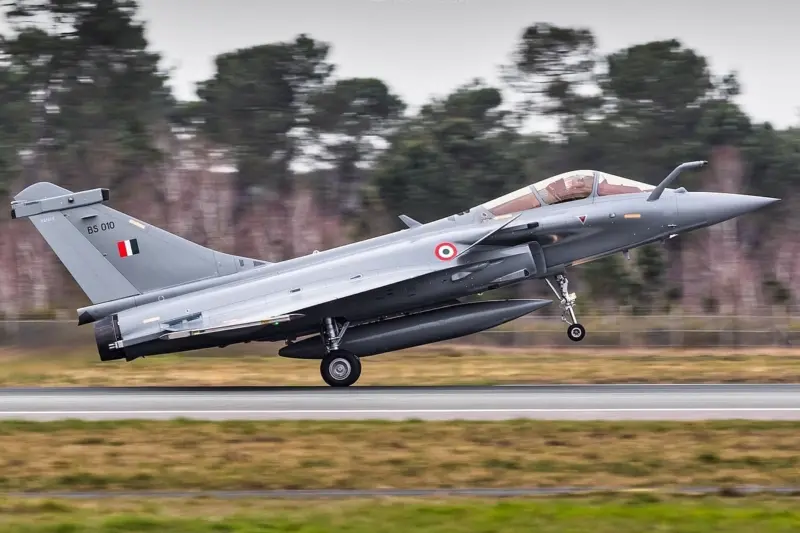
There is much hyperbole currently in India that attempts to associate a drone and missile-heavy aerial strategy as the ideal low-cost asymmetric counter in our current threat environment. In a budget-constrained environment, something must give way for this new set of toys - the suggestion being to cut the established and operationally proficient IAF to size, notwithstanding its success at the lower end of the spectrum of conflict, and reinvent the wheel by replacing it with drones and missiles where we are way behind our principal adversary both in terms of numbers and doctrinal advancements.
By suggesting so in an 'either/or' strategy, India runs the risk of attempting to match strength against strength with little hope of winning if one looks at the gap between India and China in both drone and missile inventories, with no domestic industrial strength to catch up over the next several decades.
Those who bandwagon on such an approach must reflect on the geopolitical evaluation, economic support and operational conditions under which China, Iran and Ukraine have developed their drone and missile forces.
China's rocket force has two principal aims - create a firepower asymmetry during a possible invasion of Taiwan and act as a deterrent to any possible US advance in the Pacific beyond the Second Island Chain. As a corollary, it can direct all these capabilities against India in case of a conflict.
Iran has spent decades building missile and drone capabilities with the clandestine support of Russia, China and North Korea in an opaque political system without any financial guardrails or accountability to its people. Without undermining the technical prowess of Ukraine's indigenous defence manufacturing ecosystem, it would not have been able to build its drone and counter-drone capability without the active financial support from the US and NATO.
None of the above templates can be applied to India should it embark on a radical change in its operational philosophy and migrate to a predominantly missile and drone regime as suggested by several experts. To build the kind of inventories of missiles and drones with varied ranges and firepower that will decisively determine the contours of any future conflict with China or Pakistan will require a dedicated national initiative that will threaten to derail every other defence manufacturing initiative.
There is no denying the fact that missiles and drones are important war-waging tools, but it is quite clear from ongoing conflicts that they have not proven to be war-winning instruments. Rather, they have been more pivotal in strategies of resistance, attrition and denial.
For India, missiles and drones will be important as part of a transformational multi-domain military strategy that retains classical land, maritime and air power as pivots of offensive action. Any skewed strategy that calls for a sudden and drastic reduction in the inventory of offensive manned aerial platforms will be disastrous in any future military campaign that India's armed forces are likely to engage in.