
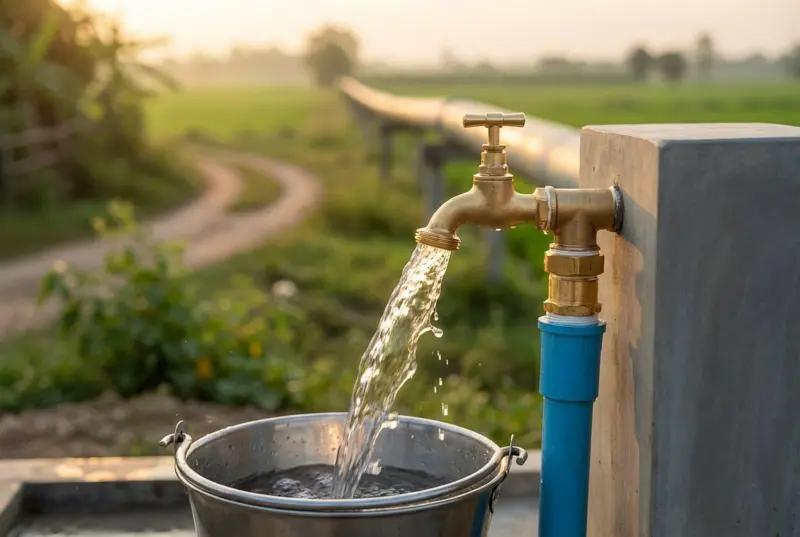

Jal Jeevan Mission built one of the largest rural water networks in the world. A ground level survey went door to door to find out what that looks like in practice.
When India launched the Jal Jeevan Mission in August 2019, barely one in six rural households had a functional tap delivering the mandated 55 litres of water per day.
Six years later, that figure has crossed 81 per cent, reaching nearly 15 crore families across 90 per cent of the country's villages, an expansion with few parallels in the developing world. Backed by a cumulative public investment of approximately ₹3.6 lakh crore between 2019 and 2024, the Mission represents one of the most ambitious social infrastructure undertakings in India's history.
The Mission's foundational premise was a shift in philosophy: away from counting assets built, and toward ensuring that every rural household receives potable water at the tap, reliably, every day.
Its theory of change rested on three pillars: generating human capital and welfare gains (especially for women), decentralising management to local Village Water and Sanitation Committees with mandated 50 per cent women's representation, and embedding long-term sustainability into both infrastructure design and financial planning.
To assess whether that theory is translating into reality, the Centre for Accelerating India's Growth at the Nation First Policy Research and Change Foundation conducted a rigorous primary evaluation, surveying 3,065 households across 12 districts in six states, combining Bayesian multinomial regression models with a Difference-in-Differences impact analysis.
While the findings confirm historic progress, they also point clearly to what must now be done.
The Coverage Question
Starting with the most basic measure, the survey asks: how many households actually have a JJM tap connection?
Official dashboards report coverage above 80 per cent nationally. The NFPRC survey, which distinguishes JJM-specific connections from pre-existing taps and legacy infrastructure inherited from earlier schemes, finds that 62.1 per cent of sampled households actually had a JJM tap connection.
Part of this gap reflects differences in measurement.
The current reporting system aggregates connections created under JJM with those inherited from prior programmes, flattening a distinction that matters operationally. A more differentiated approach, separating installed connections from verified functional systems from service-regular supply, would provide a clearer basis for planning and a more honest account of where the programme stands.
Across roughly 15 crore households, the expansion of piped water access has generated measurable welfare gains, with the largest improvements observed among those who previously bore the greatest burden.
Scheduled Caste households registered a 23.5 percentage point increase in access to household-level water, while Scheduled Tribe households saw a 19.6 point improvement.
Low-income households reported a 21.6 point increase, and households where women hold primary responsibility for water-related decisions experienced a 22.6 point gain.
In a context where water collection falls overwhelmingly on women and girls, and where every kilometre walked carries a direct cost in lost income, education, and rest, these gains are far from abstract.
A functional tap connection cuts roughly 104 metres from the daily walk and 15 minutes from the daily clockQualitative evidence from the survey suggests that time savings resulting from reduced water collection are associated with greater participation in intra-household decision-making, increased investment in children's education, and improved rest for women.
The Functionality Question
A connection, however, is meaningful only if it delivers reliable water. And here the picture fractures sharply by geography.
Haryana sits at one end of the spectrum, where mission-attributed connections translate into service reliability with notable consistency: functionality above 96 per cent, supply regular year-round, and maintenance responses typically occurring within a day or two.
At the other end is Rajasthan, where the challenge lies less in the performance of completed systems and more in achieving stable commissioning at scale. In a severely water-stressed environment, the state expanded from roughly 11 per cent to 57 per cent coverage, and where schemes are fully operational, functionality exceeds 90 per cent.
Coverage expanded rapidly, but Reliable daily supply is a different story.But converting infrastructure into dependable service at scale remains far more difficult. The distance between these two states captures something essential about the programme's current moment: infrastructure can be built quickly; reliable service systems take much longer to establish.
The Sustainability Question
One of the study's most striking findings concerns the determinants of service reliability. Using Bayesian multilevel regression, the researchers found that households paying a monthly user charge had 84 per cent higher odds of reporting a functioning tap. Similar patterns held for year-round availability and perceived water quality.
The causal relationship, however, is more nuanced than a simple fee-equals-functionality equation. Households willing to pay may already be in better-served areas, and their willingness may itself reflect trust built by consistent service. The association likely runs in both directions. Even so, the policy implication is difficult to ignore.
Rural water systems require predictable resources to operate. Pumps must be powered, operators paid, pipelines repaired, water treated and chlorinated. These costs recur every month, every season, every year, for as long as the system is expected to function. Without a reliable revenue stream, maintenance is deferred, supply becomes irregular, and the infrastructure gradually degrades.
The alternative, reliance on intermittent government grants, often leaves village institutions scrambling for maintenance funds and allows costly systems to deteriorate for want of relatively small sums. Yet introducing user charges in rural areas remains politically sensitive. Panchayats and Village Water and Sanitation Committees frequently operate without predictable recurrent budgets, and in many areas no clear mechanism exists for collecting, managing, or deploying contributions.
The study does not advocate high tariffs. Rather, it underscores the need for predictable, locally acceptable contribution systems: modest user charges within reasonable limits, ring-fenced maintenance funds, and safeguards to ensure that poorer households are not excluded.
The real challenge lies not in whether such systems should exist, but in how they are designed.
The Governance Question
The user-fee finding points to a deeper problem of institutional design.
Rural water systems in India occupy a peculiar governance space. They are too large and technically complex to be managed by village committees with no training or resources, yet too dispersed and locally variable to be effectively operated from state capitals. The system needs a competent middle tier, and that middle tier is largely missing.
The NFPRC study finds that many districts lack the staffing, technical expertise, and monitoring systems needed to manage large rural water networks. State-level agencies carry expansive technical responsibilities but their capacity remains uneven. District-level facilitation structures are well staffed in some places and barely present in others.
The result is a delivery chain where policy ambition at the top is not matched by implementation capacity in the middle, a pattern that recurs across India's development programmes with notable consistency.
At the village level, more than five lakh Village Water and Sanitation Committees (VWSCs) have been constituted, covering over 90 per cent of India's villages. However, constitution does not guarantee functionality. Where committees meet regularly and possess basic technical and bookkeeping capacity, systems are more likely to have identified operators, clearer supply scheduling, and established repair pathways.
Where this is not the case, which the study suggests is common, overlapping mandates between Gram Panchayats and VWSCs create ambiguity over roles and responsibilities.
Policy ambition is strongest where it is farthest from the tap, and weakest where it matters mostIndonesia's PAMSIMAS programme, which reached 22 million people across 32,000 villages by 2020, confronted a similar institutional question: how to sustain community-managed systems after installation. Its relatively high full-functionality rate of 85 per cent was not achieved through committee formation alone, but through sustained capacity-building, structured mentoring, and continuous support from district-level institutions.
The implication is straightforward. Village water committees cannot be assumed to function autonomously. Their effectiveness depends on ongoing administrative and technical support, which remains uneven and often inadequate across Indian states.
The Credibility Question
Beyond infrastructure and governance lies a less visible dimension: whether people believe the system will work. The survey found that only about half of respondents were even familiar with the Jal Jeevan Mission. Awareness rises with education and is consistently lowest among households earning less than one lakh rupees a year, often those facing the most severe water access constraints.
Since awareness is associated with a 77 per cent higher likelihood of having a tap connection, this is not merely a communication gap. It reflects a delivery gap.
In areas where water supply has historically been irregular, households continue to rely on traditional sources even after receiving tap connections. This is an entirely rational response to decades of broken promises: defunct hand pumps, dry borewells, and intermittent piped supply.
Overcoming this accumulated scepticism is a performance challenge, not a communication one. Trust is built not through declarations or awareness campaigns but through the slow, undramatic accumulation of evidence that the tap works - today, tomorrow, next month, next summer, next year.
The report proposes transparency reforms that could support this process: public disclosure of water quality test results, village-level Water Safety Plans aligned with WHO standards, and a "Jal Index" for districts or villages, published annually and benchmarked nationally.
By combining infrastructure reliability and service regularity into a single score, such an index could create pressure on weaker administrations, guide support to underperforming areas, and provide an independent check on official dashboard claims.
It would move JJM away from a model in which the government largely reports to itself, and towards one in which communities can hold local institutions accountable for the water that does, or does not, flow from their taps.
The Distance That Remains
Taken together, these four tests - coverage, functionality, sustainability, credibility - describe the distance between a good idea and a working system. The Jal Jeevan Mission changed how India thinks about rural water. It has not yet changed how rural water works, not fully, and not durably.
The priorities ahead are not obscure. More than 85 per cent of the programme's rural schemes depend on groundwater, which means long-term water security hinges on aquifer management, catchment protection, and conjunctive-use planning - coordination across multiple government programmes that is structurally difficult in the Indian administrative system.
District and village institutions must be built in practice, not merely constituted on paper. Monitoring must shift from installation-based reporting to verified service delivery. And the programme must invest seriously in the information and trust architecture that determines whether households adopt piped water, maintain their connections, and hold local institutions to account.
None of these are glamorous reforms. They will not generate headlines, inspire speeches, or lend themselves to ribbon-cutting. They involve the slow, unglamorous work of institutional design and will require sustained political commitment to a problem that is no longer novel.
Construction generates visible outputs, employment, and events. Maintenance generates invisible continuity, noticeable only when it fails.
India has changed how it conceives of rural water supply. The challenge now is to ensure that the system delivers safe, reliable water not for a year or two after commissioning, but over the 15-to-20-year lifecycle that piped water infrastructure demands. In that sense, the most difficult phase of Jal Jeevan Mission may only just be beginning.