




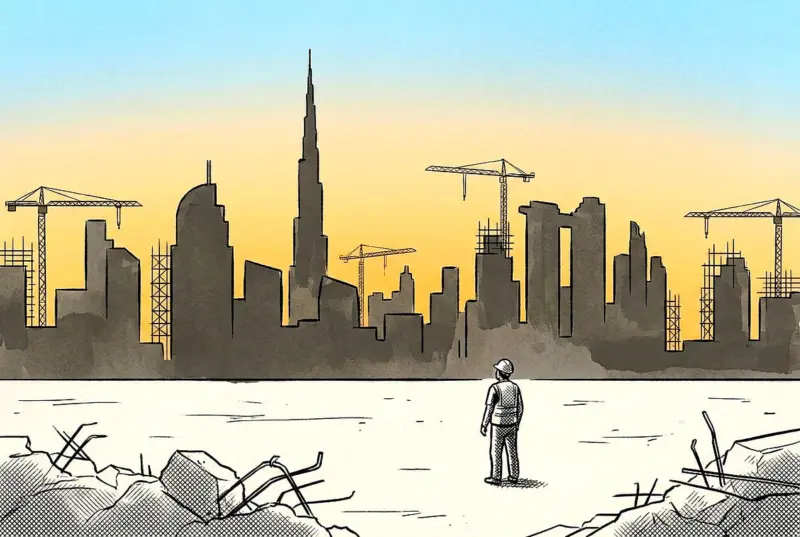

India's strategic ambiguity through the Iran-Israel-US war has set up the labour pipeline for the largest civil reconstruction in living memory.
When rebuilding begins, India will hold the labour-market trust that no other major nation enjoys across Tehran, Tel Aviv and the Arab Gulf simultaneously.
The largest civil construction opportunity of the 21st century is being assembled in the rubble of the Iran-Israel-US conflict. When the hostilities end, what follows will dwarf every Middle East rebuild in living memory. But who does the work?
The answer, if she plays her cards right, is India.
The Scale of What Has Been Destroyed
Iran has assessed its own losses at $270 billion in direct and indirect damages. Energy infrastructure alone (refineries, petrochemical plants, pipelines) has absorbed an estimated $34 to $58 billion, according to Rystad Energy. Iran's own central bank has warned that full economic recovery could take up to 12 years.
The list of destroyed civilian infrastructure in Iran reads like a development blueprint in reverse, taking in bridges, ports, railway networks, power plants, water desalination facilities, universities and hospitals. Israel has absorbed sustained damage to civilian infrastructure across Tel Aviv and surrounding areas, and the Arab nations caught in the conflict's wider arc will add their own tallies.
For scale, consider the precedents. According to the World Bank, Lebanon's 2024 conflict required an estimated $11 billion for reconstruction. Post-IS Iraq needed $88 billion. The 2003 invasion's aftermath cost over $220 billion across a decade. What we are looking at now operates on a different order of magnitude entirely.
This Region Has Rebuilt Before, but It Has Always Needed to Import Labour
The Middle East's reconstruction history is instructive. After 2003, Iraq spent over $220 billion rebuilding across a decade, with deeply mixed results, largely because the labour strategy was improvised, politically contentious and consistently prioritised proximity over competence. Post-IS reconstruction in 2015 required a further $88 billion push. Lebanon has existed in a near-permanent state of rebuild since its 1975-1990 civil war, interrupted by the 2006 conflict.
Each cycle surfaced the same structural problem. These countries needed enormous volumes of skilled and semi-skilled labour fast, and sourcing it was as much a geopolitical exercise as an economic one.
The lesson from every one of these rebuilds is the same: reconstruction happens fastest when the labour pipeline already exists, and when the source country has no political agenda on the ground.
Why India Is the Only Answer That Works for Everyone
Three factors converge to make India the natural choice.
The workforce is already embedded. Over 90 lakh Indians currently live and work across Gulf Cooperation Council countries. In Israel, Indian workers were already systematically replacing Palestinian labourers well before the current conflict. Just weeks before the war's most intense phase, India and Israel formalised a deal to bring an additional 50,000 Indian workers over five years. The supply chain doesn't need to be built from scratch; it just needs to be scaled.
Israel's traditional construction workforce had depended heavily on Palestinian labourers. Work permits before October 2023 were supplemented by workers from Moldova, China and Thailand. Moldova has since suspended its labour agreement with Israel after allegations of worker abuse in conflict zones. China is geopolitically compromised, given its close Iran ties in this conflict. India was already filling that gap before the latest escalation.
India has kept every door open. The Modi government's handling of this conflict has been a strategic exercise in deliberate ambiguity, and it has worked. India upgraded its relationship with Israel to a Special Strategic Partnership in February 2026. It quietly distanced itself from the SCO's initial condemnation of Israeli strikes on Iran.
At the same time, the India-Iran relationship survived remarkable stress: Indian ports continued handling Iranian cargo through the conflict, and Modi maintained communication channels with Tehran throughout. India condemned strikes on American military bases without naming Iran, while refusing to formally join the US-Israel axis.
While some nations may gain diplomatically from the conflict in the short term, India's advantage is labour market trust across all three camps, which is worth considerably more over a 10-year reconstruction horizon. The result is the most valuable diplomatic position possible for what comes next: Tehran does not view India as an enemy, Tel Aviv views India as a partner, and the Arab Gulf states remain home to 9 million Indian workers with established institutional relationships on both sides.
The alternatives are structurally disqualified. Pakistan and Bangladesh can supply blue-collar labour to Arab countries, but Iran will not easily accept Sunni-majority nations with deep American security ties as its primary reconstruction workforce. Israel cannot rely on Muslim-majority nations at all.
China has continued supplying weapons to Iran throughout the conflict, which makes Chinese construction firms politically less appetising for Israeli reconstruction and strategically uncomfortable for the Arab states. India is the only country acceptable to all parties simultaneously.
India's Own Conditions Are Right
This couldn't have arrived at a better domestic moment. India has built an enviable pipeline of manpower, and the Modi government's infrastructure decade, spanning rail, highways, bridges and airports, has produced a trained technical workforce at scale. The question of surplus technical labour capacity was one India was going to have to answer regardless. The Middle East reconstruction cycle answers it for them, and at a premium.
None of this is cause for celebration. The human cost of what has happened across the region is immense, and what is being described here as an 'opportunity' is built on genuine suffering.
The right sense is not triumphalism but preparedness. When the guns fall silent, rebuilding will begin fast, as all parties have the money and the urgency. India should be positioned diplomatically, logistically and institutionally before the demand arrives.