
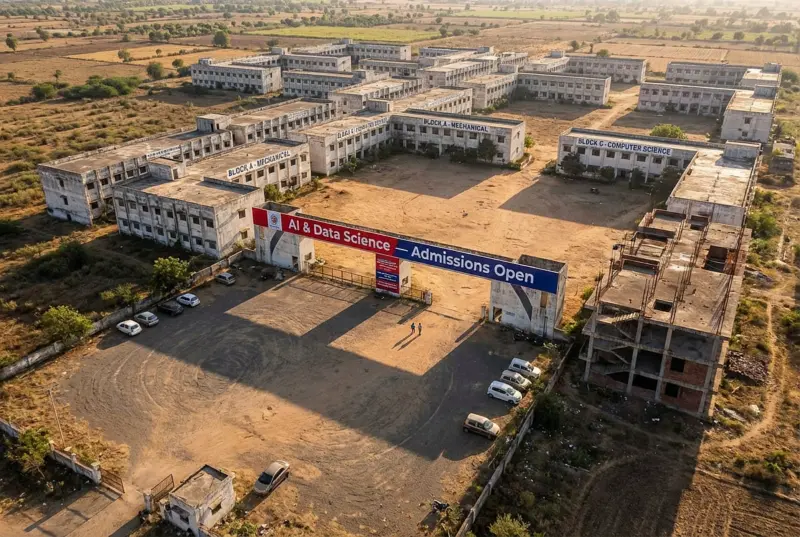

The Galgotias episode was spectacular. But across thousands of engineering colleges, a quieter version of the same dynamic plays out daily in 3,000 colleges.
Every semester, quietly, and by design.
It's likely fresh in public memory, but let's revisit it quickly. In February this year, Galgotias University sent a professor to the India AI Impact Summit in Delhi to showcase what she described as "Orion" - a robotic dog developed at the university's Centre of Excellence.
Guess what, social media identified it within hours as a Unitree Go2, a commercially available Chinese product with a starting price tag of $1,600.
The government ordered Galgotias to vacate its pavilion. Its power supply was cut.
Then it turned out that a "drone soccer" system at the same booth - billed as India's first - bore a striking resemblance to a South Korean product made by the Helsel Group. Yikes.
The university threw its own professor under the bus, saying she "was not aware of the technical origins of the product and in her enthusiasm at being on camera, gave factually incorrect information."
The episode became a national embarrassment, handed foreign media waiting for just such a thing to happen, a ready-made story, and for weeks overshadowed some of the other good stuff about the summit.
The irony was sharpened by what else was on display at the same event. IIT Kanpur's xTerra Robotics exhibited SVAN-M2, a robot dog developed through years of translational research by the institute's students and faculty - genuine Indian robotics capability, in the same room.
But the more interesting question from the episode is why almost nobody in Indian higher education was surprised.
The Galgotias fiasco was spectacular, sure - a purchased product presented as indigenous innovation at a government-backed event - but the underlying dynamic it exposed is ordinary.
Across India's vast middling tier of engineering colleges, a version of this is commonplace, just not filmed.
The 81-35 Divide
India has over 3,000 AICTE-approved engineering colleges. The top tier - the Indian Institutes of Technology (IITs), Indian Institute of Science (IISc), National Institutes of Technology (NITs), BITS Pilani, a handful of strong state universities and private institutions - produces fewer than 5 per cent of all engineering graduates.
The remaining 90-odd per cent come from private colleges affiliated to state universities, deemed universities of varying quality, and standalone institutions scattered across the likes of Greater Noida, Pune's outskirts, the engineering belt of Tamil Nadu, and Telangana.
These institutions produce the overwhelming majority of India's engineers. The question that emerges from the data - and that policy discussions don't necessarily focus on - is whether they are actually educating their students, or simply providing a venue where bright individuals educate themselves while accumulating a credential.
In other words, are a majority of India's, let's say, "middling colleges" just better-dressed coaching centres?
A qualification may be in order here that the "middling" category does contain significant variation. There are VJTIs, PSG Techs, NIE Mysores - institutions that punch above their weight through strong departments, active coding clubs, or individual faculty who run real labs. These pockets of genuine quality exist. But it's safe to say they survive despite the system, not because of it, and are exceptions in a landscape of over 3,000 colleges.
The structural divide across this landscape is sharp. A Factly analysis of NIRF data (2023) found that faculty with doctoral qualifications made up 81 per cent of the top 100 engineering institutions - and just 35 per cent in the rest.
A KPMG analysis of NIRF 2025 data confirms the trend holds, with PhD-qualified faculty in top-100 engineering colleges now exceeding 80 per cent.
The Factly analysis also found that only one-third of all engineering institutions meet the AICTE-mandated faculty-student ratio of 1:20, and that approximately 62 per cent of all research publications come from the top 100 institutions, with the remaining thousand-plus sharing the rest.
On one side of this divide, a small number of institutions with PhD-holding faculty, active research, and a reasonably current curriculum.
On the other, the overwhelming majority, where the teacher at the front of the class may have a master's degree obtained from a similar institution a few years ago, little to no research practice, and a syllabus frozen to whatever the affiliating university prescribed - sometimes years behind what industry demands.
A drop-off in faculty with PhDs after you move past the top institutesThis divide has historical roots that go deeper than recent policy failure. As Gautam R Desiraju, Professor Emeritus at IISc, and lawyer Deekhit Bhattacharya argue in Fixing Science in India: A Socioeconomic Prescription, Indian universities were organised from the colonial period as examination-oriented bodies with affiliated colleges; the British were careful to ensure that significant research did not take place in them.
The newly formed government of independent India, aware of the problems within these universities - their inflexible bureaucracies and entrenched interests - chose not to reform them but to sidestep the issue by creating research institutes (CSIR, ICMR, ICAR) independent of the university system.
The authors call this "the single biggest blunder committed in the Indian scientific arena in our early years."
The result was a university system that was never designed to produce knowledge, only to certify its reception - and a research ecosystem that was never connected to the institutions that train the country's graduates.
The middling college that functions as an examination hall with a placement cell is far from a recent aberration. It is more like the original design that was never fixed.
Employable On Paper, Unemployed In Practice
The student-output data reflects this.
The problem was documented as far back as 2019 by the Aspiring Minds National Employability Report, which - based on assessments of 170,000-plus graduates from over 750 colleges - found that nearly 38 per cent of Indian engineering graduates could not write a single piece of error-free, compilable code, that only 40 per cent had done an internship, and that just 36 per cent had attempted any project beyond what their coursework required.
Swarajya reported those findings at the time, noting that Tech Mahindra's CEO C P Gurnani had previously said 94 per cent of engineering graduates were not fit for hiring.
Six years on, the more recent data suggests the picture has not materially improved. The Mercer-Mettl India Graduate Skill Index 2025, drawing on data from over 2,700 campuses and a million students, found that overall graduate employability had actually declined - from 44.3 per cent in 2023 to 42.6 per cent in 2024.
The tier-wise breakdown is telling: Tier 1 colleges produce graduates with 48.4 per cent employability, Tier 2 at 46.1 per cent, and Tier 3 at 43.4 per cent.
That spread is only 5 percentage points across the full range of Indian higher education. If institutional quality were the primary variable, you would expect a much wider gap.
Graduate employability doesn't drop off as much as one would expect as you go from a tier 1 college to a tier 3 oneThe narrowness is consistent with the possibility that the common variable is the student - their motivation, self-study habits, and peer group - rather than what the college contributes. (The gap may also understate institutional impact on dimensions this metric doesn't capture - job quality, salary, long-term career trajectories - but as a measure of baseline employability, the near-uniformity across tiers is striking.)
Separately, the India Skills Report 2025, based on the Wheebox employability test, assessed 71.5 per cent of BE/BTech graduates as possessing job-ready skills. Yet the Unstop Talent Report 2025 found that 83 per cent of 2024 engineering graduates remained unemployed or without internships.
The same report found that 73 per cent of recruiters now dismiss premier college tags in favour of talent-based hiring - meaning employers are looking, and actively so, but not finding what they need.
These are different reports using different methodologies - one measuring test performance, the other tracking actual employment outcomes. But the gap between them points to a skill mismatch rather than a demand shortage: what colleges produce and what the market needs are different things.
A mismatch between what colleges produce and what the market needsWhere The Learning Actually Happens
To understand why, it helps to be precise about what middling colleges actually provide versus what students must build for themselves.
Colleges provide three things reliably: a credential (the degree), coordination (placement timelines, exam schedules, a structured four-year path), and a peer group.
These are not trivial; the degree is a regulatory gatekeeping function, the coordination reduces transaction costs, and the peer group is where much informal learning happens.
What colleges largely do not provide - and what students who succeed must acquire independently - is substantive skill formation: coding proficiency, domain expertise, project experience, the ability to apply concepts to real-world problems.
This distinction matters because it means the institution's value is primarily administrative and social, while the educational heavy-lifting is increasingly externalised to platforms, communities, and individual effort.
Talk to engineers who graduated from middling colleges and landed good jobs - at product companies, through GATE, at competitive startups - and this pattern holds. The college was more like the backdrop, while the learning happened in parallel.
NPTEL - the National Programme on Technology Enhanced Learning, a joint initiative of IITs and IISc - has accumulated 1.86 billion views and 5.62 million YouTube subscribers across 3,200-plus courses, all free. The consumption is overwhelmingly from students at non-IIT colleges, accessing instruction from IIT faculty that they cannot get in their own classrooms.
That consumption pattern is itself the self-study trail - students choosing, with their screen time, the quality their institutions don't provide.
The competitive programming ecosystem - Codeforces, LeetCode, CodeChef - is another visible trace. So are the Coursera and Udemy certificates that populate the LinkedIn profiles of recent graduates from colleges that don't feature in any ranking.
NPTEL's own documented testimonials illustrate the dynamic. One student, Vivek Gawande, described being drawn to NPTEL by a professor's recommendation, studying alongside friends, competing in TCS's CodeVita competition, and landing a job at TCS - crediting NPTEL courses, not his college curriculum, for his coding skills.
A Swarajya report in April 2025, profiling the Formula Bharat programme - where student-led teams in engineering colleges build Formula-style racing cars - documented a rare example of genuine hands-on engineering education.
A participant described the experience as giving the degree "not just paper value, but applicable value, not just knowledge value, but applied knowledge value." The formulation captures, by contrast, what the vast majority of middling colleges do not provide.
No systematic study exists on how much of a middling college graduate's marketable skill set comes from classroom instruction versus self-study - direct causal measurement is missing, and is probably even difficult to capture. But multiple independent indicators converge: NPTEL's consumption numbers, the competitive programming ecosystem, the narrow Mercer-Mettl tier gap.
Someone with deep knowledge of the sector confirmed the pattern to Swarajya: "Yes, the proposition is correct. Mostly it's peer learning and the exposure they get at the colleges that helps them."
Self-study is increasingly critical for employabilityThe Great Repackaging
The damage compounds when institutions respond to market pressure not by improving instruction but by repackaging what they already offer.
The same person put it directly: "In the era of marketing, ethics have taken a backseat. Now as there is an AI buzz, institutions have just repackaged and cloned their earlier courses into different streams such as Data Sciences, AI, or CSE. The crux remains the same with minimal value addition."
And a sharper structural point: "They have done away with core engineering branches like Mechanical, Electrical, and Civil. And this is going to hit us hard. AI should have been horizontally integrated into all streams of engineering rather than just a standalone course."
The data confirms this. AICTE reported BTech intake hitting a five-year high of 75 per cent in 2024-25, but the surge is overwhelmingly concentrated in computer science and AI-branded courses. Over 2 lakh new engineering seats were added in the 2024-25 session alone, most in CS and AI streams.
States like Karnataka have considered capping CSE seats after colleges were caught converting civil and mechanical engineering allocations into computer science slots without long-term planning.
In Tamil Nadu, 54,587 engineering seats were vacant after the third round of counselling. In Andhra Pradesh, almost 1.2 lakh seats went unfilled.
NASSCOM has projected that the demand-supply gap for digital talent will widen from 25 per cent to nearly 30 per cent by 2028 - meaning the flood of AI/CS-branded degrees isn't closing the gap but rather failing to address it.
Even IITs reflect the shift. Metallurgical and Materials Engineering at IIT Roorkee lost over 54 per cent of its open intake between 2015 and 2025. Textile Engineering at IIT Delhi saw a roughly 48 per cent reduction.
A Swarajya report in 2019 had flagged a government committee's recommendation to halt the creation of new engineering colleges from 2020 due to persistent vacancies. AICTE initially imposed a moratorium, then reversed it in 2023, triggering the current seat explosion.
A Swarajya investigation in March 2025, examining why India's best researchers often fail to build real-world technologies, found that even at IITs, undergraduates are rarely involved in core engineering projects - a pattern that, in top universities in the US and Europe, is the norm.
The disconnect between education and application runs all the way to the top. At the middling tier, it just deepens to a very high degree.
The Ranking Game
The information infrastructure that is supposed to help students navigate this landscape - the ranking systems - has itself become part of the problem.
NIRF, the National Institutional Ranking Framework, was launched in 2015 to give students a data-driven way to evaluate institutions.
In March 2025, the Madurai Bench of the Madras High Court stayed the publication of NIRF rankings after a PIL argued that institutions were submitting fraudulent data without cross-verification. The stay was eventually lifted, but the episode pointed to the system's vulnerabilities.
India had over 5,000 research paper retractions flagged between 2020 and 2024, many involving plagiarism or data fabrication - and NIRF's methodology, which weighted publication volume heavily, was incentivising this behaviour.
Saveetha Dental College in Chennai topped the NIRF dental rankings in 2023 and 2024, only for an investigation by Science magazine and Retraction Watch to find evidence of publishing malpractice.
A Springer Nature study flagged Chandigarh University for publication output growth that vastly outpaced changes in faculty size - a classic marker of metric inflation.
The 2025 rankings introduced negative marking for retracted papers - a corrective step. But the deeper problem is structural: NIRF relies on self-reported data with minimal verification. Institutions inflate placement numbers, fabricate patent filings, and attempt to flood perception surveys.
A Chinese robot dog presented as indigenous innovation at a national summit is spectacular fraud, the kind that gets caught on camera. Inflated NIRF submissions are quiet, systematic fraud - the kind that doesn't get caught, and that shapes where lakhs of students invest their money and four years of their lives.
Why The Regulators Can't Fix This
The regulatory apparatus is supposed to prevent this. The reasons it doesn't are structural.
AICTE mandates internships after every alternate semester but does not require institutions to arrange them. The result: companies have sprung up - some openly advertising online - that sell internship certificates for a fee.
The regulator creates a box-ticking requirement, the institution doesn't fulfil it, and a grey market fills the gap. NIRF mandates data submission but doesn't verify it, so institutions game it.
UGC identifies fake universities - 32 across 12 states as of the latest count, up from 20 two years earlier - but only issues advisories to parents and students.
And the government's own data infrastructure has gone dark: India has not released AISHE (All India Survey on Higher Education) reports since 2021-22, meaning policymakers are making decisions about a system they cannot currently measure.
You can see the pattern. Regulators measure compliance with input metrics - campus size, teacher-student ratio on paper, number of courses listed - rather than learning outcomes. The accreditation frameworks - NAAC, NBA - have become games that institutions optimise for, not standards they aspire to.
NEP 2020 acknowledged many of these problems, identifying "large affiliating universities resulting in low standards of undergraduate education," "limited teacher and institutional autonomy," and "an ineffective regulatory system" among the structural failures. But identification is not prescription.
As Desiraju and Bhattacharya argue, these failures persist because of the political economy of Indian education: it is a long-term investment with a high initial outlay, and it would hardly be a priority for "clientelist politicians and the science gatekeepers who are generally more interested in their immediate short-term gains obtained at minimum cost."
On the ground, NEP reforms are being absorbed into the same compliance culture. The introduction of a fourth undergraduate year is likely to worsen the faculty-student ratio, since there is no corresponding plan to scale faculty recruitment.
In the latest QS World University Rankings, 63 per cent of Indian universities saw a decline in this ratio even as the total number of ranked Indian institutions reached an all-time high. Representation is up, but the structural quality is eroding.
India's higher education system - especially its vast middling tier - functions primarily as a credentialing and coordination layer, while substantive skill formation increasingly occurs outside the classroom, driven by student initiative, peer learning, and external platforms.
The student who lands a good job after four years at one of these institutions does so largely because she was bright and driven enough to develop herself - through NPTEL, YouTube, competitive programming, peer study groups, and determination. The college provided the credential and the peer group. The rest, she built on her own.
The system persists because the information asymmetry is enormous. A 17-year-old choosing a college cannot evaluate curriculum depth, faculty publication records, or lab quality. They see a campus, a placement brochure with inflated numbers, a NIRF rank that may have been gamed, and an AI-branded course name that sounds like the future.
This is the system the Galgotias robot dog briefly made visible. A university that presented a purchased Chinese product as indigenous innovation at a national summit was doing, in concentrated and camera-friendly form, what thousands of institutions do every semester: presenting the appearance of capability - a degree, a placement number, a course name - without the substance behind it.
The robot dog was the version that got caught. The system that produced it has not been examined with the same scrutiny.
That examination is overdue.