





Film stars from southern India have repeatedly converted screen fame into genuine political power - founding parties, winning states, and governing.
Bollywood actors have never managed the same. Four structural reasons explain why.
Tamil Nadu's single largest party is two years old. Its founder, Joseph Vijay, is a film actor who spent three decades playing the righteous avenger of the dispossessed on screen before he built it. Vijay's Tamilaga Vettri Kazhagam won 108 seats in its first election and pushed the ruling DMK below 60.
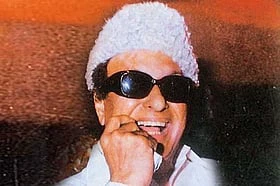
The pattern is older than Vijay though. NTR founded the Telugu Desam Party in March 1982 and was the Chief Minister of Andhra Pradesh by January 1983, in nine months. MGR founded the AIADMK in 1972 and became Chief Minister of Tamil Nadu in 1977, in five years. Both were film actors. Both built parties from scratch. Both governed.
In the Hindi belt, the record looks different. Amitabh Bachchan won Allahabad in 1984 with 68.2 per cent of the vote and resigned three years later without having built anything.
Hema Malini has won Mathura three times. Dharmendra won Bikaner, Shatrughan Sinha won Patna Sahib, Sunny Deol won Gurdaspur. Between them: no party founded, no Chief Ministership held, no executive office of any consequence.
On the southern side of the country: Jayalalithaa took oath as Chief Minister of Tamil Nadu six times across 25 years. Vijayakanth founded the DMDK in 2005 and became Leader of the Opposition in the Tamil Nadu assembly by 2011. Pawan Kalyan founded Jana Sena in 2014 and is today the Deputy Chief Minister of Andhra Pradesh.
Each of these is a story of an actor who converted cultural capital into political power, who founded something, built it, and wielded executive authority in their own right.
On the side of Hindi cinema, Govinda won Mumbai North in 2004 and lost interest before his term ended.
Raj Babbar held Congress tickets across three decades and multiple constituencies without accumulating any power beyond the ticket itself.
Vinod Khanna served as a minister of state in the Vajpayee government, the closest any Bollywood actor has come to executive office, and then returned to cinema.
Shatrughan Sinha spent two decades with the BJP, some years as the Union Shipping Minister, switched to Congress, and then to Trinamool Congress.
Each came in on someone else's ticket, served on someone else's terms, and left without having changed the equation.
The question is why the conversion that works routinely in the South has never worked in the North.
In the South, actors founded parties, built organisations, and wielded executive power. In the North, they held tickets on someone else's terms and left without changing the equation.Four structural explanations, taken together, account for it.
The first is infrastructure. Cinema in southern India is a far more total experience than in the Hindi belt, and the numbers are not close. Southern India has approximately two cinema screens per lakh of population. The Hindi-speaking states average around 0.5, a quarter of the density.
Cinema screens per lakh of population: the South has four times as many cinema screens per person as the Hindi belt.Tamil Nadu and the Telugu states, which have produced the most actor-politicians, sit at the top of the southern distribution. As far back as 1979, advertising surveys found that nearly half of urban adults in southern India visited a cinema hall every month. The equivalent figure for northern India was under 15 per cent.
What this means, in political terms, is that a Tamil or Telugu star is a regular, weekly, communal presence in the lives of his audience, watched with the frequency and ritual intensity of a congregation. The actor who fills the hall is, in the psychological life of that audience, something closer to a recurring public figure than a distant entertainer.
The second explanation is geographic. MGR's fans were Tamil. They lived in Tamil Nadu. MGR too lived in Tamil Nadu (Chennai).
When he founded the AIADMK and stood for election, the political unit, Tamil Nadu, matched the cultural unit, Tamil cinema's audience, exactly. NTR's fans were Telugu-speakers. Telugu-speakers had one state (undivided Andhra Pradesh). NTR could own that state, and he did.
Bollywood's political geography is 'broken' in that context. A Hindi film star's following is across many states in the north-Uttar Pradesh, Bihar, Rajasthan, Madhya Pradesh, Punjab, Haryana. That national spread, which is the commercial asset that makes a Bollywood A-lister worth hundreds of crores at the box office, becomes a political liability the moment the star considers translating it into electoral power. The Hindi belt has no political unit equivalent to Tamil Nadu. There is no Chief Minister of the Hindi belt.
Then there is the residence problem, which compounds the geography. Bollywood's stars live in Mumbai. Their social world is a Maharashtra-based entertainment and business ecosystem with essentially nothing to do with the political families of the Hindi belt. Amitabh Bachchan's world in 1984 was Rajiv Gandhi's coterie, a Maharashtra-based entertainment ecosystem with no local party machine in Allahabad, no caste arithmetic in eastern UP, no grass-roots structure of any kind. When he resigned in 1987, there was nothing to fall back on.
Tamil and Telugu stars live in the states where their fans vote. They attend the funerals, the weddings, the temple festivals of the people who will one day be their voters. That presence is the slow accumulation of political capital that looks, from outside, like cultural adoration.
The third explanation is cultural. In Tamil Nadu, the relationship between cinema and politics was deliberate, constructed over decades by men who understood both.
The Dravidian movement used Tamil cinema as a political instrument before any actor entered formal politics. Karunanidhi wrote screenplays as ideological vehicles: films as propaganda for Tamil self-assertion.
MGR's on-screen persona was an accumulation of that project: the incorruptible hero from among the poor, the man who could not be bought or frightened. By the time MGR stood for election in 1977, Tamil audiences had spent twenty years being trained through cinema to read his on-screen persona as a political programme. The seat he occupied in their imagination was that of a protector.
NTR's authority had a different but related source. He had played Lord Krishna and Lord Rama in over a hundred Telugu films across three decades: literally, physically, performing divinity on screen for audiences who treated those performances as religious events. When he founded the TDP in 1982 on the plank of Telugu self-respect against the Congress high command, the framing landed because the persona sustained it.
Temples have been built to MGR, to NTR, to Rajinikanth. The relationship the audience had with the star was, in these cases, one of worship, and worship implies a protector. Admiration implies an entertainer. The political transfer works only in the first case.
Within this cultural difference lies a more specific difference: Tamil and Telugu mass cinema made the poor its explicit political subject. The villain was the landlord, the corrupt official, the indifferent state. The hero's victory was a rehearsal for what justice should look like. Audiences were being shown a template for governance alongside the entertainment.
Vijay's own filmography did this work across two decades: post-2000s collaborations with directors like Atlee and Murugadoss built a consistent screen persona fighting corrupt officials, corporate villains and indifferent systems, so that when TVK was founded, the political character had already been established.
Karnataka had the same raw material: Rajkumar commanded the kind of devotion that MGR and NTR did. He stepped back deliberately, refusing to let his stardom become a political instrument. Had he taken the plunge and succeeded, Kannada cinema might have developed the same actor-to-institution pipeline that Tamil Nadu and Andhra Pradesh built.
Malayalam cinema engages seriously with poverty and injustice, but its protagonists are ordinary people navigating broken systems. The social critique is present; the saviour mythology that enables the political transfer is absent.
Bengali cinema has also produced works on poverty and inequality, but as subjects of artistic contemplation rather than political mobilisation. Malayalam and Bengali cinema's failure to build the saviour mythology is part of why neither state has produced an actor who governs. Even where the geography allowed it, the cultural conditions were missing.
Hindi mass cinema's hero is aspirational - the young man who rises - but the enemy he defeats is a personal one. The Bollywood hero, from Dilip Kumar's tragic figures through Bachchan's angry young man to the romantic leads of the 1990s, was rarely the saviour of the poor and never divine.
Bachchan's greatest characters were moral outlaws: Vijay in Deewar, who chose crime over capitulation; Jai in Sholay, a bandit with a code. These carry no governance claim. An audience that loves Vijay does not thereby conclude that Amitabh Bachchan should govern Uttar Pradesh.
The fourth explanation is structural. Electoral arithmetic.
North Indian elections are decided by caste coalitions assembled by professional politicians with decades of local relationship-building behind them. The SP runs on Muslim-Yadav consolidation. The BSP was built on Dalit mobilisation that took Kanshi Ram twenty years of ground-level organising to construct. The BJP's dominance in UP rests on a coalition managed through an organisational apparatus spanning every booth. A film star arriving in this environment brings one resource: fame, and nothing else. Fame is insufficient. The caste and local political arithmetic must be satisfied.
Rajesh Khanna lost to L K Advani in the 1991 New Delhi Lok Sabha election, and won the seat only in the subsequent by-poll after Advani vacated it.
Pawan Singh, the Bhojpuri megastar, contested the 2024 Lok Sabha election as an Independent from Karakat and lost.
Nirahua alias Dinesh Lal Yadav, another Bhojpuri star, lost Azamgarh to the Samajwadi Party's caste consolidation through PDA in the same election despite genuine local popularity. The star could not substitute for the coalition.
The Dravidian model offered something the Hindi belt has never produced: a politics organised against caste hierarchy as the primary basis of representation, at least in in appearance. MGR and Jayalalithaa won by positioning themselves above caste arithmetic, as champions of the poor irrespective of jati. That positioning was available because the Dravidian movement had spent decades delegitimising caste-based politics as the grammar of Tamil public life. In the Hindi belt, caste remains the grammar. A star cannot step outside it. (Yet beneath the rhetoric of Dravidian universalism, caste has remained as enduring and politically consequential in Tamil Nadu as it is in the politics of the Hindi belt).
Kerala and West Bengal confirm that strong party structures block the conversion even where geography is favourable. Both states have regionally concentrated cinemas: Malayalam and Bengali, with audiences living in the same state as their stars. The geographic precondition that disqualifies Bollywood is present in both. Yet neither has produced an actor who founded a party or held a Chief Ministership.
In West Bengal, TMC fielded Tollywood actors extensively across three election cycles. They won seats when the party's tide was high and lost them when it turned: the 2026 election swept the BJP to power with 208 seats, and several TMC actor-candidates fell with the wave. Their electoral fate tracked the party's fortunes, which is the definition of an instrument.
Suresh Gopi's trajectory in Kerala makes the point precisely. He lost Thrissur twice, in 2019 and again in the 2021 assembly election, before winning in 2024 on the back of the BJP's growing base, Modi's visible backing, and local anti-incumbency against both the LDF and UDF.
When Kerala's assembly elections came around in 2026, the BJP ran its campaign without him: he was, as one report noted, conspicuous by his absence even in the constituency he represents. He holds a Union ministry. He has not built a party, led an opposition, or accumulated any political capital independent of the BJP's own machinery. In Kerala, as in Bengal, the star's ceiling is exactly the height of the party holding him.
Bengal and Kerala both run on organised ideological contests between parties with deep institutional roots. In that environment, a star's cultural capital is an addition to the party's strength. It cannot substitute for it when the political wind shifts.
Whether any of this changes is the more interesting question.
The structural conditions that produce actor-politicians are, in one important respect, beginning to replicate themselves in fragments across the Hindi belt. Bhojpuri cinema has a geographically concentrated audience: eastern UP, Bihar, and a large diaspora, a star-as-hero mythology, and stars who live among their audiences rather than in Mumbai.
Manoj Tiwari has won Northeast Delhi three consecutive times and Ravi Kishan has held Gorakhpur across two terms, and the reason is specific. Both of them contest among audiences whose cultural identity they already embody. Bhojpuri cinema's viewers are concentrated in eastern UP, Bihar, and the Purvanchali diaspora in Delhi, a geographically coherent base that a star can own, in the way Tamil and Telugu stars own their states.
Bollywood's hold over Hindi-speaking audiences has fractured over the past five years. Southern films, Gujarati cinema, Punjabi cinema, Assamese cinema have all claimed audience share that once defaulted to Mumbai. The pan-Hindi star whose fame once made him irresistible to parties is a fading category.
The FICCI-EY 2026 report adds another dimension to this shift: northern India is adding screens at 3 per cent annually, while southern India is losing screens at 1 per cent, as streaming absorbs more of its viewing.
The infrastructure gap that once separated Tamil and Telugu cinema's political reach from Bollywood's is narrowing, and regional cinemas across the Hindi belt stand to benefit most from that convergence.
Given the four structural conditions this piece has laid out: thin screen density, broken geography, absent mythology, caste arithmetic, a Bollywood actor building genuine political power was always structurally unlikely. With Bollywood's cultural monopoly now gone, it is close to impossible.
If a northern actor ever does govern rather than campaign, the pathway runs through regional cinema: a Bhojpuri or Maithili star who consolidates a culturally coherent, geographically concentrated audience into an electoral base, the way Tamil and Telugu stars did in the twentieth century.
Vijay's 108 seats are the system working as designed. The system just does not exist, yet, anywhere in the Hindi belt.