





The claim that the Vedas foretold the crucifixion is not new. What is new is the scale, the manufactured verses, and the political cover the hoax now enjoys.
The auditorium lights dim, the heavy resonance of a conch shell reverberates through the hall, and the sacred Vedic chants fill the air, accompanied by the solemn strum of classical Indian instrumentation.
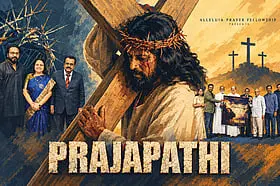
On the illuminated screen, an ascetic-looking human figure is bound to an ancient wooden sacrificial post (yupa). But as the camera draws closer through the haze of incense, the narrative violently pivots: the figure yoked to the post is not just some ascetic, but Jesus of Nazareth, crowned with thorns, his blood poured out as the supposed fulfilment of the ancient Purusha-medha. The yupa is the cross.
Promotional material of the play 'Prajapathi'Fringe perhaps? Look around.
Such depictions are becoming common. Today an average Christian pastor will tell you with confidence that Prajapati is none other than Jesus - prophesised in your own Vedas, he would add. And they are increasing their political clout as well.
The musical 'Om Shalom' has quite an acclaimed cast. 'Nizhalkal Ravi' a veteran actor and in real-life born in an orthodox Vaishnava family, is featured. The title makes you think it a cultural dialogue. But it is not.
It lifts the Vedic Om, then props up the old Prajapati-as-Christ line and feeds them back to Hindus as if the Vedas had been waiting for a Palestinian crucifixion.
Prajapathi is a musical drama and it does the same thing in the open: a 25-year Jesus drama given a Vedic title so that devout Hindus could be lured into watching it.
This is Robert de Nobili's method with a stage and limelights. It does not matter if Hindu scholarship does not read the Vedic Prajapati as a sneak preview of the Gospels.
Into this context walks T. Mano Thangaraj, DMK's former minister from Padmanabhapuram, taking time from office to stand with the film 'Om Shalom'.
Former DMK Minister Mano Thangaraj endorsing 'Om Shalom'A circulating Facebook reel by the director of the film, shows him endorsing it and offering to help another pastor, Augustine Jebakumar, take it to northern India.
Whether every syllable of that reel can be certified from this desk or not, the alignment is not mysterious. Jebakumar runs GEMS (Gospel Echoing Missionary Society) . GEMS operates in Bihar with its own Hindi version. The former minister is not blessing a student short film. He is offering political help to a North-India mission brand.
In effect the former DMK minister is willing to help carry a 'Vedas prophesised Jesus' narrative right into northern India.
The farce is completed by the other side of the political aisle. John Christian Devavaram Prabhakar, former AIADMK leader, now TVK Speaker of the Assembly, launched the trailer of Prajapathi, a Jesus biography wearing a Vedic name.
DMK and the Speaker's camp can fight in the House. On this circuit they rhyme. One blesses the film that will travel north with GEMS. The other gongs the trailer in Chennai. Rival parties, same errand: put Hindu vocabulary on a Christian product.
Steal the noun. Empty the deity.
But there is more.
When the machinery of religious proselytising begins to enjoy institutional patronage from the highest corridors of political power, theological subversion ceases to be a fringe curiosity, it becomes an existential civilisational challenge.
The catastrophic consequences of this process are not theoretical; they are already an accomplished reality across the southern districts of Tamil Nadu, particularly in Tirunelveli, Thoothukudi, and Kanyakumari.
In these regions, the very word 'Vedam' has been systematically severed from the Rig, Yajur, Sama, and Atharva Vedas. In common parlance among millions of Tamils today, Vedam simply denotes the Christian Bible, a Christian church is referred to as a Veda Kovil, and a Christian pastor is addressed as a Veda-bodhagar. A Bible class is Vedagama Palli. Even a lay Hindu in these districts if asked who is a 'Vedakaran' would answer without blinking an eye, 'Of course a Christian!'
Having successfully colonised and erased the primary meaning of Veda in the colloquial vernacular of the region, this project has escalated to its ultimate logical step: claiming the Shruti itself, asserting that Prajapati is the crucified Christ, and reducing the bedrock of Sanatana Dharma to an introductory preface for the Gospel.
The Historical Lineage: From Colonial Apologetics to Inculturation
The attempt to graft the Christian Passion narrative onto Vedic literature represents a century-and-a-half-old missiological project.
The genesis of this paradigm lies in the nineteenth-century Bengal Renaissance. Its primary architect was Rev. Krishna Mohan Banerjea (1813-1885), a Kulin Brahmin convert mentored by Presbyterian missionary Alexander Duff. Banerjea realised that direct missionary denunciations of Hindu deities as 'false idols' caused educated Hindus to retreat into orthodox defense or get into even more Upanishadic Brahmo-like movements.
In works such as The Arian Witness (1875) and The Relation Between Christianity and Hinduism (1881), Banerjea developed the thesis of a "primitive revelation".
He argued that the ancient Indo-Aryans preserved an uncomprehended memory of God's plan for universal redemption through blood sacrifice. Banerjea claimed that 'the throne of Prajapati was vacant' because no deity in the Hindu pantheon claimed the identity of the self-sacrificing Purusha, leaving the office open to be uniquely claimed and fulfilled by Jesus Christ.
In 1913, John Nicol Farquhar formalized this framework into 'Fulfillment Theology' with The Crown of Hinduism. Invoking Christ's declaration that he came 'not to destroy, but to fulfill', Farquhar argued that the rites of the Vedas were incomplete 'gleams of light' that terminated logically in the historic person of Christ. The Vedas were framed merely as the temporary husk; Christianity was the true fruit.
Today, what began as an elite colonial thesis has expanded into mass-market vernacular cinema and digital proselytism. Evangelists such as Sadhu Chellappa, backed by regional political presence, distribute tracts like Christ in Ancient Vedas and produce feature-length films that blend classical music, Sanskrit chants, and dramatic passion scenes, telling Hindus that accepting Christ is the ultimate realisation of the rishis.
The Anatomy of Textual Deception: A Philological Deconstruction
The entire 'Prajapati as Jesus' edifice relies upon mistranslations, decontextualization, selective omissions, and manufactured Sanskrit texts. When subjected to the even simple scrutiny of Sanskrit grammar and the most elementary traditional exegesis, the claims collapse.
The Category Hoax:
A central text weaponised by evangelists is the Purusha Sukta (Rigveda 10.90), which describes the primal sacrifice of the cosmic Purusha by the Devas. Missionaries equate this cosmic dismemberment with the physical execution of Jesus on Calvary, noting that Jesus referred to himself as the 'Son of Man'.
This comparison intentionally misrepresents the underlying metaphysics. The Purusha Sukta does not depict penal substitutionary atonement for moral transgression or 'original sin'. It is a panentheistic cosmogonic hymn detailing how the unmanifest Divine voluntarily differentiates into the manifest universe - the cosmos, the seasons, the flora, fauna, and human society. The Divine is simultaneously the sacrificer, the sacrifice, and the resulting creation (Yajnena yajnam ayajanta devah).
Reducing this cosmic philosophy to a localised Roman penal execution strips the hymn of its foundational metaphysics.
The Semantic Hoax:
The compound Prajapati (praja + pati) translates simply to 'Lord or Protector/Head of Praja'. In the Samhitas and Brahmanas, it functions as a functional epithet applied to the cosmic creative principle, a caring ruler, or an enlightened Guru. It is an ontological principle, not the proper name of a mortal saviour walking the earth in first-century Judea.
To make Prajapati resemble the Christ of their theology, evangelists selectively sanitise the Brahmanas. In Vedic literature such as Shatapatha Brahmana and Aitareya Brahmana, Prajapati is the personification of primal as well as cosmic procreative impulses (kama) and heat (tapas).
The primary Vedic narrative describes through Prajapati a cosmic allegory for the manifestation of light and life from the unmanifest. This complex allegory of cosmic generation is wholly incompatible with the Christian doctrine of a redeemer dying for the mythical human guilt. The hoax here is the suppression of this Vedic primary mythos of Prajapati because it shatters their comparative model.
The Piltdown Prajapati Quote Hoax
When authentic texts fail to yield the required dogmatic parallels, modern propagandists do not hesitate in the least to manufacture fake ones, like the infamous Piltdown fossil hoax.
Across digital tracts and vernacular broadsheets distributed in India, one finds fabricated 'mantras' presented as canonical Sanskrit verses.
Here are a few which you may soon come across near your own locality:
'Om Sri Brahmaputra Namaha' (Claimed: "O God, Son of God, we worship you") : A synthetic compound nowhere found in the Vedic Samhitas.
'Om Sri Kannisuthaya Namaha' (Claimed: "O God, born of a virgin, we worship you") - A crude linguistic hybrid incorporating the Tamil word for virgin (kanni) into a pseudo-Sanskrit case ending.
'Om Virshtaya Namaha' (Claimed: 'O God who is circumcised, we worship you") - A certainly garbled form of a line with no proper meaning and definitely not part of any worshipful hymn in any Hindu temple.
'Om Sri Panchakaya Namaha' (Claimed: "O God of the five wounds"): A distortion of standard Sanskrit for 'five-sheathed bodies' or even a substitute at times for Panchakavya cleverly used to mimic the stigmata of the crucifixion.
'Om Sri Vritchsula Arul Daya Namaha' (Claimed: 'O God crucified on a tree who provides grace')- An ungrammatical pastiche combining Sanskrit (vriksha, shula) and Tamil (arul).
One of the sources of the hoax can be traced to a Prof. M.M.Ninan who had written 'a history of Hinduism'.
Ninan was the brother of an erstwhile Governor of Nagaland. In his book he claims the above verses are chanted in Hindu temples by the priests during the worship.
Even entire verses are fabricated and then confidently pinned on well-known Upanishads.
In the movie Om Shalom (26:50), a character recites the following verse as from Taittiriya Upanishad: 'Sarva Papa Pariharo Raktha Proshana Avasyam Thath Raktham Paramatmavena Punyadana Baliyagam'.
The diction is alien to Upanishadic verse. The line occurs in none of the principal Upanishads leave alone Taittiriya Upanishad. No Upanishad prescribes rakta-prokshana (blood-sprinkling), as a means of removing sin.
The Upanishads are knowledge-centric, not sin-obsessed.
Screen grabs from 'Om Shalom': Fake Upanishad hoax-quotesThese phrases are forgeries designed to prey upon the reverent trust of Hindus who revere the sound of Sanskrit but have been severed from its mastery.
The Mission Purpose: Creation of a 'Vedic Old Testament'
The danger of this 'Prajapati is Jesus' hoax extends beyond textual distortion.
To understand how, one must look at religious history. Early Christianity interacted with the Hebrew Scriptures by redefining them. The autonomous, self-sufficient Torah and prophetic books of Judaism were reframed as the 'Old Testament', meaning that they form an incomplete, preparatory covenant whose primary purpose was to anticipate the arrival of Jesus.
Once Christ arrived, the Old Covenant was considered superseded by the Gospel.
The 'Jesus as Prajapati' propaganda attempts an identical structural replacement of Hindu culture:
1. Eradication of Spiritual Autonomy: The Vedas and Upanishads are stripped of their internal metaphysics - Karma, Samsara, Moksha, and the non-dual realization of Aham Brahmasmi and Tat Tvam Asi. The expansive cosmic vision of the Rishis is reduced to a single Judeo-Christian concept: substitutionary blood sacrifice for sin.
2. Structural Demotion to a 'Vedic Old Testament': The Shruti is relegated to a primitive, localised preparatory dispensation. The claim is made that God spoke to the Jews through the Prophets and to the ancient Indians through the Rishis, but that both lines terminate in the Cross.
3. Pathologisation of Living Hinduism: The living, breathing elements of Sanatana Dharma-vigrah pooja, temple Agamas, Bhakti movements, the Puranas, and Darshanas, they all get characterised as corruptions of an imagined, monotheistic Vedic revelation that supposedly sought a single sacrificial saviour.
4. Cognitive Neutralisation: By telling Hindus that accepting Jesus is the true fulfilment of the Rigveda, the psychological friction of conversion is removed. The convert is told: 'You are not converting to an intolerant monopolistic religion whose ethos are virulently against the civilisational ethos of India but you are simply becoming a true follower of the Rishis who themselves were monotheistic'.
The Dark Historical Parallel
To understand where this road leads, Hindus must look squarely at religious history. The combination of Replacement Theology and emotive passion plays has a documented, blood-soaked history in the Western world.
For centuries in medieval and right into the pre-holocaust modern Europe, annual Easter passion plays dramatically depicted the suffering and crucifixion of Jesus. Hitler eulogised them.
Passion Plays were traditionally used to incite violence against the Jews.These plays did not exist in a theological vacuum; they operated alongside a doctrine which taught that the Jewish covenant was dead, their scriptures had been superseded by the Church, and their refusal to accept Jesus as the prophesied Messiah was proof of spiritual blindness and moral guilt.
The psychological impact of those passion plays was catastrophic.
Audiences, whipped into an emotional frenzy by the graphic depiction of Christ's wounds, poured out of public squares and directed their rage at local Jewish communities. The narrative logic was deadly: 'If your own scriptures prophesied this Savior, and you still refuse him, you are willfully wicked and complicit in deicide'.
It created the virulent, systemic anti-Semitism that haunted Europe for millennia and laid the groundwork for historical catastrophes.
Across Tamil Nadu, large-scale stage productions and passion plays are now openly titled 'Prajapati', organised in prominent public venues like the YMCA grounds in Chennai, mounted with hundreds of actors, massive soundscapes, and advertised with dramatic visuals of Christ carrying the wooden beam beneath the bold Vedic title in Tamil: பிரஜாபதி (Prajapati).
Promotional posters for 'Prajapathi' at YMCA, MadrasThe theological message preached to the new convert is unambiguous: 'The ancient Hindu Rishis knew and worshiped Jesus as Prajapati; the Vedas commanded his acceptance; therefore, modern Hindus who continue to worship Shiva, Vishnu, Murugan [just poor imitations of Jesus], or practice traditional rituals [just poor deficient substitutes for the blood of Jesus] are wilfully rejecting their own ancestral scriptures'.
This manufactures a toxic, internalized animosity toward the unconverted Hindu family and community. The practicing Hindu is no longer seen merely as someone of another faith, but as a stubborn apostate who denies the 'true' meaning of the Vedas. It plants the seeds of deep communal fracture, estranging converts from their families, their temples, and their ancestral roots.
Civilisational Consequences
If the Hindu community remains indifferent to this epistemic subversion, the civilizational consequences will be severe:
--Linguistic and Cultural Erasure: Just as the southern districts of Tamil Nadu saw the word Vedam co-opted to refer exclusively to the Bible, the loss of core philosophical vocabulary (Prajapati, Purusha, Yajna, Moksha) leads to total cultural amnesia.
Already through Dravidianist and Tamil chauvinist proxies Hindu deity Murugan has become the centre of a Hindu resistance against fraudulent appropriation.
--Fracturing of Indigenous Epistemology:Sanatana Dharma is built upon Darshana - direct experiential realisation through yoga, meditation, and inner inquiry. Replacing this with an exclusivist, history-centric soteriology dependent upon an external historical saviour destroys the experiential foundation of Indian spirituality. The latter could subsume into Hindu spirituality harmoniously but not the other way round.
--Institutionalised Theo-Piracy: When ministers, assembly speakers, and cultural leaders lend their public presence and legitimacy to films and events peddling fabricated Vedic prophecies, the state apparatus becomes an indirect sponsor of civilisational displacement.
--Destabilisation of Interfaith Harmony: As Hindu revivalist thinkers such as Sita Ram Goel warned, inculturation strategies that dress Christian dogmas in saffron robes, temple architecture, and Sanskrit chants are fundamentally deceptive. They destabilise genuine interfaith harmony by substituting open, honest comparative dialogue with theological subterfuge.
Reclaiming the Sacred Shruti
The antidote to textual manipulation and massive fraudulent propaganda is genuine knowledge. The 'Prajapati as Jesus' campaign thrives exclusively in the soil of Hindu scriptural illiteracy.
1. Mass Sanskrit and Vedic Literacy: We must democratise the study of Sanskrit and Vedic literature. Every temple, ashram, and Hindu institution must run accessible classes teaching the basics of Sanskrit vyakarana, enabling everyday Hindus to read and understand the Samhitas and Upanishads in their authentic context, rather than relying on second-hand translations.
2. Institutional Indological Defense: Hindu organisations must fund and establish dedicated research institutes staffed by traditional pandits and rigorous modern scholars. These institutions must actively monitor, debunk, and publish scholarly rebuttals against textual fraud, manufactured mantras, and predatory inculturation strategies.
3. Public and Digital Education: The profound truths of the Purusha Sukta, the Hiranyagarbha Sukta, and the Brahmanas must be brought out of academic isolation and communicated through accessible digital media, podcasts, vernacular booklets, and grassroots study circles. When a Hindu youth knows that the Purusha Sukta is a cosmic meditation on the unity of existence, no tract can convince them it is a prophecy of a Roman execution.
4. Demanding Integrity in Inter-religious Dialogue: Genuine mutual respect cannot be built on predatory syncretism or structural super-sessionism. Hindu leadership must make it clear in interfaith forums that attempts to subsume Vedic deities into foreign dogmas violate the boundaries of ethical dialogue and will be challenged intellectually at every turn.
5. A United Front for Legal Protection Against Theo-Piracy: Traditional Hindu leaders, the Shankaracharyas, Jeeyars, Adheenams, and Mahants of ancient mathas, must set aside sectarian divisions and forge a common front with modern Hindu movements like the Sri Ramakrishna Mission, Arya Samaj etc.
Alongside them, truly secular citizens and civil libertarians who value pluralism, intellectual property rights, and cultural preservation must step forward.
Just as international laws and sui generis legal frameworks protect traditional cultural expressions, indigenous bio-cultural knowledge, and geographic indications against corporate bio-piracy, India's legal framework must be expanded to safeguard sacred indigenous literature and terminology against predatory theo-piracy by expansionist, monopolistic religions.
The deceptive co-optation of sacred names, fraudulent manufactured texts, and super-sessionist misrepresentation must be met with legal accountability.