
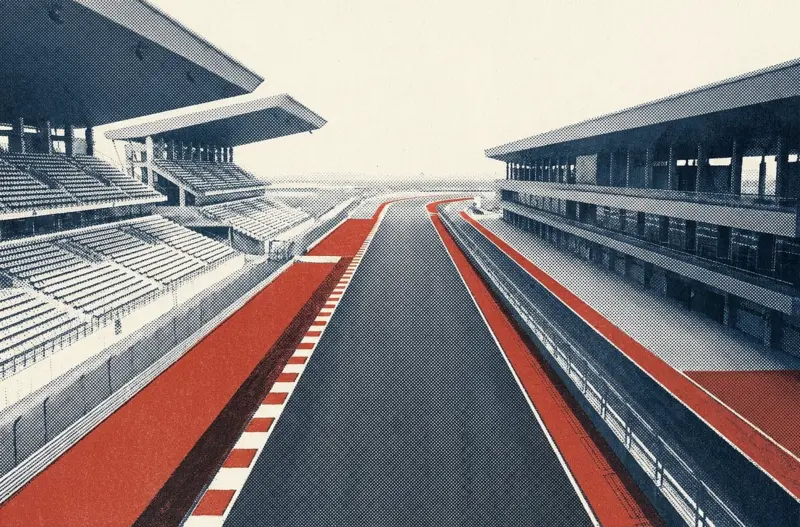

Thirteen years after Formula 1 left India, four things have shifted at once - a fan base of 79 million, a promoter with the balance sheet to carry $50 million hosting fees, a Gulf calendar disrupted by war, and a policy establishment that has understood the lesson of 2013.
The Buddh International Circuit has been silent for thirteen years. The asphalt is intact. The grandstands are intact. The pit lane is intact. What the track has lacked, since Sebastian Vettel won his fourth world championship on it in October 2013, is a race.
On 13 April, Union Sports Minister Mansukh Mandaviya stood at the circuit and told reporters that India would "surely have Formula 1 races in 2027." The line made the evening bulletins. It was the second piece of news from Buddh inside six weeks.
Five weeks earlier, the Racing Bulls driver Arvid Lindblad - nineteen years old, of Indian heritage through his mother, a week away from his Formula 1 debut in Melbourne - had driven Vettel's 2012 championship-winning Red Bull around the same track. Karun Chandhok, the former grand prix driver, took a current-generation VCARB car out on the same day. The footage travelled widely. Formula 1 was at Buddh again, if only for an afternoon.
The question hanging over both visits is whether the silence is ending.
The case that it is rests on a specific claim: that the conditions for a second Indian Grand Prix have converged for the first time since the first attempt failed. Four conditions in particular. A domestic fan base large enough that Formula 1's own commercial machinery can no longer treat India as a peripheral market.
A private promoter with the balance-sheet strength the sport now demands of its hosts. A 2026 calendar disruption that has forced the FIA to think seriously about where the sport's growth regions actually lie. And, underpinning all three, a policy establishment that appears to understand - in a way the Uttar Pradesh government of 2011 did not - why the first Indian Grand Prix ended after three seasons.
That is what is at stake in the 2027 question. It is larger than a race. India has already secured the 2030 Commonwealth Games and has mounted a serious bid for the 2036 Summer Olympics. The country that will stage those events cannot also be the country that lost its Formula 1 slot to a tax dispute and never recovered it. A returning Indian Grand Prix would register internationally as the moment the 2013 exit stopped being read as evidence of what India cannot do. Continued absence registers as the opposite.
The 2013 exit became a specific piece of evidence - the one international observers still reach for when they doubt India's readiness to host events of this scale. That reading rests on what happened at Buddh between 2011 and 2013.
India hosted three successive Formula 1 Grands Prix at Buddh from 2011 to 2013. Vettel won all three. The 2013 edition - the race at which he sealed his fourth consecutive drivers' championship - should have been the circuit's arrival on the global calendar. Instead, it was the circuit's farewell.
The event failed on a single administrative decision. The Uttar Pradesh government of the time classified Formula 1 as entertainment rather than sport. That classification stripped the race of the tax treatment available to athletic competitions and replaced it with entertainment taxes and heavy customs duties on the high-value technical equipment a Formula 1 race requires - engines, transmissions, telemetry, the hundreds of tonnes of freight that cross borders for every round. The financial framework buckled under the new costs and the litigation that followed. Formula 1 left.
The lesson the sport drew from the exit was that India's problem had been a policy problem. The inaugural race in October 2011 drew a near-capacity crowd of around 95,000 on race day. Turnout softened in the next two editions but remained commercially viable. The event failed because a tax architecture designed for concerts was applied to a global sporting competition.
This is the distinction the 2013 exit forced on to the record, and it is the distinction the 2026 revival talk has to answer to. A well-run event can still fail if the state's policy framework treats it as something it is not.
What has changed since 2013, and what has not, decides whether the second attempt is structurally different from the first.
The audience has changed.
A 2019 survey by Formula 1's commercial rights-holder identified India as one of the five largest fan markets in the world, at 31 million followers. A 2025 survey by Formula 1 and the Motorsport Network, polling more than 100,000 fans across 186 countries, put the Indian number at 78.8 million - large enough that India now figures in the sport's strategic calendar conversations in a way it did not a decade ago. Seventy-five per cent of Indian respondents who had not been to a race said they intended to attend one. Ninety per cent said a home race would deepen their connection to the sport.
The commercial indicators tell a similar story. The 2025 Joseph Kosinski film centred on a fictional Formula 1 team, starring Brad Pitt, grossed over Rs 125 crore at the Indian box office - its biggest non-United States market and the highest-grossing Hollywood release in India that year.
FanCode, Formula 1's exclusive streaming partner in India, has doubled its user base across all sports from 100 million in 2024 to more than 200 million in 2026 - a platform-wide figure rather than an F1-specific one, but one in which Formula 1 is among the sharpest drivers of subscriber growth. Indian viewership numbers for grand prix weekends are now routinely cited by rights-buyers in the sport's internal commercial discussions.
These are the kind of numbers circuit promoters and rights-holders put on the table when bidding for calendar slots. The 2011-13 Indian Grand Prix was commercially promising; the 2027 case rests on a domestic market an order of magnitude larger.
The promoter problem is the second change. In 2011, the Indian Grand Prix was staged by the Jaypee Group, a real-estate and infrastructure conglomerate whose core businesses went into sustained distress in the decade that followed. The Buddh circuit became a stranded asset inside a stranded company, and the financial structure behind the original race became unviable well before the tax litigation finished the job.
In 2026, Jaypee's assets - including the circuit - are moving through the insolvency process and are being acquired by the Adani Group. Karan Adani, managing director of Adani Ports and Special Economic Zone, has publicly said the group intends to revive the race.
The acquisition is pending and contingent on the bankruptcy-code resolution running its course, which remains a material uncertainty. What is no longer uncertain is that the promoter question has a serious answer. A race that now commands hosting fees of upwards of $50 million a year requires a promoter with the balance sheet to carry those fees and the operational credibility to satisfy Formula 1's corporate structure. Adani has both.
The third change is external. Formula 1's 2026 season was built around a record 24-race calendar. That calendar has since been reduced to 22. In March 2026, the FIA and Formula 1 cancelled the Bahrain Grand Prix scheduled for 10-12 April and the Saudi Arabian Grand Prix scheduled for 17-19 April, after Iranian retaliation to United States and Israeli air strikes made operations in both countries untenable. A five-week gap now sits between the Japanese and Miami rounds. No timeline has been offered for the return of either race.
This matters because of how concentrated the sport's Gulf footprint has become. Bahrain, Saudi Arabia, Abu Dhabi, and Qatar collectively host four of the 24 rounds - a concentration that reflected a decade of commercial courtship by the region's sovereign-backed promoters and paid the sport handsomely in hosting fees. It has also produced a calendar whose vulnerability to a single geopolitical event has now been demonstrated. The FIA's internal calculation about regional diversification has changed.
Hosting agreements are long and contractual priority will return to Bahrain and Saudi Arabia the moment conditions allow, so the 2027 opening is narrow rather than wide. But the opening is real, and it exists for the first time in more than a decade.
A market the size of India, with a fan base on the trajectory Formula 1's own surveys describe, is the obvious candidate to benefit from any calendar rebalancing. The Singapore Grand Prix - a race Formula 1 commercial executives still describe as the template for what an Asian night race can achieve - has generated, by the Singapore Tourism Board's own estimates, more than $1.5 billion in incremental tourism receipts since its 2008 debut. The economics of an Indian race weekend would not map directly on to Singapore's. The direction of travel would.
Against all of this sits the counter-case, and it is worth taking seriously because the case for return has so far mostly been argued in its absence.
The sceptic's first point is that the 2011-13 turnout trajectory was not a success story. The inaugural weekend drew a near-capacity crowd. The second year did not. By the third year, the organisers were papering sections of the grandstand. A country with a large television audience is not automatically a country with a large ticket-buying audience, and the Buddh track's location - well outside the NCR core, with access infrastructure that was adequate in 2011 and has not kept pace since - remains a real constraint. Singapore works partly because the circuit is the city. Buddh is the opposite of that.
The second point is that the Adani acquisition is still pending. Insolvency resolutions in Indian courts have a history of slipping. A commitment to revive a race is not the same as the resolved ownership and capital structure that Formula 1's corporate side will want to see before it opens a calendar slot.
The third point is that policy alignment at the Union level does not guarantee policy alignment at the state level. The tax classification that sank the 2011-13 race came out of Lucknow. Uttar Pradesh in 2026 is governed differently from the Uttar Pradesh that made that call, and the current state administration has been visible in sports-event bidding in ways its predecessor was not. But any long-dated hosting agreement has to survive more than one state government. The 2030s will see multiple Assembly elections in UP before the fifth or sixth running of a revived Indian Grand Prix. The risk is real.
The fourth point is the calendar itself. Formula 1 has 23 confirmed rounds for 2027 and a framework that prioritises incumbents and existing commercial relationships. Bahrain and Saudi Arabia have contractual priority for their slots once the region stabilises. India's entry, even under optimistic assumptions, most likely means a 24th round rather than a replacement for a cancelled one, and adding a round takes negotiation with the existing hosts whose calendar position would shift.
The sceptic's composite position is that the 2027 date the Sports Minister has put into circulation is politically useful but commercially premature, and that a 2028 or 2029 race is the realistic outcome even if everything the optimistic case predicts goes right.
This is where the rebuilt case has to answer honestly. 2027 is tight. A formal hosting agreement with Formula 1 and the FIA is a multi-year instrument, and the supporting architecture - the tax classification, the promoter's resolved capital structure, the local-level operational commitments at the circuit and in the access infrastructure around it - has to be in place well before the paperwork is signed. The minister's 2027 is better read as a statement of intent about the window rather than a reliable date for lights-out at Buddh.
What the Indian side now needs, beyond intent, is a commercially structured long-term hosting agreement that settles the tax classification question permanently, establishes the promoter's capital and credibility, and pays the hosting fees today's calendar commands.
But what the 2011-13 experience lacked, and what the 2026 picture contains, is the rest of the list. A fan base of the scale that rights-holders cannot ignore. A promoter whose balance sheet can carry the fees. A geopolitical reshuffling that has opened a window in a calendar that had closed. And a policy establishment that, on the available evidence, has understood the lesson of the first attempt.
Formula 1 and Red Bull Racing do not stage expensive show runs at tracks they consider closed. The March 2026 drives at Buddh - by a teenager one week from his grand prix debut, and by the country's most recognisable former Formula 1 driver - were the sport's commercial machinery reading the same convergence the minister was about to announce.
Kush Maini, the Bengaluru-born Formula 2 driver, is Alpine's test and reserve driver in Formula 1; Lindblad has become the first grand prix driver of Indian heritage to start a race since Karun Chandhok in 2011. The pipeline is thin, but it is no longer empty.
What happens next depends on whether both sides can move faster than Formula 1's calendar process normally allows. The Buddh track is still intact. The grandstands are still intact. The question is whether a second grand prix will turn out to have been delayed by thirteen years - or whether the silence is what the track's history turns out to be.
On the evidence now available, the first reading is the one that looks more likely for the first time since the silence began.