
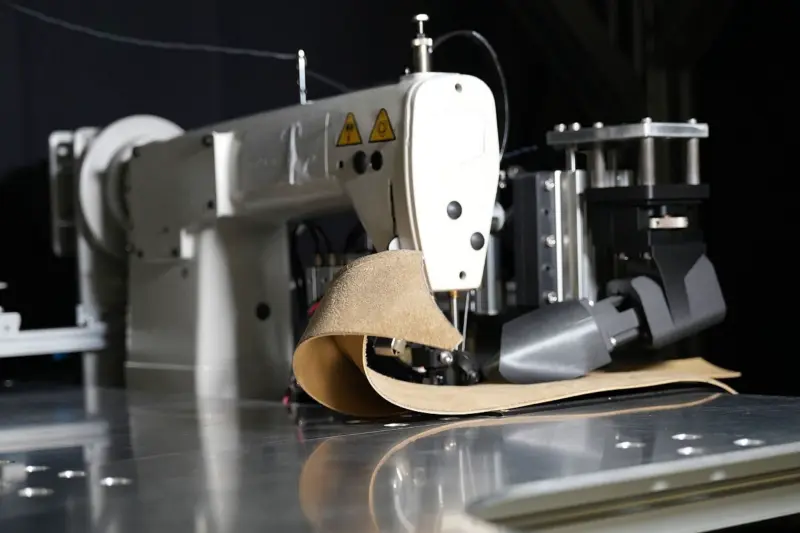

AI-powered sewing robots are edging toward commercial reality. India's garment sector - 45 million workers, $37 billion in exports - has perhaps a decade to prepare.
The images arrived without context, as the most unsettling ones usually do. In a series of clips circulating across Indian social media in early April 2026, factory workers could be seen hunched over industrial sewing machines with small cameras mounted on their foreheads.
The footage was shaky, intimate, first-person - the kind of video a surgeon might record during an operation. Except these were not surgeons. They were garment workers, and the cameras were capturing every stitch, every pinch of fabric between thumb and forefinger, every micro-adjustment of a wrist navigating cloth through a needle at speed.
The clips went viral almost instantly. Indian news channels ran breathless segments. The phrase "training their replacements" trended on X. One widely shared comment captured the mood: "It's like being asked to write the manual for the person who is going to fire you." Another was blunter: "They're digging their own graves."
The outrage was not entirely well-targeted. Multiple Indian media outlets noted that no official confirmation had linked the specific viral videos to any AI training programme. The explanation - that workers were recording 'egocentric footage' destined to teach robotic systems how to replicate human dexterity - was, as one report put it, the most widely circulated theory rather than established fact.
But the theory stuck because it described something that is genuinely happening, at enormous scale, elsewhere. Micro1, a Palo Alto startup led by CEO Ali Ansari, has recruited roughly 4,000 workers across 71 countries to strap iPhones to their heads and film themselves performing manual tasks.
The company collects over 160,000 hours of video per month, selling the data to humanoid robot developers - the likes of Tesla, Figure AI, and Agility Robotics - who use it to train machines through imitation learning. Ansari has estimated that robotics companies now spend more than $100 million annually buying real-world movement data. Scale AI has gathered over 100,000 hours of similar footage. The industry will ultimately need "billions of hours," according to Micro1's VP of robotics data.
Workers in India who participate in such programmes reportedly earn $230 to $250 per month - a modest premium over standard textile wages. They are vetted by an AI agent named Zara that conducts automated interviews. Critically, they are not told which companies will purchase their recordings or how the data will be deployed.
"People are opting into doing this. They could stop the work at any time," Ansari has told CNN. But as Yasmine Kotturi, a professor of human-centred computing at the University of Maryland, has argued, workers must be informed of where the technology might go and how it might affect them.
The ethical dimensions go further than disclosure. Workers face what critics have called "double exploitation" - performing physically demanding labour for standard wages while simultaneously having lifetime-honed skills harvested as training data, without additional compensation tied to the downstream value that data creates.
MIT Technology Review's investigation into the phenomenon revealed that intimate details of workers' homes and daily routines are incidentally captured on the head-mounted cameras, raising privacy concerns that India's still-evolving data protection framework has not yet addressed. The power asymmetry is stark: a garment worker in Tirupur earning ₹19,000 a month generates footage that flows to robotics companies valued in the billions. No mechanism exists to share that value back.
What these workers are not being told - what the viral footage inadvertently revealed - is that the machines their movements might one day train are no longer hypothetical. They are being built, tested, funded, and in some cases, prepared for commercial sale. And they are being built to do exactly what those hands do.
The $0.04 T-shirt
In the spring of 2025, Kaia Rhodes, a robotics entrepreneur based in Atlanta, announced a new venture on X. Anatar, she wrote, would transform US apparel manufacturing through integrated design, robotics, and AI. The posts were bold in the way that startup founders' posts tend to be - heavy on vision, light on caveats.
But the numbers she cited were arresting. Anatar's automation, she claimed, would enable a single operator to set approximately 2,500 shirt pockets in an eight-hour shift at a cost of $0.10 each, compared to 316 pockets at $0.46 on a standard machine. The company projected a path to sewing a complete T-shirt for just $0.04 in labour cost - a reduction of roughly 99 per cent.
The claims have not been independently verified. Anatar is pre-revenue and building toward a manufacturing facility in Florida. But the venture has attracted backing from the Chang Robotics Fund and secured membership in three defence-related consortia, including the Advanced Robotics for Manufacturing Institute and the Defence Industrial Base Consortium. Rhodes did not respond to requests for comment.
Anatar is one of at least half a dozen startups now racing to crack what has long been considered the last great unsolved problem in manufacturing automation: sewing. Unlike welding, painting, or assembly - processes that industrial robots mastered decades ago - sewing involves manipulating soft, flexible, unpredictable material. Fabric deforms under pressure. It bunches, stretches, and slips. Teaching a machine to handle it the way a human seamstress does has defeated engineers for generations.
The furthest along is SoftWear Automation, also based in Atlanta, whose origins trace back to a DARPA-funded research programme at Georgia Tech.
The US defence establishment's interest in automated sewing was not sartorial - the military wanted domestic capacity to produce uniforms and equipment without depending on foreign supply chains, a concern that has only intensified since the pandemic exposed the fragility of globalised manufacturing. SoftWear's patented Sewbot worklines use high-speed computer vision to track the needle and coordinate fabric movement in real time, making thousands of micro-corrections per second.
In August 2025, the company closed a $20 million Series B1 funding round led by BESTSELLER, the Danish fashion group behind Jack & Jones and Vero Moda. The investment was significant not merely for its size but for its source: when a major fast-fashion conglomerate puts money into sewing robots, it is making a strategic bet about where its own production will eventually move.
SoftWear's third-generation T-shirt Sewbot, expected to reach commercial availability in the first half of 2026, is claimed to produce nearly twice as many finished T-shirts in an eight-hour shift as a manual sewing line produces in 24 hours.
The technical approaches vary. Sewbo, a Seattle startup that has worked with Siemens and attracted the interest of Levi's, takes a radically different tack - temporarily stiffening fabric with a water-soluble thermoplastic polymer so that standard industrial robots can grip and manipulate it as if it were rigid. The polymer washes out at the end.
In Munich, sewts has raised €7 million to develop AI systems that use finite element simulations to predict how textiles will behave before robots touch them, closing what it calls the automation gap in textile handling. Silana, a Vienna-based startup accepted into Stanford's StartX accelerator, claims its system can produce garments four times faster than conventional sewing and has reported pre-orders for close to 200 machines.
Perhaps most symbolically, Robotextile has partnered with C&A, one of Europe's largest fashion retailers, to build a "Factory for Innovation in Textiles" in Mönchengladbach, Germany - explicitly reshoring jeans production from Asia. The company's rationale is blunt: reshoring prevents overcapacity, benefits the environment, and strengthens the local economy.
The total disclosed investment across all of these companies remains small - perhaps $30 to $35 million in aggregate. Set against a global garment industry worth hundreds of billions, this is negligible. But every dollar is pointed in the same direction: making clothes where they are sold, not where labour is cheapest.
There is, however, an important cautionary tale embedded in this narrative, and honest reporting requires telling it. In 2016, Adidas opened its first Speedfactory in Ansbach, Germany, followed by a second in Atlanta - high-profile bets on automated shoe production in high-wage countries. Both were closed by 2020. The technology was transferred to existing suppliers in Vietnam and China.
The lesson was sobering: automation did not reshore production. It migrated to where supplier ecosystems and manufacturing know-how already existed. The question for SoftWear, Anatar, and their peers is whether AI-era sewing automation - built on imitation learning, computer vision, and the very egocentric data now being harvested from developing-world workers - will follow a different trajectory.
Forty-five million pairs of hands
To understand what is at stake, consider the scale of the industry these machines are being designed to disrupt.
India's textile and garment sector exported a record $36.6 to $37.7 billion in the fiscal year ending March 2025 - roughly 8.4 per cent of the country's total merchandise exports and between 2 and 2.3 per cent of GDP.
The United States alone absorbs close to $11 billion in Indian textile exports, making it the sector's single largest market. The industry employs an estimated 45 million people directly, second only to agriculture, and supports over 100 million more in allied trades: dyeing, finishing, embroidery, logistics, cotton farming.
The workforce is overwhelmingly female, disproportionately migrant, and concentrated in a handful of clusters - Tirupur in Tamil Nadu for knitwear, Bengaluru and Noida for woven garments, Surat for synthetic fabrics, Ludhiana for woollens.
Average manufacturing wages sit around $195 per month, higher than Bangladesh's $135 to $140 but far below China's $600 to $800. These are not, for the most part, workers with transferable skills or fallback options. A woman stitching T-shirt hems in Tirupur has typically migrated from a rural district, possesses limited formal education, and has spent years developing a manual dexterity so specific that it is simultaneously her greatest asset and her greatest vulnerability: it is precisely the skill the robots are being trained to replicate.
The industry's structure compounds its vulnerability. An estimated 70 per cent of the sector consists of small and medium enterprises operating on margins thin enough to be wiped out by a single season's tariff change. And in 2025, that is precisely what happened.
Under the Trump administration's reciprocal trade actions, effective duties on Indian textiles spiked to 50 per cent by September 2025 after a punitive surcharge linked to India's Russian crude oil purchases. Order volumes to the US fell by as much as 70 per cent for staple categories. An estimated 100,000 to 200,000 jobs were threatened in key textile towns.
A February 2026 interim trade deal brought the rate down to 18 per cent, which inadvertently gave India a competitive edge - Bangladesh faced 37 per cent and Vietnam 46 per cent. But the whiplash exposed a structural weakness: an industry built on cost arbitrage and dependent on a single dominant export market is inherently fragile, regardless of what robots can or cannot do.
The episode also demonstrated something else: that the US market India depends on is itself undergoing a strategic recalculation about where its goods should come from, and automation is central to that recalculation. Every tariff spike strengthens the business case for reshoring, and every reshoring dollar flows toward the robotic systems that would make domestic production viable.
India's relationship with automation tells its own story. The country has an estimated 5 to 7 industrial robots per 10,000 manufacturing workers, among the lowest ratios in the world. China has 470. South Korea has 1,012. The global average is 162.
Within India's textile sector specifically, robot adoption is negligible. Automated fabric cutting machines have penetrated some larger export-oriented facilities. Warehousing and logistics operations are beginning to adopt robotic systems. But sewing - the most labour-intensive step, employing the most workers - remains almost entirely manual.
This is not irrational. At $195 a month per worker, the economic case for a sewing robot simply does not close for most product categories. A Sewbot workline represents a capital expenditure that only makes sense at wage levels several multiples higher. India's low wages are, in a perverse way, its best defence against automation, precisely because they reflect the poverty that automation threatens to entrench.
The ladder and the question of whether it still stands
What makes the Indian textile story more than an industry analysis - what elevates it to a question about the future of economic development itself - is the role that garment manufacturing has played in the modern history of how poor countries become richer ones.
The pattern is sometimes called the 'flying geese' model, after the Japanese economist Kaname Akamatsu. As wages rise in one country, labour-intensive manufacturing migrates to the next, cheaper one. Japan industrialised through textiles after the Second World War, then moved up to electronics and automobiles, ceding garment production to South Korea. Korea followed the same trajectory, passing the baton to Taiwan and the Southeast Asian economies.
They, in turn, lost garment work to China, which has now seen its own manufacturing wages rise high enough ($600 to $800 per month) that basic stitching is migrating again, to Bangladesh, Vietnam, and India.
This escalator has been the single most reliable mechanism for mass poverty reduction in modern history. Hundreds of millions of people have ridden it out of subsistence farming and into the lower middle class. India, with its vast, young, and underemployed population, has bet heavily on being the next to board.
But a growing body of economic research suggests the escalator may be slowing - or, in the most pessimistic readings, preparing to stop. Harvard's Dani Rodrik documented in an influential 2016 paper that developing countries are reaching their manufacturing employment peaks sooner, and at far lower income levels, than early industrialisers did. Britain placed over 30 per cent of its workforce in manufacturing at the height of its industrial revolution. India peaked at roughly 13 per cent - a phenomenon Rodrik calls 'premature deindustrialisation'. Countries are, in effect, deindustrialising before they have fully industrialised.
Automation sharpens this dynamic considerably. If robots can sew T-shirts in Atlanta or Mönchengladbach at costs competitive with Tirupur, the incentive for Western brands to source from low-wage countries weakens. The geese stop flying. Carl Benedikt Frey of the Oxford Martin School has estimated that 69 per cent of Indian jobs are susceptible to automation.
MIT's Daron Acemoglu warned in 2025 that persistent US tariffs would compel firms to reshore supply chains - but through AI and robots, not human workers. The reshoring data already points this way: 244,000 reshoring and FDI-related manufacturing jobs were announced in the United States in 2024, with reshoring outpacing new foreign direct investment at a record ratio of 66 to 34.
Yet the picture is not uniformly bleak, and overstating the imminence of disruption would be as misleading as ignoring it. A major study by Hallward-Driemeier and Nayyar, published through the Brookings Institution and World Bank, found that robots "have not grounded the flying geese, at least not yet."
Only 3 per cent of their sample showed automation levels high enough to redirect foreign investment flows away from developing economies. The Adidas Speedfactory's failure is a concrete reminder that reshoring through automation has been attempted before and found wanting.
Mark-Alexandre Doumba, Gabon's minister of the digital economy, coined a useful phrase in a March 2026 essay: "premature automation" - the risk of countries embracing AI before they have the infrastructure, institutional capacity, or labour-market mechanisms to absorb the consequences. It is a mirror image of Rodrik's concept, and the two together describe the trap: deindustrialising before you are rich, while the technology that caused it arrives before you are ready.
China offers a preview of the mathematics. Its manufacturing workforce has shrunk from 115 million to below 85 million since 2013, a loss of some 30 million jobs, even as the country's manufacturing exports hit record highs. But China's per capita income at the point of this transition was roughly five times India's. It could - just about - absorb the displacement into a growing services economy. India, with a per capita GDP under $3,000 and a services sector that has so far failed to generate mass employment for low-skilled workers, has far less margin for error.
The horizon
So how worried should India be? The honest answer - the one that neither the alarmists nor the dismissives will like - is: not yet, but soon.
Full automation of garment sewing remains, for the moment, confined to the simplest product categories. T-shirts, pillowcases, towels, basic straight-seam items - these are where the Sewbots and their competitors are making their first credible claims.
Complex garments involving collars, cuffs, zippers, darts, and tailored construction are years away from automated production, if they are achievable at all. The total venture capital deployed into sewing automation startups amounts to $30 to $35 million - serious money for seed-stage robotics, but a rounding error against a global apparel trade worth over $800 billion.
India's low wages extend the timeline further. At $195 per month, the cost of a human worker remains a fraction of the amortised expense of a robotic sewing line. The economic crossover point - the moment at which it becomes cheaper to automate than to employ - is further away for India than for virtually any other major garment exporter.
But the correct planning horizon for an industry that employs 45 million people is not next year. It is 2030, 2035, and beyond. Basic garments, precisely the category where automation bites first, are also the category that accounts for the bulk of India's mass textile employment. The technology is following a cost curve.
Each generation of Sewbot is faster, more accurate, and less expensive than the last. The egocentric data pipeline that did not exist five years ago is now delivering hundreds of thousands of hours of human movement footage to the companies training the next generation of robotic systems.
India's policy apparatus has not been idle. The Production Linked Incentive scheme for textiles, worth ₹10,683 crore, is designed to move the industry toward man-made fibre apparel and technical textiles - higher-value segments where Indian manufacturers can compete on more than cost alone.
The seven PM MITRA mega textile parks, backed by ₹4,445 crore, aim to create scale and infrastructure advantages. A third round of PLI approvals in April 2026 cleared 52 new projects attracting ₹6,708 crore in anticipated investment. The Cotton Mission, the handloom subsidies, the skilling programmes - the apparatus exists.
The question is whether anyone inside this apparatus is modelling the specific trajectory of sewing automation and planning for what happens when the cost curves cross.
Which product categories will hit automation cost-parity first? What is the skilling pathway for workers displaced from basic stitching - into higher-value garment work, into technical textiles, or out of the sector entirely? Are the MITRA parks being designed with automation resilience in mind - as integrated, technology-forward clusters that move Indian manufacturers up the value chain - or simply as larger versions of what already exists?
There are models to study. Bangladesh's garment industry, which faces the same automation threat with even greater concentration risk, has begun investing in lean manufacturing and vertical integration to raise productivity before robots arrive. Vietnam has deliberately courted higher-value electronics assembly alongside textiles, diversifying its manufacturing base.
India's advantage is that its domestic market is vast enough to absorb a significant share of its own textile production - unlike Bangladesh, which exports nearly everything it makes. A strategic shift toward serving India's own 1.4 billion consumers, rather than remaining primarily an export-processing economy for Western brands, could provide a buffer that smaller garment-producing nations lack.
India's textiles ministry almost certainly tracks these developments. The country's policymakers are not naive about the direction of technology. But tracking is not the same as planning, and planning is not the same as acting at scale.
A sector that employs more Indians than the entire population of Spain does not pivot quickly. The decisions that will determine whether India's garment workforce navigates the coming transition or is overwhelmed by it are decisions that need to be taken in the next few years - while the window is still open, while the robots are still learning, and while the cost curves have not yet crossed.
The cameras, after all, are still recording.