





For years, companies described artificial intelligence as a productivity tool.
Now, some executives are beginning to describe it as a workforce replacement strategy.
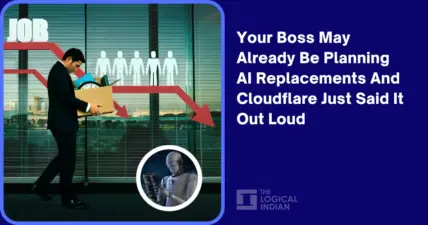
That shift became unmistakably clear when Cloudflare CEO Matthew Prince openly argued that AI-driven layoffs would become the "new normal" for businesses after the company eliminated around 1,100 jobs, nearly 20% of its workforce, in May 2026.
The statement was remarkable not only because of the scale of the layoffs, but because of the language surrounding them.
Prince reportedly framed AI not as a support system for workers, but as a mechanism for deciding which employees could be replaced. The company simultaneously emphasized that the layoffs were not caused by financial distress, making the message even more significant for global labor markets.
That distinction matters. Historically, mass layoffs were usually linked to falling revenues, recessions or collapsing demand. But AI-era layoffs are increasingly happening even inside profitable technology companies.
Cloudflare may now represent a broader turning point in how corporations think about labor itself.
Corporate AI Anxiety Rising
The anxiety around AI and employment has been building since the launch of ChatGPT in late 2022.
Initially, many executives described generative AI as a collaborative tool that would augment workers rather than replace them. But over the past two years, corporate messaging has gradually shifted toward automation-led restructuring.
The World Economic Forum's Future of Jobs Report 2025 suggests the transformation could become massive by the end of this decade. The report surveyed more than 1,000 employers representing over 14 million workers across 55 economies and found that 86% of employers expect AI and information-processing technologies to fundamentally transform their businesses by 2030.
The same report projected that 170 million new jobs could emerge globally by 2030 while 92 million existing roles may disappear.
Those numbers are often presented optimistically because the net balance remains positive. But that framing hides a harsher reality.
Job creation and job displacement rarely happen simultaneously, geographically evenly or across identical skill groups.
The people losing jobs are not always the same people qualified for the newly created AI-era roles.
White Collar Jobs Vulnerable
The latest wave of concern is especially focused on white-collar employment.
Unlike earlier automation cycles that primarily disrupted manufacturing or repetitive industrial labor, generative AI is increasingly capable of performing tasks associated with software coding, legal research, customer support, marketing analysis and administrative operations.
That is changing how companies think about headcount.
Cloudflare's layoffs reflect a growing belief inside the tech sector that AI can now eliminate portions of knowledge-based work at scale. Similar conversations are emerging across Silicon Valley, where companies are under investor pressure to improve efficiency after years of aggressive hiring.
Even OpenAI CEO Sam Altman recently acknowledged that fears around white-collar job destruction may have been overstated in the short term, although the broader concern remains unresolved.
The uncertainty itself has become economically significant.
Companies no longer need to fully automate entire professions to reduce hiring. They only need enough AI capability to slow recruitment, shrink junior teams or reduce operational dependency on entry-level workers.
That process may already be underway.
Entry Level Hiring Weakens
One of the clearest labor market signals is emerging among younger workers.
Researchers cited by Business Insider found that entry-level hiring in the United States had fallen 29% from pre-pandemic levels by 2025.
The researchers argued that remote work, not AI alone, was a major factor behind the decline. But they also noted that generative AI continues reshaping junior roles by automating repetitive tasks traditionally assigned to entry-level employees.
That trend could create long-term structural problems.
Many industries historically relied on junior employees learning through routine work before advancing into higher-value roles. If AI absorbs much of that foundational work, companies may eventually face shortages of experienced talent pipelines.
The labor disruption may therefore become gradual rather than sudden.
Instead of dramatic overnight unemployment spikes, economies may experience slower hiring, weaker wage growth and fewer opportunities for early-career professionals.
Productivity Gains Drive Decisions
What makes the AI transition different from earlier tech cycles is the scale of productivity expectations.
Companies increasingly believe AI can improve output without proportionally increasing labor costs. Investors are rewarding firms that demonstrate operational efficiency through automation.
Cloudflare itself highlighted surging internal AI usage before the layoffs. According to reports, the company's use of AI tools increased sixfold within three months. That speed matters because technological adoption cycles are accelerating.
In previous industrial revolutions, businesses often required years to integrate transformative technologies into operations. Generative AI tools are being deployed across industries within months. This creates intense pressure on workers to adapt rapidly.
The World Economic Forum warned that skill gaps remain one of the biggest barriers to workforce transformation globally.
The challenge is not simply learning AI tools. It is determining which human capabilities will remain economically valuable once AI becomes deeply embedded across workplaces.
Human Skills Become Critical
Despite growing automation fears, most labor economists do not believe AI will eliminate human work entirely. Instead, the likely outcome is a restructuring of tasks rather than complete removal of professions.
Research increasingly suggests that roles involving strategic thinking, emotional intelligence, relationship management and complex judgment remain harder to automate fully. But adaptation may not happen smoothly.
Cloudflare's layoffs reveal how quickly corporations can move from AI experimentation to workforce reduction. What was once discussed as a distant possibility is now becoming active boardroom strategy.
The bigger question is no longer whether AI will affect employment. It is how aggressively companies will use it to redefine the economics of human labor itself.
Now, some executives are beginning to describe it as a workforce replacement strategy.
Corporate AI Anxiety Rising
White Collar Jobs Vulnerable
That is changing how companies think about headcount.
The uncertainty itself has become economically significant.
That process may already be underway.
Entry Level Hiring Weakens
That trend could create long-term structural problems.
Productivity Gains Drive Decisions
Human Skills Become Critical