




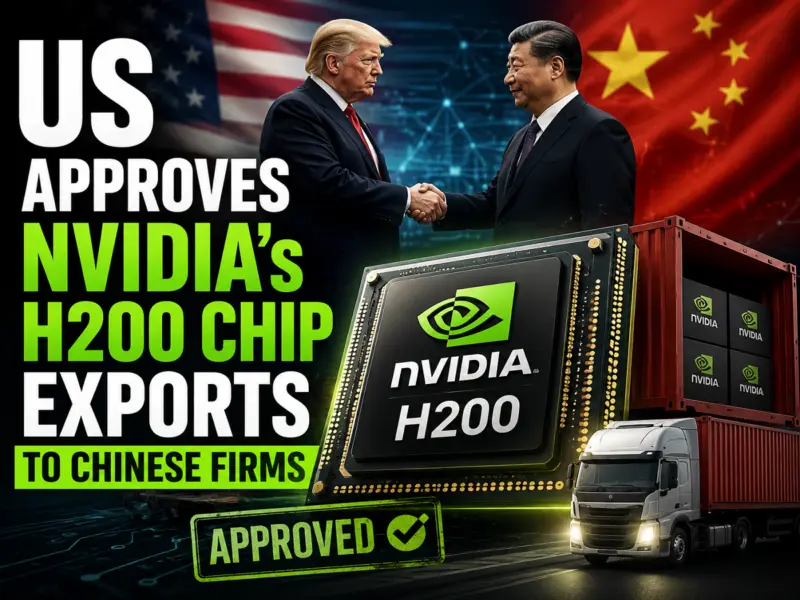

The big news coming from the US-China Summit 2026 is that President Trump has approved the export of Nvidia's second-most-powerful chip, the advanced H200 artificial intelligence chip, to ten Chinese technology firms, including Alibaba, Tencent, ByteDance, and others, Reuters reported, citing sources familiar with the matter.
This decision followed a high-stakes meeting between US President Donald Trump and his Chinese counterpart, President Xi Jinping, aimed at reviving stalled efforts to sell H200 chips to China.
The development is believed to be the result of efforts by Jensen Huang, the founder and CEO of Nvidia. He also joined the US delegation after receiving a late invitation from Trump through a personal call.
Huang's visit to China was seen as a breakthrough for Nvidia in the Chinese market, as the chipmaker has faced export restrictions and growing competition from domestic rivals.
Apart from Alibaba, Tencent, and ByteDance, JD.com is also among the approved buyers, according to reports. Distributors, including Lenovo and Foxconn, have received authorization to distribute the chips in China.
According to reports, each approved customer is allowed to purchase up to 75,000 H200 chips under US licensing conditions.
Why Are Chinese Firms Delaying Purchases Despite Approval?
Although Chinese firms have received the green light from the US, they are reportedly delaying finalizing purchases amid concerns within China over foreign technology companies. China has intensified scrutiny of overseas firms as it seeks to accelerate the development of domestic AI chips, particularly through Huawei.
This uncertainty reflects the growing tech rivalry between Washington and Beijing. Nvidia controls around 95% of China's advanced AI chip market, which accounts for about 13% of its total revenue.
According to the report, the export deal is approved on the condition that Chinese buyers will not use the chips for military purposes, must meet strict security standards, and that Nvidia must certify sufficient inventory within the United States before the sale is completed.
Trump has also negotiated a structure under which the US government will receive 25% of the revenue generated from the sales. The agreement also states that the chips must transit through US territory before being shipped to China.
Why Is China Hesitant to Buy Nvidia Chips?
China wants to reduce its dependence on foreign technologies, especially in critical industries such as semiconductors, artificial intelligence, and cloud computing.
According to Chinese leaders, relying on US technology could lead to long-term security risks. Consequently, China has accelerated its efforts to develop domestic AI chips and semiconductor infrastructure. Washington's export controls have reinforced those concerns.
Chinese company Huawei is playing a leading role in making China self-sufficient in technology. Chinese firms are being encouraged to use domestic chips rather than relying on Nvidia. Top AI firms like DeepSeek have emphasized using local semiconductor solutions.
Large-scale purchases of Nvidia chips could undermine China's domestic industry at this critical stage of development.
US Experts Criticize the Move
The potential sales deal has drawn criticism from hardliners in Washington, who argue that allowing Nvidia to sell advanced AI chips to China could weaken America's technological edge.
Chris McGuire of the Council on Foreign Relations told Reuters, "Any deal that allows Nvidia to sell more chips to China means fewer Nvidia chips for US firms and a smaller US lead in AI over China."
Nvidia Deal's Effect on the Global AI Industry
The uncertainty surrounding Nvidia's China business could have major implications for the global artificial intelligence industry.
If China does not gain access to Nvidia chips, it may accelerate efforts to create domestic alternatives, potentially reshaping the global semiconductor market over the next few years.
Restrictions on AI chip trade could fragment the global technology ecosystem into competing US and Chinese spheres. This may limit international collaboration, disrupt supply chains, and intensify geopolitical competition over emerging technologies.