
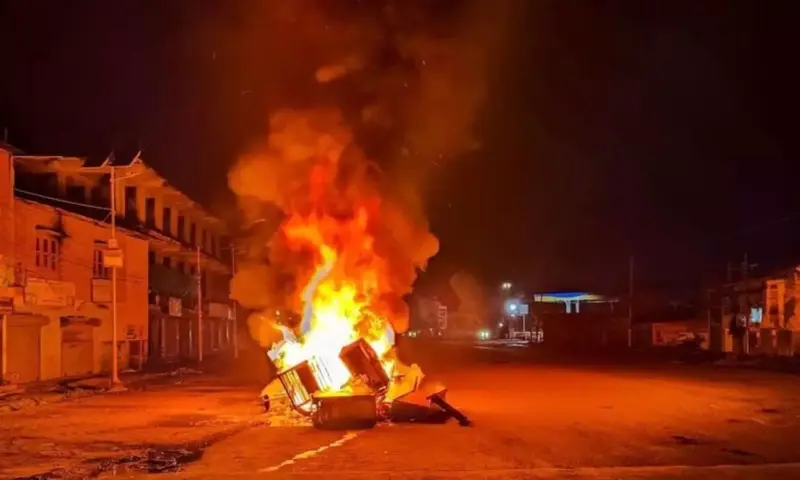

A file image showing a car torched amid ethnic violence in Manipur which erupted in 2023. (AT Photo)
On late Sunday morning in Imphal, three years after violence first tore through Manipur, a low-intensity IED blast near a crematorium close to the airport's cargo terminal briefly punctured the city's fragile calm.
It did not trigger panic. It did not spiral into fresh unrest. But it lingered as a quiet, unsettling reminder that the conflict that began on May 3, 2023 has not ended.
Across the state, the third anniversary of the unrest is marked not by closure but by commemoration and contestation.
Rallies in the valley, memorials in the hills, and conventions organised by civil society groups each carry their own memory of what happened and their own interpretation of why it happened.
The result is not a shared moment of reflection, but a mosaic of grief, anger and unresolved questions.
From rupture to stalemate
The violence that erupted during a "Tribal Solidarity March" in 2023 quickly escalated into one of the most severe ethnic conflicts in Manipur's recent history.
Entire neighbourhoods were emptied, homes were torched, and thousands were displaced as clashes between Meitei groups in the valley and Kuki-Zo communities in the hills intensified.
In the months that followed, the state moved from chaos to control. Security deployments increased. Arms were seized. Arrests were made. Large-scale violence subsided. But what replaced it was not peace. It was a stalemate.
Today, Manipur exists as a divided geography. The hills and the valley, once interconnected through trade, education and daily movement, now function as distinct spaces.
The so-called buffer zones, created as temporary security measures, have hardened into de facto boundaries, reinforcing separation not just in territory, but in trust.
The illusion of normalcy
In Imphal, markets have reopened, schools are functioning, and traffic moves along familiar routes. Yet, beneath this resemblance of normalcy, sporadic incidents of firing, arrests and weapons recoveries continue to be reported, a constant reminder that underlying tensions remain unresolved.
For civil society groups, this is the core of the problem. The state, they argue, has succeeded in containing the violence but has failed to address its causes. Security operations may have stabilised the situation, but they have not resolved it.
"Although the State has taken measures in the name of inclusive development and peace, we do not see tangible outcomes. Firing incidents, killings and security operations continue in both hill and valley areas. Arms are being recovered daily, people are being arrested, yet the core issues remain unaddressed," says Nahakpam Shanta, spokesperson, COCOMI.
Calls for a "practical, field-based review" of government actions reflect a growing impatience; a demand not just for intervention, but for outcomes.
"Today we have organised a convention to review the past three years - what has been done, what has not, the extent of damage, funds utilised, and to arrive at a public consensus on how to take these matters forward with both the State and Central governments," he adds.
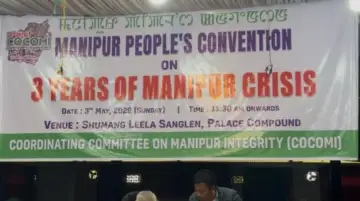
COCOMI organising a convention to review three years of Manipur Violence which erupted in 2023 (Photo: AT)
A battle of narratives
If the ground reality is fractured, the narratives surrounding it are even more so.
For sections of the political leadership, the conflict is not an internal ethnic rupture but a consequence of external pressures; particularly concerns around illegal infiltration and demographic change.
Former Chief Minister N. Biren Singh has framed the crisis differently, arguing it is being wrongly portrayed as an internal ethnic conflict.
Instead, he links the unrest to "illegal infiltration" and demographic concerns, insisting that Manipur's history is rooted in coexistence.
But this view is strongly rejected by sections of the Kuki-Zo community, who hold his leadership directly responsible for the crisis.
This framing seeks to reposition the crisis within a broader national security context. But this interpretation finds little resonance among many in the Kuki-Zo community, where the events of 2023 are seen through a sharply different lens - one of marginalisation, insecurity and state failure.
Perhaps the most visible expression of this breakdown is the observance of "Separation Day" across Kuki-majority districts such as Churachandpur, Kangpokpi and Moreh on Sunday.
The message is clear - for many, coexistence no longer appears viable. This is not just a political position. It is an emotional one, rooted in trauma and shaped by three years of lived separation.
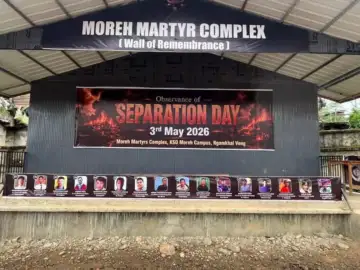
Observance of "Separation Day" across Kuki-majority districts in Manipur on Sunday (Photo: AT)
"The sad truth is, no matter how much you try to hide, Manipur will never be the same again. The trust deficit is so deep, and the mental and emotional wounds are so severe that we can never live together again," says Kuki activist Kelngoi Sakeibahkai
Over the past three years, this divergence has hardened into a deep trust deficit. What was once a conflict between communities has evolved into a conflict of perspectives, where each side holds a fundamentally different understanding of reality.
Three years on, Manipur is not defined by a single narrative, but by multiple, coexisting ones:
• For civil society, it is a crisis that has been managed but not resolved
• For the political establishment, it is a security issue shaped by external dynamics
• For sections of the Kuki-Zo community, it is a question of identity, safety and separation
• For academic voices, it is evidence of systemic limitations in addressing complex conflicts
These narratives do not intersect. They run parallel, occasionally colliding, but rarely converging.
Governance under strain
As competing narratives deepen, questions around governance have become more pointed. Academic observers have highlighted what they describe as a failure of both State and Central governments to move beyond crisis management towards conflict resolution.
The concern is not just about what has been done, but about what remains undone.
The slow pace of resettling internally displaced persons, the continued reliance on buffer zones, and the absence of a clear roadmap for reconciliation all point to a gap between administrative action and political resolution.
With the 2027 Assembly elections approaching, there is also unease about the direction of political discourse.
There is a risk that the conversation may shift towards blame and rhetoric rather than solutions, further entrenching divisions instead of bridging them.
The uncertain road ahead
Anniversaries are often moments of reflection, but in Manipur, this one feels more like a checkpoint than a conclusion.
The state has moved past the immediacy of violence, but not beyond its consequences. The wounds, physical, social and psychological, remain open. Trust, once fractured, shows little sign of repair.
Peace, for now, is defined not by reconciliation but by restraint. And as long as the underlying questions remain unanswered - about identity, security, justice and coexistence - Manipur's future will continue to be shaped by the unresolved tensions of its recent past.
Three years after May 3, the violence may have faded from headlines. But in Manipur, it still lives on - in memory, in politics, and in the competing truths that define its present.
By Mubasir Raji