

"Do you ask the same question to a male cricketer? Do you ask them who their favourite female cricketer is?"
That was Mithali Raj in 2017, calmly dismantling a question that revealed more about the ecosystem around her than about her.
Different example, same instinct: the need to anchor every conversation to the most dominant narrative in the room.
Nearly a decade later, her question still hangs in the air, unanswered, unlearned from, and, judging by what unfolded with Manu Bhaker this week, largely ignored.
Because here we are again.
At an event celebrating 75 years of Indian shooting, a space meant to honour precision, discipline, and a sport that has quietly delivered Olympic glory, a double Olympic medallist was asked about a 15-year-old cricketer.
Not about her craft. Not about her journey. Not about the weight of history she now carries. But about Vaibhav Sooryavanshi, Indian cricket's new-found star.
And just like that, the spotlight shifted.
The real issue: context, not curiosity
Let's be clear, this isn't about Sooryavanshi. His rise is extraordinary, his talent undeniable, and his story worth telling.
But not here. Not at an event dedicated to a sport that has fought, and continues to fight, for visibility, funding, and sustained attention. Not when the athlete in front of you has just rewritten India's Olympic history.
Because the problem isn't curiosity, it's context.
When you ask a shooter about cricket at a shooting event, you're not expanding the conversation. You're replacing it.
Indian sport doesn't just have a favourite child. It has a centre of gravity.
But what is problematic is how that dominance seeps into spaces where it doesn't belong.
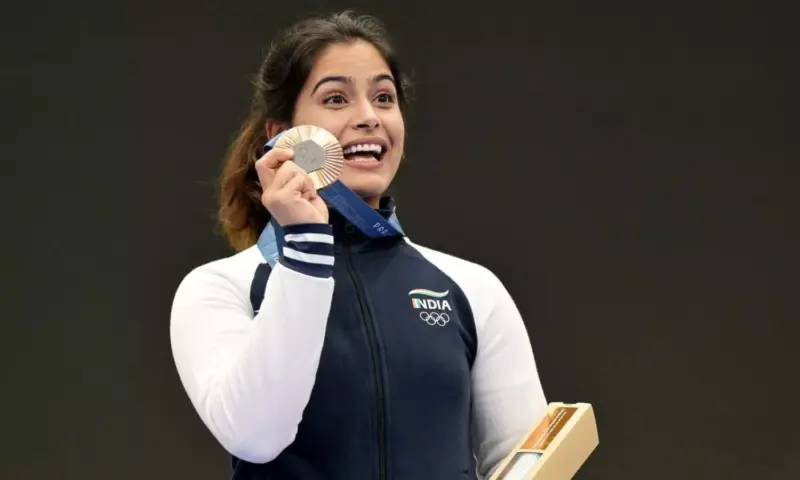
Consider who Bhaker is in that room. At 2024 Paris, she changed the scale of Indian shooting. Two Olympic bronzes, the first Indian woman shooter to stand on that podium, and the first Indian athlete in decades to win two medals at a single Games.
She reached the final in all three events she entered. She ended a long Olympic drought for Indian shooting. That is just the headline.
Before that, there was a Commonwealth Games gold with a record. Asian Games gold. World Championship medals. More than a dozen ISSF World Cup gold medals.
A career built across 10m and 25m pistol, across junior and senior levels, across years when shooting rarely held the country's attention for long.
This is what excellence in a non-cricket sport looks like in India: sustained, decorated, and still fighting for space.
And yet, even here, at an event meant to celebrate that very sport, the conversation bent towards cricket.
Not because Sooryavanshi isn't worth talking about. His rise is remarkable. But relevance is not universal. Context matters.
A shooting event is not a backdrop for a cricket storyline, just as an IPL press conference wouldn't be the place to ask a teenage batter about Olympic pistol finals.
That asymmetry is the point.
Cricket doesn't just dominate coverage in India; it defines the frame. It is the default reference, the easy pivot, the guaranteed headline. And over time, that dominance has created a reflex: when in doubt, bring it back to cricket.
Even if it means interrupting another sport's moment.
We've seen this pattern before. After every Olympics, there is a surge of recognition for athletes from shooting, wrestling, athletics, and badminton.
For a few weeks, they are the centre of the sporting conversation. Then the spotlight tilts back. Coverage narrows. And when these athletes do appear again, it is often through comparisons, cross-sport questions, or fleeting updates.
They are visible, but rarely central. That's why this moment feels familiar. Not because it is shocking, but because it is routine.
To her credit, Bhaker handled the question with composure. She spoke about mentorship, about potential, about the future. She did what elite athletes are trained to do: respond with grace, no matter the framing.
But grace shouldn't be mistaken for validation. Because the issue isn't how she answered. It's why she had to.
The real cost of Cricket's default dominance
This reflex has consequences that go far beyond one awkward press question.
When non-cricket athletes like Manu Bhaker are routinely framed through a cricket lens, even at events celebrating their own sport, it reinforces a powerful signal: cricket is the only sport that truly matters.
In India's rapidly growing sports economy (now over $2 billion), cricket accounts for nearly 89% of the market share.
The result is predictable: sponsorship money, media attention, and corporate interest flow disproportionately to one sport, leaving shooting, wrestling, athletics, badminton and others to fight for scraps.
Emerging non-cricket leagues have seen sponsorship revenues decline in recent years, while grassroots participation suffers because young talent (and their parents) see where the visibility, rewards, and career security actually lie.
Every time a double Olympic medallist's moment is gently redirected toward the latest cricket prodigy, we quietly tell the next generation of shooters, wrestlers or athletes that their excellence will always play second fiddle.
This isn't just unfair to athletes who have already delivered historic results, like Bhaker ending India's long Olympic shooting drought. It actively hinders the country's broader sporting ambitions, especially for a nation that is aiming to host the Olympics.
Mithali Raj's question still lingers because it challenged a one-way street. Back then, it was about women's cricket being framed through men's cricket. Today, it's about every other sport being framed through cricket itself.
If Indian sport is serious about becoming broader, deeper, and more inclusive of its own excellence, that instinct has to change.
Not dramatically. Just through awareness. If you're standing in front of a double Olympic medallist at a milestone event for her sport, let that be enough. Let her story hold the space.
Because if even that moment needs to be redirected, then the problem isn't one misplaced question.
It's what we've come to accept as normal.