
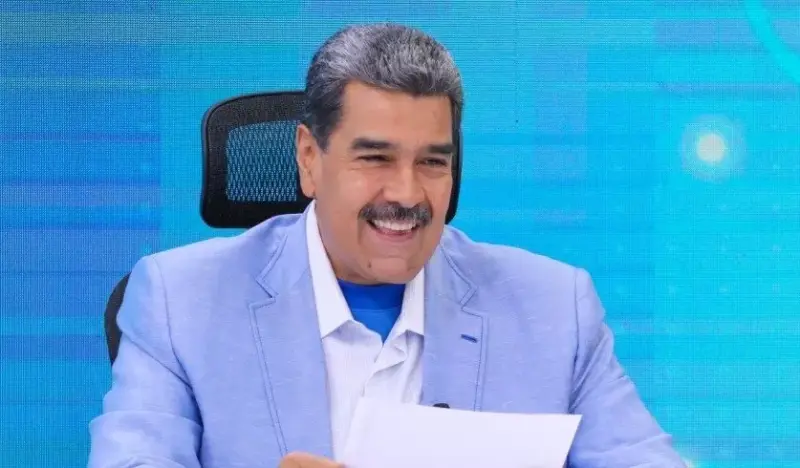

Two days before he was captured in a lightning US military operation in Caracas, Venezuelan President Nicolas Maduro publicly called for serious negotiations with Washington, signalling openness on drug enforcement, oil investment, and dialogue with US President Donald Trump.
The remarks, made in what would become his final interview before the capture, complicate the Trump administration's assertion that force was the only remaining option.
The interview, conducted by Spanish journalist Ignacio Ramonet, was originally published in the Mexican newspaper La Jornada and aired on Venezuelan state television on New Year's Day. In it, Maduro said Venezuela and the United States "must start to speak seriously, with the facts in hand," striking one of his most conciliatory tones towards Washington in years.
Less than 48 hours later, US forces launched Operation Absolute Resolve, capturing Maduro and his wife in an overnight assault that ended his rule and opened a new, uncertain chapter in Venezuela's political future.
'If they want oil, Venezuela is ready'
In the interview, Maduro revealed that he and Trump had spoken directly - but only once. "US President Donald Trump called me on Friday, November 21st, from the White House," Maduro said. "We spoke for 10 minutes, and it was, as I say, a very respectful conversation."
"What I can tell you is that the national defence system… has guaranteed and continues to guarantee territorial integrity, peace in the country, and the use and enjoyment of all our territories," Maduro said, insisting Venezuela remained stable.
On drug trafficking, Maduro again denied US accusations that Venezuela functioned as a narco-state, arguing that cocaine flows originate in neighbouring Colombia and claiming his government had a "perfect model" to combat trafficking.
Operation Absolute Resolve
On Saturday, Trump announced that Nicolás Maduro had been "captured and flown out of the country" following a large-scale US military operation. In a post on Truth Social, he said the mission was carried out "in conjunction with U.S. Law Enforcement" and confirmed that American forces had conducted extensive strikes.
The operation, dubbed Absolute Resolve, had been planned and rehearsed for months, US officials said, and unfolded in under 30 minutes once launched. According to Gen. Dan Caine, chairman of the Joint Chiefs of Staff, more than 150 US aircraft entered Venezuelan airspace after air defences were neutralised, Bloomberg reported.
Trump later said the US would temporarily "run" Venezuela and warned neighbouring Colombia to remain cautious. He also indicated that Washington was prepared to escalate further if required. "We are not afraid of boots on the ground if we have to," he said, adding that US forces had already operated on Venezuelan soil "at a very high level."
Pentagon chief Pete Hegseth described the operation as "sophisticated, complicated, successful," and issued a blunt warning to US adversaries, saying Maduro "f'd around and found out."
He added adversaries of the US should "remain on notice" that "America can project our will anywhere, anytime". "Welcome to 2026," Hegseth said. "Under President Trump, America is back."
Who leads Venezuela now?
Following Maduro's capture, Vice President Delcy Rodríguez was sworn in, and Trump said Secretary of State Marco Rubio had held a long phone conversation with her. However, Venezuela's opposition maintains that the rightful president is exiled politician Edmundo González, backed by opposition leader María Corina Machado.
Trump has so far declined to endorse a specific leader, saying only that the US would remain "very involved" in Venezuela's future. "We can't take a chance of letting somebody else run it - just take over where Maduro left," he said.
(With agency inputs)