
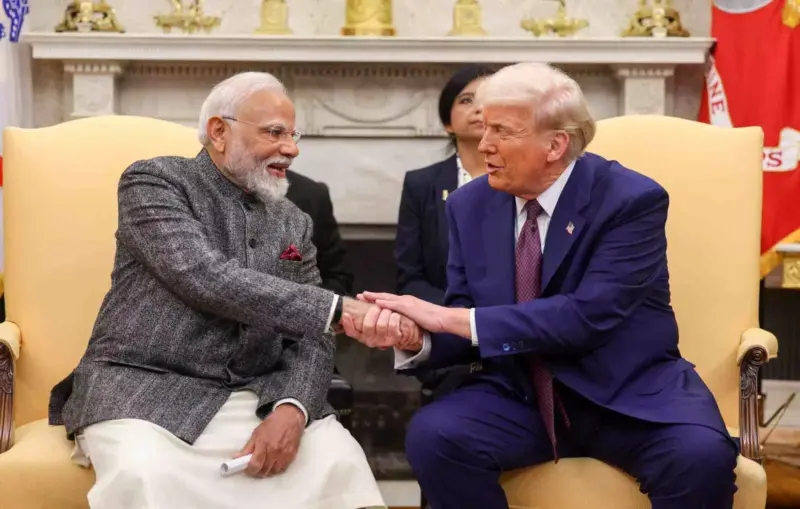

Prime Minister Narendra Modi is delighted that the India-US trade deal has now been agreed upon in principle. In a post on Truth Social on February 2, US President Donald Trump announced that Modi and he had a telephonic conversation in which they discussed various issues, including bilateral trade and the Russia-Ukraine war.
Trump asserted that India had agreed to stop buying Russian oil. This, he claimed, would help end the Ukraine conflict.
He went on to write, "Out of friendship and respect for Prime Minister Modi and, as per his request, effective immediately, we agreed to a Trade Deal between the United States and India, whereby the United States will charge a reduced Reciprocal Tariff, lowering it from 25% to 18%. They will likewise move forward to reduce their Tariffs and Non Tariff Barriers against the United States, to ZERO. The Prime Minister also committed to "BUY AMERICAN," at a much higher level, in addition to over $500 BILLION DOLLARS of U.S. Energy, Technology, Agricultural, Coal, and many other products."
Modi responds with public gratitude
Responding to Trump's post, Modi put on the social media platform X that he was "delighted" that he had spoken to his "dear friend", the American President, who had agreed to reduce the tariff on Indian goods exports to the US to 18 per cent. For this "wonderful announcement", he thanked Trump on behalf of 1.4 billion people.
Modi went on to express the view that the trade agreement will unlock immense potential for mutually beneficial cooperation. Thereafter, Modi veered far away from trade to state, "President Trump's leadership is vital for global peace, stability and prosperity. India supports his efforts for peace."
Goyal urges restraint on assessment
On February 3, Minister of Commerce and Industry Piyush Goyal said in a media conference that the trade agreement would be of immense help to Indian trade and industry in upgrading their operations and in India joining global supply chains. He also assured the country that the interests of the farmers had been fully protected by the government.
It will be argued by some "realists" that India does not stand to lose anything if it can get its way by lavishing praise on Trump. That is a point of view, but even if praise is to be made an instrument of diplomacy with Trump, it cannot be by using words that can recoil on India. It is possible that Trump may inform India that he can further the cause of peace, which India has supported his doing by mediating between India and Pakistan. India will naturally have to refuse his offer because of its principle that India-Pakistan differences have to be settled bilaterally. In sum, words which can harm Indian interests in the long term should be avoided.
Friendship claim rings hollow
One final point: Trump's post emphasises that Modi requested for a reduction in tariffs, and he obliged because of his respect and friendship for the Prime Minister. Naturally, this comment can hardly be taken seriously because if he really had a friendship with Modi, he would not have imposed a 50 per cent tariff at all. This is a strange friendship that initially causes great harm, and then, after a long time, some balm is applied.
India's dignified diplomacy, in which there was an objective realisation that interstate relations proceeded on the basis of national interests, had many merits. It should not be sought to be replaced.
(The Federal seeks to present views and opinions from all sides of the spectrum. The information, ideas or opinions in the articles are of the author and do not necessarily reflect the views of The Federal.)