

In this episode of Capital Beat, international affairs expert Prof Aftab Kamal Pasha and The Federal's Consulting Editor KS Dakshina Murthy join the discussion on the dramatic and contested ceasefire between Israel and Iran announced by US President Donald Trump.
The panellists analyse what triggered the ceasefire, who gains the most from it, and what lies ahead for the Middle East.
'Iran's surprising counterstrike'
Opening the discussion, Prof Pasha pointed out that Israel launched pre-emptive strikes against Iran, targetting key nuclear sites like Natanz and Fordow, along with missile production centres and military installations. According to him, Iran's surprising counterstrike capabilities, especially using hypersonic and ballistic missiles, stunned even the US and Israeli defence establishments.
How European markets fared
European markets, however, had closed lower on Monday, still digesting the weekend's geopolitical drama. The Stoxx 600 index slipped 0.28 per cent to 535.03, its lowest level in over a month. Germany's DAX fell 0.3 per cent, France's CAC 40 declined by 0.7 per cent, and the UK's FTSE 100 shed 0.2 per cent.
Spain's market ended the day flat. European investors moved toward defensive sectors such as utilities while oil and gas shares continued to ride earlier price spikes.
It is possible European markets are still concerned as Europe will be far more dependent on oil from the US; if supply from Iran stops - than its Asian counterparts like China and India; that can still depend on Russia.
US markets close on a high
In contrast, US markets closed on a high note. The Dow Jones Industrial Average added 375 points, a rise of 0.89 per cent. The S&P 500 increased 0.96 per cent to close at 6,025.17, snapping a three-day losing streak.
The tech-heavy Nasdaq Composite gained 0.94 per cent to finish at 19,630.97. Volatility subsided as the CBOE VIX index dropped nearly 7 per cent to 20.62.
For now, the ceasefire has brought a temporary reprieve and a rally across risk assets, but analysts remain watchfulWhile energy stocks led the early gains, the retreat in oil prices shifted the spotlight back to growth and technology shares by the end of trading. In commodities, Brent crude saw a steep decline of over 7 per cent overnight and was trading near $66.21 per barrel in Asia, its lowest in more than a week. The easing of conflict-related supply concerns has taken the pressure off oil prices.
Expats rattled, scared
Recounting the moment when the strikes happened, Naushad M, a native of Kerala, based in Doha, said, "The building I live in shook as if the earth itself trembled. There was a sound outside, like an explosion. I rushed down to the courtyard. Everyone was already there. Air Force planes were flying overhead in all directions. I hurried back to my room and then saw the news… Iran had launched a missile attack targeting the American base in Qatar."
"I don't like violence. I haven't even played PUBG, yet this shook me to the core. May all wars end soon. If the missile had struck a residential area, it would have been some poor migrant, someone who had left their country just to feed their family, who would've died", Naushad added.
Airspace closures, flight disruptions
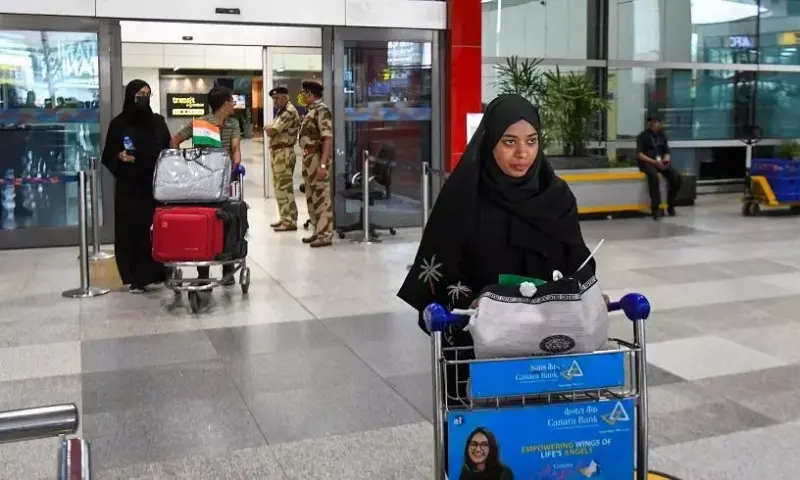
The reverberations of Iran's missile strike on the US military base in Qatar have travelled swiftly, not just through diplomatic cables and defence radars, but through the lived experiences of the massive Indian diaspora in the Gulf. Among them, the expatriate community from Kerala, deeply rooted in Qatar, is reeling from the sudden shock of airspace closures, flight disruptions, and the uncertainty that has engulfed the region.
Following the missile strike, described by Tehran as retaliation for recent American attacks on its nuclear facilities, Qatar closed its airspace as a precautionary measure. Bahrain followed suit. The closure brought international flight operations in and out of Qatar to a halt including the bustling air routes that connect Kerala to Doha, one of the most-travelled corridors in the region.
Chaos at airports
At Cochin International Airport, confusion began to unfold late on Monday. Around 10 pm, the Cochin International Airport Limited confirmed that air traffic to Qatar and through Qatari-controlled airspace was being affected.
"An Air India Express flight from Cochin that had departed at 18:53 hrs was diverted to Muscat, unable to enter Qatari airspace. A scheduled Air India service to Doha at 00:53 hrs was cancelled. Qatar Airways' inbound flight, expected to arrive at 02:53 hrs, was delayed, affecting its return leg as well. Other Gulf-bound services, such as Air Arabia's Cochin-Abu Dhabi flight, faced delays too, as regional connectivity remained disrupted," said a CIAL communique.
According to flight radar, a flight from Thiruvananthapuram to Bahrain that departed at 10.10 pm has also turned back and returned.
Long wait for flights
Passengers and families at Kerala's airports - particularly in Cochin and Kozhikode, and in Doha- waited for hours with little clarity. Many had checked in and passed immigration, only to be told their flights were cancelled or indefinitely delayed.
Among those caught in the uncertainty was Dr Suresh Kumar, a Kozhikode-based palliative care specialist who was scheduled to return home from Doha. Posting from Hamad International Airport in Doha, he wrote on Facebook: "The Kozhikode flight, which was supposed to depart an hour ago, is no longer even listed on the board. No flights are taking off. The word is that no one can say when they will resume."
His words reflected the immediate situation inside the airport - boards with blank departure slots, passengers scrolling through airline apps, and phone calls to India to update family members about delays.
Iran's assurance no consolation
The government of Iran has maintained that its missiles targeted the US Al Udeid Air Base - the largest American military installation in West Asia - and that the operation was not directed at civilians or Qatari infrastructure. Iranian Foreign Ministry officials stated that "Qatar remains a brotherly nation" and that the strike was part of a limited military retaliation.
However, these assurances did little to calm the nerves of civilians on the ground, especially expatriates. While there were no reports of civilian casualties or damage to commercial areas in Qatar, the uncertainty prompted a wave of precautionary measures.
Civilian aircraft were grounded. Reports and amateur footage - including video clips circulating on social media - showed military aircraft flying over Doha and intermittent flashes in the sky, believed to be from interception systems. While Qatar's defence establishment has not officially confirmed the nature of the interceptions, the visual evidence added to the prevailing unease.
Kerala's ties with Qatar
Qatar is home to an estimated 7 lakh Indians, with those hailing from Kerala forming the largest linguistic group among them. Qatar has remained a preferred destination for Keralites for decades, with connections spanning across sectors such as construction, healthcare, retail, logistics and domestic work. The country is also a key remittance hub for Kerala.
At Doha's international airport, arriving passengers were being redirected or held back, and outbound travellers were stuck for hours awaiting clarity from airlines. Indian embassy officials in Qatar issued a statement urging Indian citizens to remain calm and rely only on official communication. As of Monday night, no evacuation advisory had been issued, and Indian missions in Doha and Manama were monitoring the situation closely.
Community organisations, such as the Kerala Muslim Cultural Centre (KMCC) and Doha Malayali Samajam, are staying alert to provide assistance to passengers and workers stranded in transit, especially those without access to online booking services or employer communication. Helplines were active to provide language support and help people navigate the situation.
Expats stay positive
In Kerala, the Non-Resident Keralites Affairs Department (NORKA) confirmed that they were in contact with Indian diplomatic missions and tracking the airspace and travel updates.
Foreign affairs observers suggest that that the incident may remain contained, depending on the response from the United States and the broader Gulf Cooperation Council. However, the closure of airspace has underlined the vulnerability of civilian mobility in the region and its knock-on effect on transnational communities like the Malayalis.
Iran parliament backs Hormuz closure; will it isolate Tehran further?
"The missile attack lasted only 15-20 minutes, and things now seem to be returning to normal. Since there's no direct hostility between the two countries, there's no need for panic. It's the TV channels that are fuelling fear. We believe the airspace will reopen soon," said Sivaprasad a Thrissur native living in Doha.
However, for many Malayalis caught in uncertainty, whether trying to return home or head back to work, the situation remains fluid. With airports running on limited schedules, both travellers and authorities are in the dark about how long the disruption will last.
As another resident of Thrissur currently working in Doha put it over a WhatsApp voice note "We have seen wars before. But when planes are grounded, that's when we really feel the distance from home."