
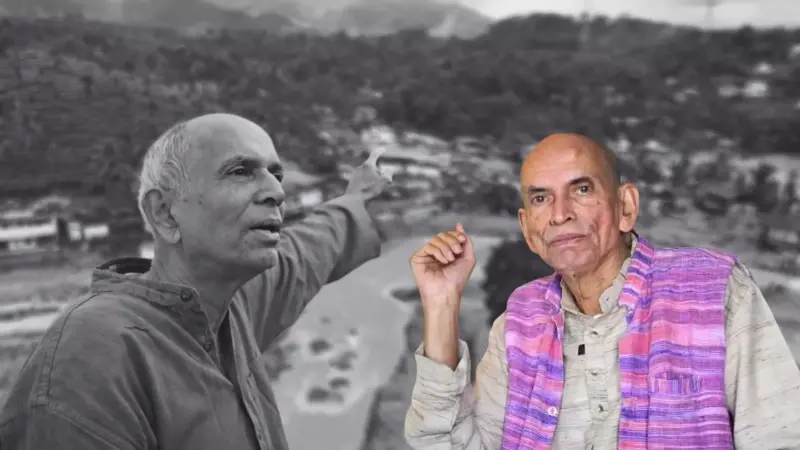

Noted ecologist Madhav Gadgil passed away in Pune after a brief illness on Wednesday (January 7) night. He was 83. In 2024, the United Nations honoured him with the Champions of the Earth award for his lifelong contribution to environmental protection, particularly the Western Ghats.
Born in Pune, Gadgil became one of the most influential and debated figures in Kerala's environmental history. For over four decades, the state argued with him, resisted his ideas, and returned to his warnings every time floods or landslides struck its hills.
Gadgil's voice often resurfaced during moments of ecological crisis, making him less a distant scientist and more a persistent presence in Kerala's political and public discourse.
Silent Valley roots
Gadgil's engagement with Kerala began during the Silent Valley movement of the late 1970s. The struggle against a hydroelectric project was more than a campaign; it marked a political awakening to ecological limits.
Madhav Gadgil obit: An ecologist who refused easy binaries
His scientific scrutiny challenged the idea that development was automatically virtuous. It also demonstrated that science could question and confront state power, leaving a lasting imprint on Kerala's environmental thinking.
That early intervention shaped how Kerala would later view large projects, forests, and fragile ecosystems.
The Ghats report
In 2010, the Union environment ministry appointed Gadgil to chair the Western Ghats Ecology Expert Panel. The report he submitted in 2011 warned that unchecked mining, quarrying, road expansion, and construction could trigger cascading ecological failures.
It proposed graded ecological sensitivity zones and emphasised decentralised governance, placing trust in local bodies and gram sabhas rather than distant bureaucracies. These ideas struck at the heart of Kerala's densely inhabited high ranges.
Land in these regions is tied to livelihood, identity, and security, making the report deeply unsettling for many.
Protest and politics
The Gadgil report entered Kerala amid fear and misinformation. Protests erupted, offices were vandalised, and Gadgil's name became synonymous with eviction and land freezes, even though the report explicitly rejected mass displacement.
What followed was a political failure, as the debate turned toxic. The report was not properly communicated in Malayalam, allowing rumours to spread faster than facts.
Political parties across the spectrum chose silence or distance, turning a scientific document into a street-level conflict.
Disasters return
The Centre later diluted the report through a second committee, but by then, the damage was done. Gadgil remained politically resisted, administratively sidelined, yet firmly lodged in Kerala's collective memory.
The floods of 2018 brought his warnings back into focus. Collapsing hills, overflowing rivers, quarrying on steep slopes, and reclaimed wetlands echoed the cumulative impacts he had cautioned against.
Gadgil never claimed prophecy. He spoke of systems, feedback loops, and governance failures. He rejected fortress conservation and insisted people were part of the Western Ghats, not intruders.
Enduring legacy
Kerala turned Gadgil into more than a scientist. He became a symbol, a warning, and a mirror reflecting the state's uneasy relationship with development and ecology.
His vision was neither anti-development nor romantic preservation. It was about limits, responsibility, and informed choice.
Madhav Gadgil did not belong to Kerala by geography. He belonged to it by argument. And in a state that prides itself on debate, that may be his most enduring legacy.
(The content above has been transcribed from video using a fine-tuned AI model. To ensure accuracy, quality, and editorial integrity, we employ a Human-In-The-Loop (HITL) process. While AI assists in creating the initial draft, our experienced editorial team carefully reviews, edits, and refines the content before publication. At The Federal, we combine the efficiency of AI with the expertise of human editors to deliver reliable and insightful journalism.)