




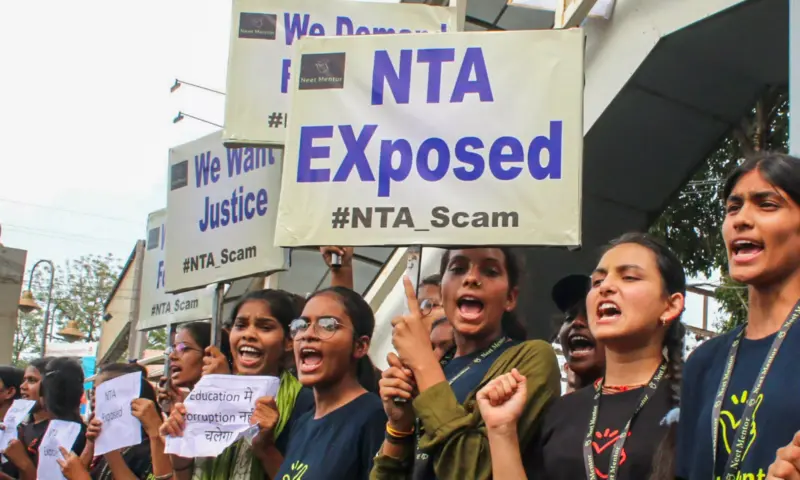

The National Testing Agency (NTA) declared the results of the National Eligibility cum Entrance Test NEET (UG)-2025 on Saturday (June 14).
The top score this year is 686.
Cancellations too
And it's not just postponement. Exams have been cancelled for various reasons too.
In 2024, the Education Ministry ordered the cancellation of the UGC-NET exam after receiving intel on integrity compromise.
"No complaints were received but the inputs we received from agencies indicated that the integrity of the exam has been compromised. The action was taken suo motu to safeguard the interests of the students," Education Ministry Joint Secretary Govind Jaiswal had said then. The matter was handed over to the CBI.
This year, too, the CUET-UG was cancelled in a centre in Srinagar, Kashmir, due to "technical problems". In Centres like Delhi, Noida, Faridabad, Dehradun, Patna, Hyderabad, etc., the exam was delayed due to glitches.
"Playing with future of children"
In April, scores of parents took to social media to point out that the JEE Main paper response sheet reflected differently from what students had filled. A man named Pramod Kamath wrote on X, "…my daughter attempted 71 questions. During submission it showed 71 questions attempted & now in the response sheet it is showing ALL questions as unanswered! Shocking! NTA is playing with the future of children (sic)."
With students and parents accusing the NTA of apathy, and the agency refusing to admit blunders at various points, several petitioned the courts, where cases are ongoing.
NTA Director-General Pradeep Singh Kharola did not respond to calls or texts by The Federal asking why the body continues to face such issues despite some "reforms".
Public or private?
According to academics, however, there are many issues. One is the issue of the NTA's nature and structure. "It is a very small outfit with no intellectual base or resources of its own. It has been given the responsibility to organise examinations of a very different nature. It also has no accountability. It is like a private body not responsible to the public," said DU Professor Apoorvanand.
However, whether the NTA is a private or a public agency is a complicated question. While it comes under the purview of the RTI (Right to Information), its organisational structure is opaque. Apart from the chairperson and the director-general mentioned as member secretary, the others are not mentioned by name, instead being listed only as "members". The only exception is Dr Harish Shetty.
A "logistical nightmare"
Professor Furqan Qamar, former vice-chancellor of the Rajasthan University and Central University of Himachal Pradesh and former adviser (education) to the Planning Commission, said the NTA has a "systemic problem".
"There are a number of issues. In CUET particularly, it is a paper-by-paper examination, so the number of examinations they have to conduct is enormous and requires huge logistics. Technology is advancing at a very rapid pace. While they have adopted technology like OMR sheets or online examination with proctoring, they are certainly not keeping pace with the technology," he said.
"India is too large and diverse a country to be subjected to one single common entrance examination for admission. To be given admission on the basis of the score of a single test to be conducted on a single day in a single shift is a logistical nightmare," he said.
Unsustainable model
Qamar said the current model was "not sustainable" and needed a rethink of the "One Nation, One Examination" motto.
"I think at a national level there should be a decision on whether it is necessary to admit a student only on the basis of the score of a single test. Most other countries adopt a holistic approach to grant admission where an aptitude test plays a role, where past academic performance has a contribution, their essays, their writing abilities and so on. All of those things are taken into account," he said.
"A decentralized manner where every university admits students based on their own methods has been working very well... Across the world, barring China and Singapore and a few other countries, it is the universities concerned which admit students. We use the argument that in that case, a student has to appear in many different tests so that is a hassle, but the solution that we have found is causing a much bigger hassle," he added.