




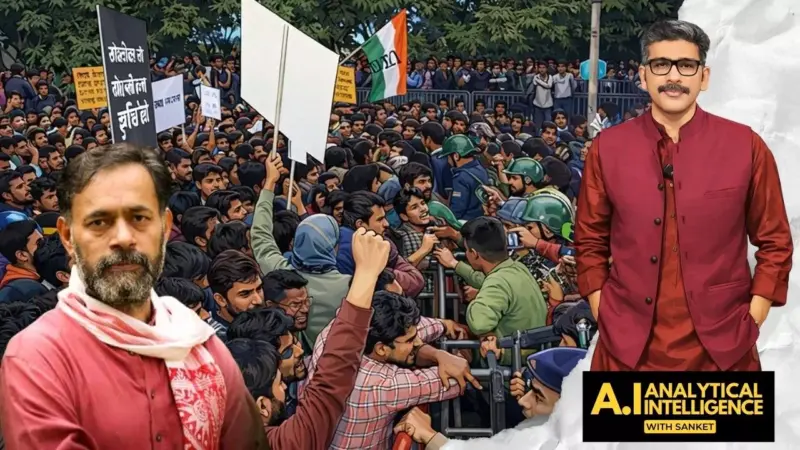

The Federal spoke to Yogendra Yadav, a former UGC member, as protests and political sparring intensify over the University Grants Commission's (UGC) 2026 equity regulations.
What is the main objection being raised to the new UGC equity rules?
I think the current debate is extremely ill-informed. We have massive debates in this country where both sides are not fully informed about what they are debating.
The first misconception is that something totally new - either revolutionary good or very bad - has come into being. That is mistaken. The 2026 rule is a reformulated version of something that already existed. Equity and anti-discrimination regulations have been in place since 2012, when I was a member and was involved in framing the original rules.
The second misconception is that the government has done something major on its own. This flows from a Supreme Court case. It is not that Mr. Modi's government suddenly developed social conscience. The Supreme Court has repeatedly said the existing regulations need improvement and must be reformulated. So this is happening at the Supreme Court's direction.
The third misconception is that caste-discrimination provisions have been introduced for the first time. That is also wrong. The 2012 directions named SC and ST; the current directions name SC, ST, and OBC. So there is nothing fundamentally new in that sense.
What is interesting is where the criticism is coming from. Usually, criticism of education policy comes from the Opposition. But here, criticism is coming from the ideological friends and followers of the regime - so the regime is, in a sense, criticising itself. The Supreme Court says tighten the rules, the government has no option, and then you generate heat saying the public doesn't like it. I see this as manufactured dissent to ensure the guidelines cannot be implemented.
And after comparing the earlier and current guidelines, I feel the debate doesn't even capture the real differences. Some parts have been tightened, as the Supreme Court wanted. But in that process, some core content of anti-discrimination law has been diluted. That is what we should be debating.
New UGC equity regulations spark protests: Here are the new rules explained
What has changed from the 2012/earlier rules to the 2026 rules? What is the continuity?
The continuity is simple: the Constitution and fundamental rights prohibit discrimination based on caste, gender, ethnicity, language, place of birth, and so on. The 2012 and 2026 regulations are meant to implement a constitutional mandate.
And both regulations are not only about caste. They cover gender, physical disability, and other forms of discrimination. Caste is one part in both 2012 and 2026.
The general formulation cites all forms of discrimination. The specific mention earlier was about SC and ST; now it has been extended from SC/ST to SC/ST/OBC. But that is only one specific mention.