




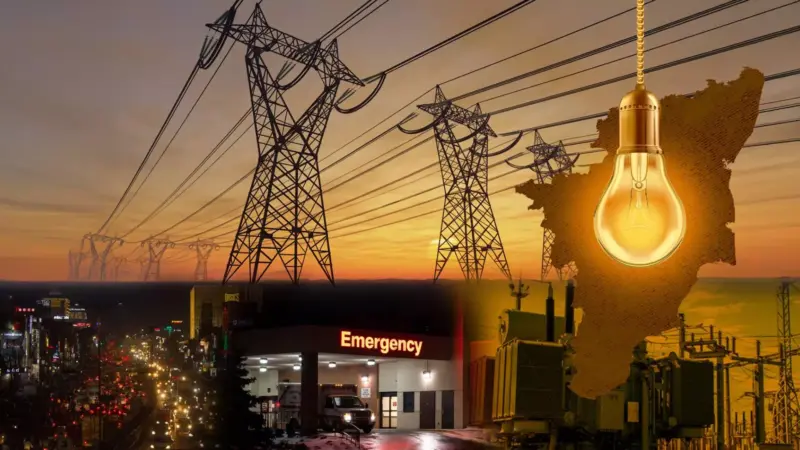

For the past few weeks, residents across Tamil Nadu have been battling sweaty nights, scorching afternoons and repeated power cuts. From crowded cities to remote villages, people say outages have been occurring without warning, leaving homes, streets and businesses in darkness during peak summer heat.
In several places, fans stopped working, water pumps failed, and households were left struggling through hours-long outages. In some alarming instances, hospitals were also affected, with critically ill patients reportedly shifted from ICUs to nearby facilities after power failures disrupted operations.
Jayasankar, General Secretary of COTEE, said: "Every year we need 1500 megawatts additional surplus. But in the past five years, there has been no new power generation. Udankudi, Uppur, Ennore heat expansion plans have also not been completed so far."
He added: "Earlier, we expected maximum peak demand between 6.30 pm and 11.30 pm. But this time it extended till 3.30 in the morning. That is why we are facing shortages and consumer problems. Field staff are very limited. More than 80 per cent of field staff positions are vacant and there has been no recruitment in the past five years."
Official explanation
Meanwhile, Tamil Nadu Electricity Board Chairperson and Managing Director J. Radhakrishnan said the state currently has adequate power availability and has been comfortably meeting daily peak demand, which has remained below 20,000 MW in recent days.
According to him, most of the recent disruptions were localised and linked to distribution-level faults and equipment failures.
He listed several reasons for the outages, including fuse-off calls due to overload during peak night hours, underground cable faults, jumper cuts, snapping of conductors and substation-related interruptions and tripping.
He also said planned maintenance shutdowns carried out to strengthen infrastructure had contributed to temporary disruptions in some areas.
(The content above has been transcribed from video using a fine-tuned AI model. To ensure accuracy, quality, and editorial integrity, we employ a Human-In-The-Loop (HITL) process. While AI assists in creating the initial draft, our experienced editorial team carefully reviews, edits, and refines the content before publication. At The Federal, we combine the efficiency of AI with the expertise of human editors to deliver reliable and insightful journalism.)