
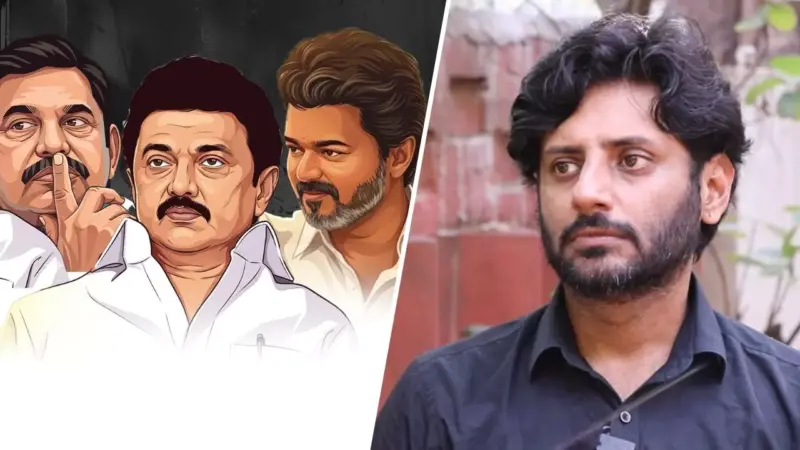

As Tamil Nadu heads toward a high-stakes 2026 Assembly election, the contours of the contest are still taking shape. Is it a straight Dravidian battle, or has it evolved into a genuine four-way fight with the entry of Vijay and his TVK?
As for the others, the Naam Tamilar Katchi (TMK) has been in the fray for quite some time now and has steadily shown an increase in its vote share. The real question is TVK's strength, which everyone is anticipating.
That said, a four-cornered contest does not mean all four have an equal chance of winning, no one is suggesting that. It simply means the vote will be split. One party may walk away with 8 per cent, another with 15 per cent, one with 30 per cent, and another with 34 per cent. The real question is who gets what. As things stand, the order in terms of gaining more votes appears to be for DMK, AIADMK, TVK, and then for the NTK.
Swamy exclusive: DMK unbeatable, Vijay a non-factor, Modi has made India irrelevant
Though we talk about elections as being personality-driven, they're still built on strong local leaders? Like Velu in Tiruvannamalai, KN Nehru in Trichy, you've pointed this out in your past poll surveys too. But, with TVK, we're not seeing that layer yet, it feels like they're going all in with Vijay as the main man. Do you think this kind of strategy actually works on the ground?
The party strength, when we speak about the AIADMK and DMK for that matter, lies in what you pointed out. Be it EV Velu in Tiruvannamalai or I. Periyaswamy in Athoor, in every district they have a local strongman. This holds true for the AIADMK as well, from SP Velumani to Thangamani to Vijayabaskar.
These are strongmen and women who add value to the party at the grassroots. At the same time, there is a central leadership with access to pan-Tamil Nadu voters. Strong grassroots combined with a pan-Tamil Nadu face is the key advantage these two parties enjoy.
In comparison, Tamilaga Vettri Kazhagam (TVK) is currently banking on Vijay. That said, they should be given the benefit of the doubt. They will take time to establish themselves, bring in more seasoned leaders, and allow their younger cadre to grow into established leadership.
After all, that is how the AIADMK and DMK also evolved. Given that TVK is only about two years old, there is still time for them to build that structure. But for now, they are up against titans like AIADMK and DMK, especially when it comes to specific constituencies.
Women make up nearly 51 pe cent of the electorate in Tamil Nadu, they are clearly a decisive bloc. Yet, there isn't a single, dominant woman leader in the fray this time. Instead, parties like the DMK, AIADMK, and TVK are all actively trying to woo women voters through targeted promises and welfare messaging. From what you've seen on the ground criss-crossing the state, where do you sense the pulse of women voters is moving?
The fact that there are 1.2 million more women voters than men in Tamil Nadu is particularly interesting from a pollster's perspective. The women's vote is issue-based and certainly focussed on leadership, but it is also driven by the search for reliable leadership with an emotional connect. That is what we have sensed. Not every woman voter, but a large section tends to be emotionally connected.
This also explains why Tamil Nadu has often seen individual-centric decision-making in elections, from M Karunanidhi to MG Ramachandran, and later M Karunanidhi versus J Jayalalithaa. The women's vote significantly favoured the AIADMK, largely because of Jayalalithaa as the face of the party. Her women-centric approach built a strong base among women voters, and there was no denying that.
After her demise, there was a vacuum, and the women's vote did feel somewhat orphaned. Then came the announcement by superstar Rajinikanth, which generated excitement among women voters, but that did not materialise. Around the same time, there were figures like Kamal Haasan and, even earlier, Vijayakanth.
TN elections|DMK alliance has early edge, TVK may split votes: Political analyst Kannan
The women's vote has consistently been drawn towards leadership they can emotionally relate to. The DMK, for long, faced a narrative of being a more male-oriented party, with perceptions around aggression and strong-arm politics, which kept some women voters at a distance. However, 2021 marked a shift. A number of clear, specific, women-focussed announcements, along with the absence of a figure like Jayalalithaa, created an opening.