The West Bengal Assembly Elections 2026 saw one of India's most dramatic and chaotic political spectacles unfolding, blending cultural symbolism, aggressive campaigning, and serious electoral concerns into a high-stakes battle.

Was West Bengal election campaign toxic or funny? Looking back at its many shades

The Federal 1 week ago
Optics and outreach
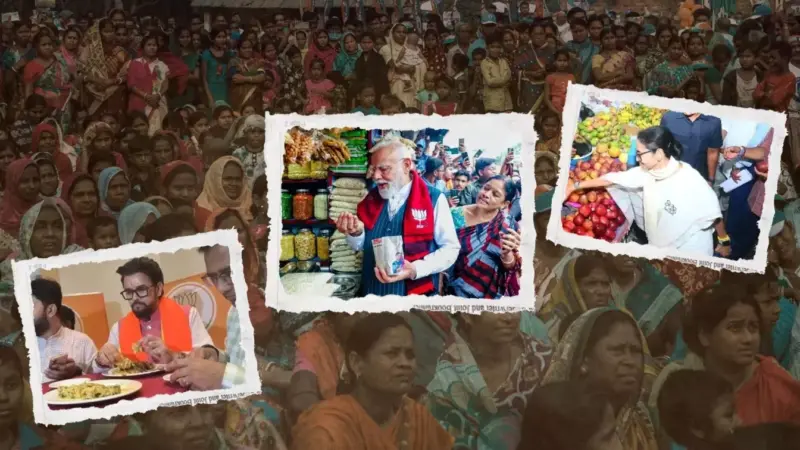
In Jhargram in south-western Bengal, for example, Modi stopped his convoy to eat "jhalmuri" (popular Bengali puffed rice snack) at a roadside stall, interacting directly with the vendor and insisting on paying-an act that quickly went viral.
Supporters hailed it as relatable, while critics dismissed it as political theatre. Yet, Modi continued such outreach efforts.
Soon after the first phase of voting on April 23, when the focus turned on Kolkata and other parts of southern Bengal, he shared images of a sunrise boat ride on the Hooghly River (a tributary of the Ganges) touching the city, with Vidyasagar Setu in the backdrop.
In a post, he wrote, "The Ganga flows through the soul of Bengal," while interacting with locals along the riverbanks.
Fish politics
Food became a central campaign theme after Mamata Banerjee warned that a BJP government might restrict consumption of fish and eggs-an emotionally charged issue in Bengal.
The BJP responded with what is now dubbed "fish politics". Party leaders and candidates were seen carrying fish during campaigns, and Union Minister Anurag Thakur was seen eating 'sorshe maach' (mustard fish) on camera.
These symbolic gestures were part of a broader cultural outreach strategy-combining food, language, and imagery to resonate with Bengali identity.
Electoral concerns
Beyond the theatrics, the election has been marked by serious concerns. A Special Intensive Revision of electoral rolls reportedly removed around nine million voters-nearly 12 per cent of the electorate.
In border and minority-dominated regions, this triggered anger and confusion. Mamata Banerjee alleged exclusion, while the BJP defended it as a cleanup of bogus entries.
The controversy added a tense backdrop as the state entered Phase 1 polling.
Violence and glitches
Incidents of violence and disruption were reported during voting. BJP candidate Shubhendu Sarkar was allegedly assaulted near a polling booth, while the vehicle of Agnimitra Paul, another saffron party face and a sitting MLA, was vandalised.
Bengal Phase 2 campaign ends amid row, sharp political exchanges | Capital Beat
In Birbhum district, a BJP election agent sustained head injuries after an attack. There were also allegations of EVM malfunctioning, with the TMC claiming their supporters' votes were going to the BJP, leading to clashes between the local people and central forces, disrupting the polling temporarily.
Amid the chaos, at least three voters-including two women-died after falling ill due to extreme heat.
Turnout and stakes
Despite the controversies, West Bengal recorded a remarkable 93 per cent voter turnout in Phase 1-the highest in its history. Both sides now await the outcome, with the electoral wave still uncertain.
This election has blurred the line between spectacle and substance-combining cultural symbolism, political messaging, and institutional concerns.
After Vande Mataram, it's Bankim: Electoral politics heats up in Bengal's Naihati
From street food moments and fish symbolism to voter roll disputes and polling violence, the West Bengal contest has evolved into more than a governance referendum.
It is a test of identity, mobilisation, and narrative control-played out in full public view, with all its drama and contradictions.
The content above has been transcribed from video using a fine-tuned AI model. To ensure accuracy, quality, and editorial integrity, we employ a Human-In-The-Loop (HITL) process. While AI assists in creating the initial draft, our experienced editorial team carefully reviews, edits, and refines the content before publication. At The Federal, we combine the efficiency of AI with the expertise of human editors to deliver reliable and insightful journalism.
Dailyhunt
Disclaimer: This content has not been generated, created or edited by Dailyhunt. Publisher: The Federal English