
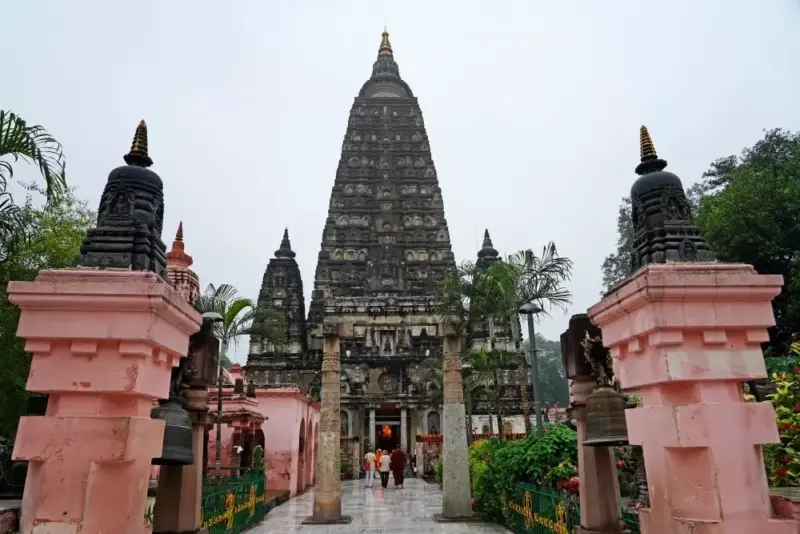

"We are a 5,000 year old civilisation and yet whenever we talk of preserving our heritage we talk only of these 3,697 iconic monuments and sites [declared as of national importance by and under the Ancient Monuments and Archaeological Sites and Remains Act, 1958 and maintained by the Archaeological Survey of India]," says professor AGK Menon, architect, town planner and former convenor of the Delhi Chapter of Indian National Trust for Art and Cultural Heritage (INTACH), about issues that have been raised and discussed in a recently tabled report of the 'Parliamentary Standing committee on Transport, Tourism and Culture'.
Of these iconic structures and sites, 90 odd seem to have disappeared, some into dam reservoirs, some due to urban growth, some to encroachments and 24 seem to have disappeared into thin air and nobody the wiser.
The parliamentary standing committee report, presented in March, on its part, highlighted concerns such as delayed, stalled or yet-to-start restoration works, vicinities of heritage sites being used as urinals and manpower crunch, among other issues.
But Menon adds: "This privileging of only the iconic, chosen under criteria outlined not by us, but by those who set up the Archaeological Survey of India (ASI) in 1861, almost one hundred and sixty-five years ago, leads by default to ignoring all other elements of our heritage. We denigrate not only all other built heritage, not considered fit to be included in the list of 'Monuments of National Importance', but all other elements of our unbuilt heritage, lately described as the intangible heritage."
The intangible includes our languages, our music and dance, both classical and folk, including the phenomenal diversities of the culture and practices of our indigenous populations, our attire, our crafts, our manuscripts and the diverse and countless other elements that together constitute our heritage.
There is little, if any, concerted effort to promote and preserve this intangible heritage. This is happening because we have been educated to believe that these 3,697 structures and sites are all that there is to our heritage.
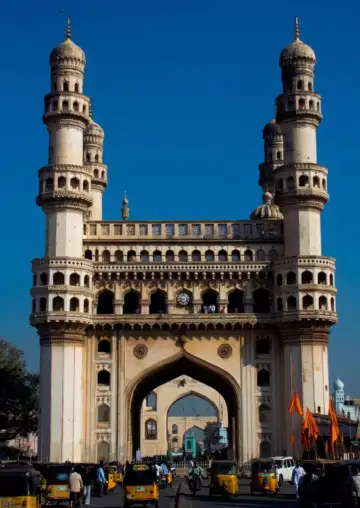
The Charminar in Hyderabad. According to the parliamentary stading committee report area behind the structure was being used as urinal. Photo: Wikipedia
The various parliamentary standing committees, set up over the decades, have engaged themselves primarily with the state of these iconic structures and sites. These structures and sites together form only a small, though significant part of our heritage. Outside of these iconic structures and sites, there are countless structures, spread across the length and breadth of India. A few of these are preserved by the respective state departments of archaeology and even fewer by the municipal authorities in a few historical cities and towns; as for the rest, no one is in-charge.
Why Karnataka's Lakkundi village has become the state's latest history hotspot
"Given the country's immense scale and diversity, its heritage protection efforts remain critically under-resourced and overstretched," says KT Ravindran, professor and head of urban design at the School of Planning and Architecture, New Delhi, and former chairman of Delhi Urban Arts Commission.
He adds: "Funds are not made available, requisite skills and capacities don't exist in the government. A consultative process to create a community-based protection mechanism could have been a good solution, but it is not in place. All focus is on the declared national monuments and thousands of high-value heritage sites embedded across the country are neglected. It is astounding that even after nearly eight decades of independent rule and governance, India has not scratched the problem of heritage protection. Add to these the cultural heritage under neglect and the scenario becomes nearly hopeless."
The newest affliction to hit India's dying heritage, according to Ravindran, is its current politicisation. "History and heritage have become contested issues in the political majoritarianism. Neglect and distortions can be a deadly combination," he alleges.
One of the issues raised in the March report by the parliamentary standing committee is of "British-era heritage sites requiring preservation".
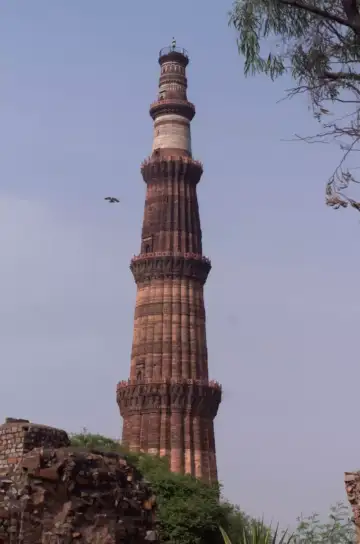
The Qutub Minar in Delhi. Photo: Wikipedia
Historian, author, art curator, heritage conservator and former convenor of the Delhi Chapter of INTACH, Dr Swapna Liddle, with her deep and constant engagement with the diverse heritage of the seven historical capitals that exited within the boundaries of contemporary Delhi, speaks about unprotected structures, in the national capital and elsewhere.
"When we talk of built heritage, we tend to focus on monuments protected by the Archaeological Survey of India, and in some cases by various state governments. This is quite misleading," says Liddle.
She adds: "In Delhi, for instance, there are hundreds of historic buildings protected under municipal laws. They constitute an important part of Delhi's built heritage, and the heritage significance is not based on numerical strength alone. This list includes important structures such as Rashtrapati Bhavan, Central Secretariat, Hyderabad House, India Gate, Fatehpuri Masjid, Town Hall, and many others. These buildings are held under varying kinds of private, public and institutional ownership and management. The heritage status and values of these are required to be monitored by the respective municipal authorities and the Heritage Conservation Committee. In practice, however, there is little proactive intervention. In the absence of proactive monitoring, the number of cases of repair and restoration following professional norms is limited, and rarely comprehensive."
According to Liddle, those most at risk are buildings that are privately owned, where owners have little incentive by way of a sympathetic technical, regulatory and fiscal environment to maintain their buildings.
"One example of the deleterious results is the fast-disappearing havelis of Shahjahanabad (Old Delhi), despite legal protection. Challenges include the unavailability of loans to repair very old buildings, or the lack of technical advice. The loss of this heritage is the loss of an important and potentially commercially valuable asset for the individuals directly concerned, as well as the community and the city. A workable vision for the protection of the city's privately owned heritage is urgently required. And of course, this is the situation that exists in other parts of the country too. Most places do not even have local/municipal laws to protect heritage, let alone robust policies to bolster them," she says.
What Telangana's Mudumal Menhirs say about India's past astronomical prowess
And so, as our heritage has been reduced to just these 3,697 structures and sites, one would have learnt to live with what was being granted, perhaps, if, at least, these 3,697 were well cared for, but even this seems like too much to hope for.
As cited in a news report published in January 2023, ASI officials claim that no physical surveys of any monuments were ever done following Independence. Nevertheless, according to a Comptroller and Auditor General (CAG) report from 2013, the nation's at least 92 centrally protected monuments were believed to be missing.
Another 2023 post by a digital news website, quoting from an earlier report of the Parliamentary Standing Committee on Transport, Tourism and Culture, stated that 'only 248 of the 3,697 monuments were guarded. Owing to financial limitations, the government could only afford to provide 2,578 security personnel at 248 locations, according to the report.
Which makes one thankful that even when of the '3697 protected monuments' of national importance '3449 were not being protected', only 24 have gone missing! Many more could have disappeared. Heritage thieves and their accomplices in India have much to learn. We have the figure of 24 missing if we account for monuments submerged, encroached upon and lost to urbanisation etc.
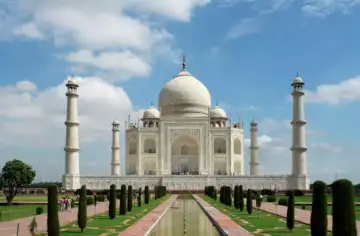
The Taj Mahal, one of India's most iconic heritage stuctures. Photo: Wikipedia
According to a 2024 report by a news agency, the ASI was allocated Rs 1,273.91 crore in the Union Budget 2024-25. If the entire amount were to be divided by 3697 (the number of monuments of national importance) the availability of funds will come to Rs 34.46 lakh per monument.
The average ticket sale at the Taj Mahal was reportedly around Rs 59 crores per year during the five-year period ending 2023-24. Reports also claimed that ticket sales at Delhi's Qutub Minar and Red Fort during the 2023-24 fiscal year, were Rs 23.80 crore and Rs 18.08 crore, respectively. So, on average, these three monuments alone had a combined ticket sale of about Rs 100 crore annually. One can clearly see the scale of revenue that can be generated from our protected monuments alone if they were positioned better, were more easily accessible and were more visitor-friendly.
Our heritage or the heritage of any people is indivisible - the cities, the monumental, the ceremonial and the quotidian, the cuisine, the attire, the music, the literature, the languages, the festivals, the lifestyle - all this together is our heritage, you cannot hive off one part and place it on a pedestal and forget the rest. All this is alive and is constantly growing and developing.
Why in Bihar's Biswak, a Kashmiri sultan's grave remains forgotten and neglected
The world is changing and so are we.
The UNESCO World heritage Atlas outlines this shift of focus from built structures to urban environment. "From a focus on monuments and outstanding buildings, heritage conservation has expanded to other types and categories, such as cultural landscapes, intangible cultural heritage, and vernacular settlements. This evolution is accompanied by a growing understanding of the potential of cultural heritage to contribute to sustainable development and climate resilience. The approach to urban heritage conservation is not about material or structural preservation and restoration as much as it is about planning, policies, laws, and regulations," it says.
This is increasingly the approach that is being followed in large parts of the world. The focus is shifting from individual structures to the entire locality, to the mohalla (neighbourhood), to the entire historical city.
We have to modernise, not by building malls in the heart of all our historical cities but by removing the ugly hanging wires; not by pulling down the small alleyways, narrow streets and lanes and replacing them with four-lane expressways and plazas, but by turning them into no traffic zones, creating promenades, roadsides eateries, shaded alleys, retaining, reviving, repurposing traditional crafts, setting up boutique hotels, museums, small performance spaces, craft exhibitions, specialty restaurants, bakeries, tandoors - turning our heritage sites, old cities, ancient and mediaeval caravanserais, trade-routes etc. into the kinds of places we travel to visit in Milan, Venice, Khiva, Tashkent, Fez, Casablanca, Ephesus, Tangier, Hanoi, Yangon or Marrakech.
We do not have to duplicate that environment, but we can learn from them how heritage can be preserved, revived and made sustainable without being drowned and suffocated under neon-lights and ear-splitting cacophony of noise impersonating music.
More importantly, preservation of heritage has to be inclusive; it has to understand that the tangible and the intangible may be treated separately for administrative reasons, but both together constitute our heritage and similarly, the past, whether it was the ancient or the medieval or the immediate past, is our collective past.
We cannot invent a past that we desire, and if we try to do so, we will only end up vitiating both our present and our future.