




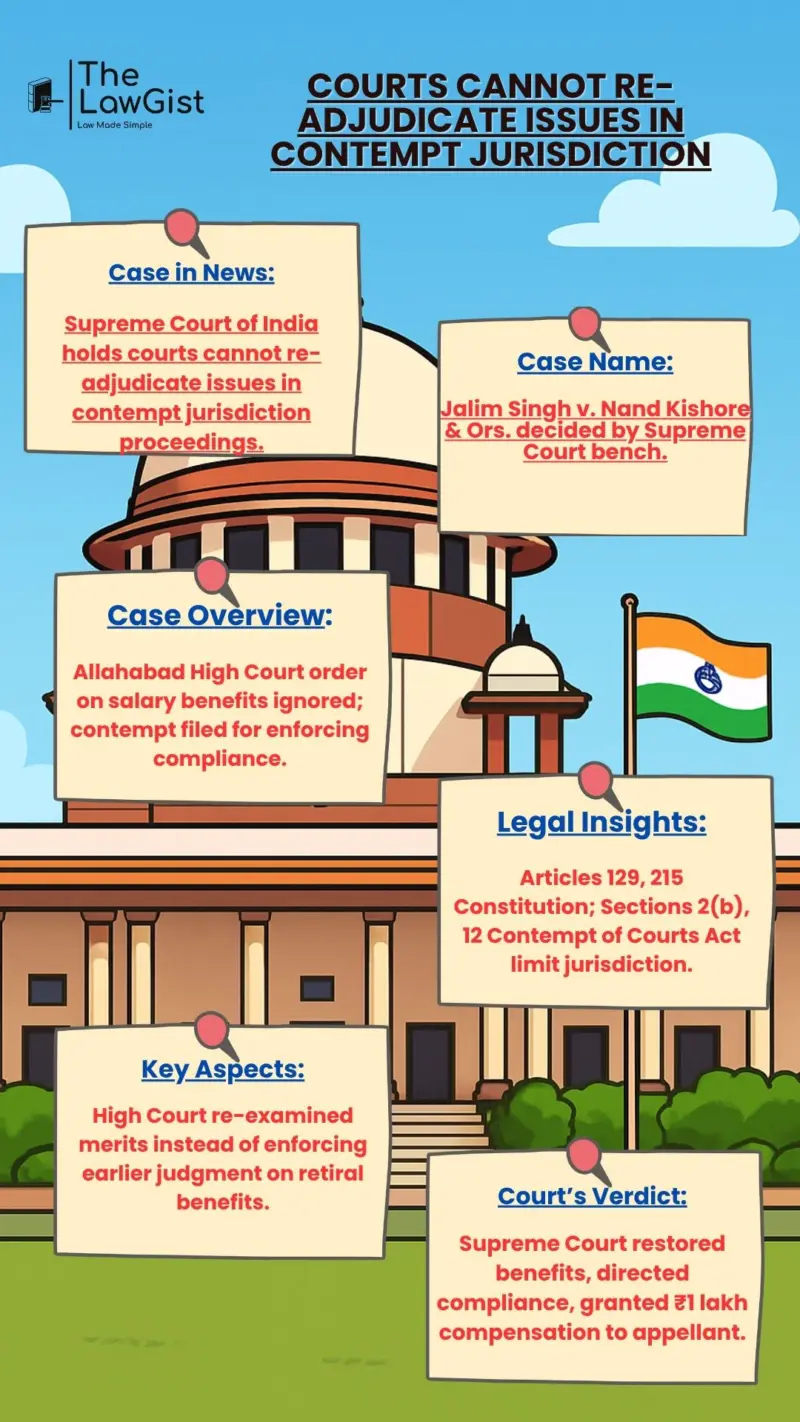

Supreme Court clarifies contempt jurisdiction scope-courts cannot re-adjudicate settled issues and must only ensure compliance with earlier judicial directions under the Contempt of Courts Act, 1971.
Case in News The Courts Cannot Re-Adjudicate Issues In Contempt Jurisdiction ruling by the Supreme Court of India clarifies limits of contempt powers. |
Discover powerfulLatin Maximsand simplify complex legal terms in seconds
Case Overview
Case Name: Jalim Singh vs. Nand Kishore & Ors.
The case was decided by the Supreme Court of India bench comprising Justice Vikram Nath & Justice Sandeep Mehta.
The appellant, an employee had earlier secured a favourable order from the Allahabad High Court directing the respondent bank to grant him full salary & service benefits for the suspension period along with retiral benefits. Despite the binding order the respondent failed to release the dues.
As a result the appellant initiated contempt proceedings before the High Court seeking enforcement of its earlier judgment. However instead of ensuring compliance with the original directions the High Court re-examined the merits of the case & concluded that the appellant was not entitled to retirement benefits. Aggrieved by this re-adjudication in contempt proceedings the appellant approached the Supreme Court of India challenging the order of High Court.
Key Aspects
Facts and Issues of the Case :
- The appellant obtained a favourable High Court order granting salary & retiral benefits.
- The respondent bank failed to comply with the directions of the court.
- The appellant filed a contempt petition seeking enforcement of the earlier order.
- The High Court re-examined the merits of the case & denied the benefits.
- The central issue was whether courts can re-adjudicate settled matters while exercising contempt jurisdiction.
Legal Insights
The legal insights regarding the case has been discussed as under -
- Article 129 of the Constitution of India empowers the Supreme Court of India to punish for contempt of itself.
- Article 215 of the Constitution of India grants similar contempt powers to High Courts of India.
- Section 2(b) of the Contempt of Courts Act, 1971 defines civil contempt as wilful disobedience of any judgment, decree, direction, order, writ or other process of a court .
- Section 12 of the Contempt of Courts Act, 1971 prescribes punishment for contempt to ensure compliance with judicial orders.
- The Court clarified that contempt jurisdiction is limited to examining compliance with earlier directions & cannot be used to re-adjudicate or reopen issues already decided.
Court's Verdict
The Supreme Court of India held that courts exercising contempt jurisdiction cannot re-adjudicate issues already settled in earlier proceedings. The High Court committed an error by reconsidering the merits of its previous decision rather than ensuring compliance with its directions.
Accordingly the Supreme Court set aside the High Court's order & directed the respondent bank to pay the appellant all arrears of salary, post-retiral dues & service benefits. Additionally the Court awarded ₹1 lakh as compensation to the appellant for the prolonged & unnecessary litigation caused by the respondent bank.
Source -Supreme Court of India
- Constitution
The LawGist ensures exam success with quality notes-TPL, Current Affairs, Recent Judgments, and more. Backed by trusted resources and videos, The LawGist is every aspirant's first choice