





DAILY CURRENT AFFAIRS (05 MAY 2026)
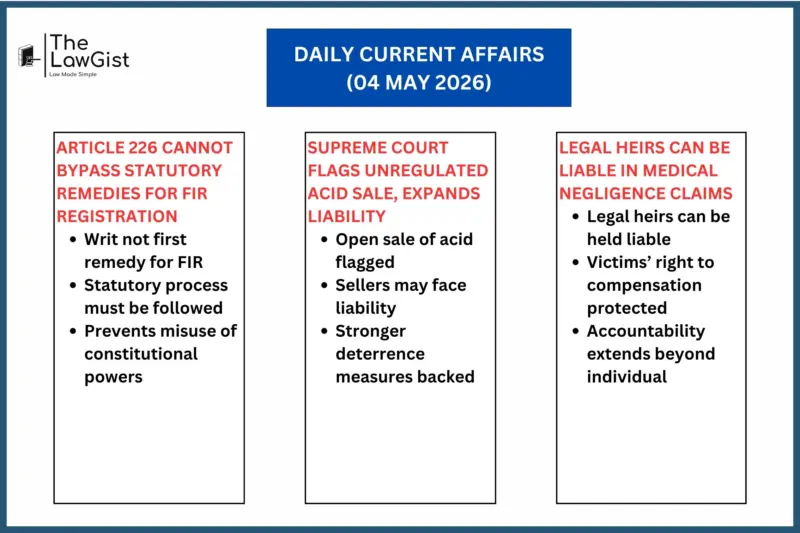
ARTICLE 226 CANNOT BYPASS STATUTORY REMEDIES FOR FIR REGISTRATION
Case Name:SUJAL VISHWAS ATTAVAR & ANR. vs. THE STATE OF MAHARASHTRA & ORS.
The Supreme Court of India held that writ jurisdiction under Article 226 cannot be directly invoked for FIR registration without first exhausting remedies under criminal procedure law. It reinforced that complainants must follow the statutory route, preserving the procedural hierarchy and preventing misuse of extraordinary constitutional remedies.
Legal Provisions:
- Article 226 - Writ Jurisdiction
- Section 154 & 156(3), CrPC
- Doctrine of Alternate Remedy
- Criminal Procedure Framework
- Judicial Restraint Principle
Source: Supreme Court of India
SUPREME COURT FLAGS UNREGULATED ACID SALE, EXPANDS LIABILITY
Case Name:Shaheen Malik Acid Attack Case
The Supreme Court of India raised serious concerns over the continued open sale of acid, calling for stricter enforcement. It observed that sellers may face vicarious liability and supported measures like property attachment of accused, emphasising stronger deterrence and accountability in acid attack cases.
Legal Provisions:
- Section 326A & 326B, IPC
- Poisons Rules / Acid Sale Regulations
- Vicarious Liability Doctrine
- Victim Protection Jurisprudence
- Article 21 - Right to life and dignity
Source: Supreme Court of India
LEGAL HEIRS CAN BE LIABLE IN MEDICAL NEGLIGENCE CLAIMS
Case Name:Supreme Court on Medical Negligence Liability
The Supreme Court of India held that legal heirs of a deceased doctor can be held liable in medical negligence cases under consumer law. It clarified that liability survives the professional, ensuring that victims are not left remediless and reinforcing accountability within the healthcare system.
Legal Provisions:
- Consumer Protection Act, 2019
- Tort Law Principles
- Medical Negligence Jurisprudence
- Doctrine of Vicarious Liability
- Right to Compensation
Source: Supreme Court of India
ALSO READ - DAILY CURRENT AFFAIRS (25 APRIL 2026)