
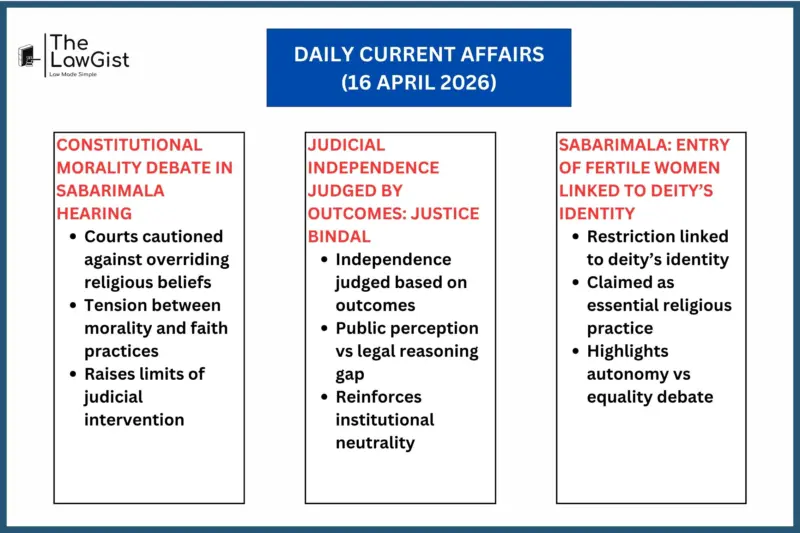

Supreme Court debates constitutional morality in religion, questions judicial independence narratives, and examines faith-based practices in Sabarimala case.
DAILY CURRENT AFFAIRS (16 APRIL 2026)
CONSTITUTIONAL MORALITY DEBATE IN SABARIMALA HEARING
Case Name:Sabarimala Reference (9-Judge Bench)
During the Sabarimala reference, senior advocate Abhishek Manu Singhvi argued before the Supreme Court of India that applying "constitutional morality" to religious practices can be disruptive and misplaced. He cautioned against courts overriding deeply rooted beliefs, highlighting the tension between constitutional values and faith-based traditions.
Legal Provisions:
- Article 25 - Freedom of Religion
- Article 26 - Religious Autonomy
- Constitutional Morality Doctrine
- Essential Religious Practices Test
- Judicial Review Limits
Source: Supreme Court of India
JUDICIAL INDEPENDENCE JUDGED BY OUTCOMES: JUSTICE BINDAL
Overview :Observations by Justice Rajesh Bindal
Justice Rajesh Bindal observed that judges decide cases strictly based on law, yet are often labelled "independent" or otherwise depending on outcomes in high-stakes matters. The remark reflects concerns over public perception of the judiciary, stressing that judicial independence must be assessed institutionally, not through selective reactions to verdicts.
Legal Provisions:
- Judicial Independence Doctrine
- Rule of Law Principle
- Article 50 - Separation of Judiciary
- Public Confidence in Judiciary
- Constitutional Governance
Source: Supreme Court of India
SABARIMALA: ENTRY OF FERTILE WOMEN LINKED TO DEITY'S IDENTITY
Case Name:KANTARU RAJEEVARU Versus INDIAN YOUNG LAWYERS ASSOCIATION THR.ITS GENERAL SECRETARY MS. BHAKTI PASRIJA AND ORS., R.P.(C) No. 3358/2018 in W.P.(C) No. 373/2006
The Travancore Devaswom Board told the Supreme Court of India that restricting entry of women of reproductive age is tied to the deity's identity as a celibate. It argued such women can visit other Ayyappa temples, asserting that the practice has a rational nexus with preserving the temple's unique religious character.
Legal Provisions:
- Article 25 - Right to Practice Religion
- Article 26 - Denominational Rights
- Essential Religious Practices Doctrine
- Reasonable Classification Test
- Religious Autonomy vs Equality
Source: Supreme Court of India
Also Read:DAILY CURRENT AFFAIRS (14 APRIL 2026)