
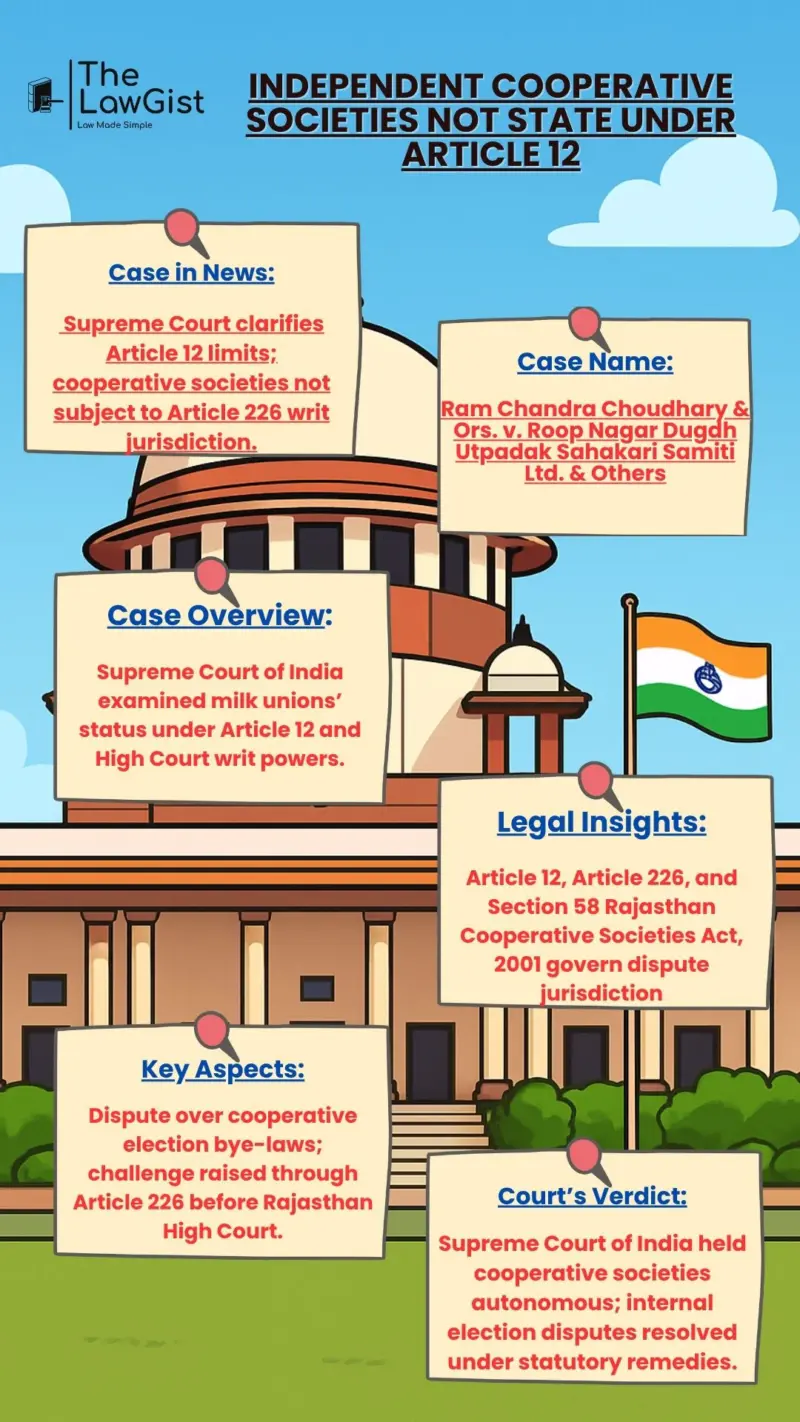

Supreme Court of India rules cooperative societies are not "State" under Article 12 and election disputes must follow remedies under the Rajasthan Cooperative Societies Act, 2001.
Case in News The Independent Cooperative Societies Not State Under Article 12 of Constitution of India ruling clarifies limits of writ jurisdiction over cooperative societies. |
Discover powerfulLatin Maximsand simplify complex legal terms in seconds
Case Overview
Case Name: Ram Chandra Choudhary & Ors. v. Roop Nagar Dugdh Utpadak Sahakari Samiti Ltd. & Others
The Supreme Court of India addressed whether District Milk Unions in Rajasthan could be treated as "State" under Article 12 of the Constitution of India or not. The matter was decided by a bench comprising Justices B.V. Nagarathna & R. Mahadevan.
The dispute arose when representatives of certain primary cooperative societies challenged the validity of specific bye laws governing eligibility criteria for contesting elections to the Boards of Directors of District Milk Unions. The Rajasthan High Court entertained writ petitions & declared the impugned bye-laws ultra vires . Aggrieved parties approached the Supreme Court of India contending that such internal disputes of cooperative societies should not be examined under writ jurisdiction.
Key Aspects
The Court examined the factual background & the legal controversy relating to election regulations within cooperative societies.
- Elections were scheduled for the Management Committees of District Milk Unions in Rajasthan.
- Certain members challenged Bye-law Nos. 20.1(2), 20.1(4), 20.2(7) & 20.2(9) prescribing qualifications for contesting elections.
- The Rajasthan High Court entertained the writ petitions & struck down the bye-laws .
- The primary issue was whether District Milk Unions qualify as "State" under Article 12 of Constitution making them subject to writ jurisdiction.
Legal Insights
Article 12 of the Constitution of India
- Defines "State" for enforcing fundamental rights.
- The Court held that District Milk Unions are autonomous, member-driven bodies & not controlled by the State to the extent needed to classify them as "State" under Article 12 of Constitution .
Article 226 of the Constitutionof India
- Empowers High Courts to issue writs against State authorities & in limited circumstances, non-State bodies performing public functions.
- The Court clarified that writ jurisdiction cannot be invoked for disputes relating purely to internal management or electoral processes of cooperative societies .
Rajasthan Co-operative Societies Act, 2001 - Section 58
- Provides a statutory mechanism for resolving disputes of cooperative societies.
- Section 58(2)(c) covers disputes connected with the election of officers of a society.
Judicial Precedents
- The Court relied on principles laid down in Ajay Hasia v. Khalid Mujib Sehravardi, Federal Bank Ltd. v. Sagar Thomas & Thalappalam Service Co-operative Bank Ltd. v. State of Kerala to determine when a body can be treated as State.
Court's Verdict
The Supreme Court of India held that District Milk Unions are independent cooperative societies & cannot be classified as "State" under Article 12 of Constitution . Therefore, the election disputes are not ordinarily amenable to writ jurisdiction under Article 226 of Constitution . The Court set aside the decision of the High Court & emphasized that parties must utilize the statutory dispute resolution mechanism given under the Rajasthan Co-operative Societies Act, 2001.
Source -Supreme Court of India
-Constitution
The LawGist ensures exam success with quality notes-TPL, Current Affairs, Recent Judgments, and more. Backed by trusted resources and videos, The LawGist is every aspirant's first choice