




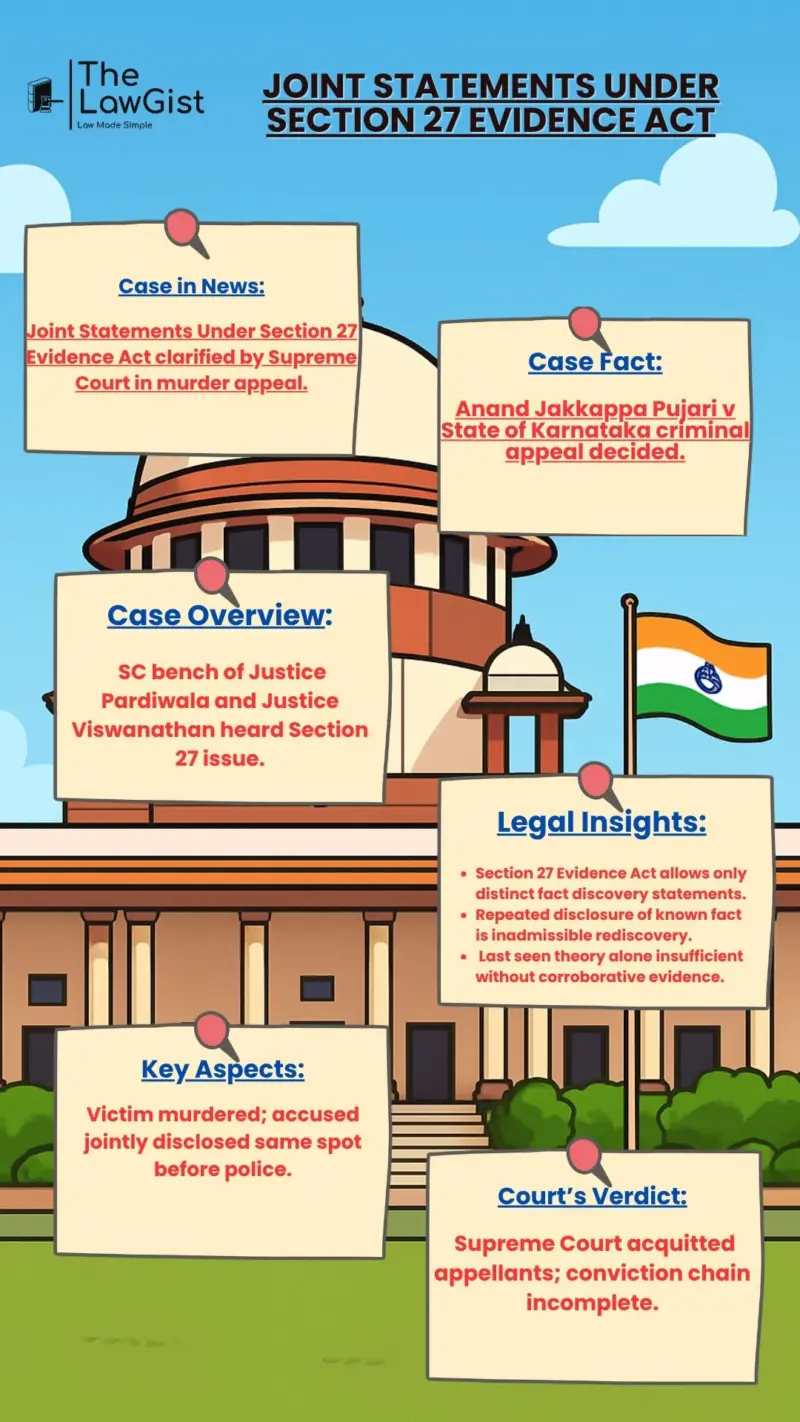

Case in News Joint Statements Under Section 27 Evidence Act clarified by Supreme Court of India in Karnataka murder appeal. |
Discover powerful Latin Maximsand simplify complex legal terms in seconds
Case Overview
Case Name:ANAND JAKKAPPA PUJARI @ GADDADAR v. STATE OF KARNATAKA
The Supreme Court of India comprising Justice JB Pardiwala & Justice KV Viswanathan examined the evidentiary value of joint disclosure statements made by multiple accused persons. The matter arose from a Karnataka murder case where conviction was based on circumstantial evidence & alleged recoveries under Section 27 of the Evidence Act.
Key Aspects
The Supreme Court analysed the factual background & legal issue relating to joint statements & recoveries made during investigation. Important facts of the case are as under :
- The victim went missing in March 2013 & her charred skeletal remains were recovered later from a forest area.
- Prosecution alleged that the accused conspired to avoid repayment of money & gold borrowed from the deceased.
- The Trial Court convicted all accused & the High Court upheld the conviction.
- Police claimed all accused pointed out the same place where murder & burning of the body occurred.
- The main issue was whether repeated disclosure of the same fact by different accused could be treated as valid discovery evidence.
Legal Insights
The Supreme Court of India interpreted the scope of admissibility of disclosure statements & reiterated settled principles under criminal evidence law. Key legal observations are as under :
- Section 27 of the Indian Evidence Act, 1872(BSA) allows only that portion of an accused's statement which distinctly relates to a fact discovered.
- If the police already know a fact later statements by other accused do not amount to fresh discovery.
- Joint statements are admissible only when each accused leads to distinct recoveries or separate discovered facts.
- Mere "last seen together" evidence under principles of circumstantial evidence is not sufficient without corroboration.
- Benefit of doubt must go to the accused where the chain of evidence is incomplete.
Court's Verdict
The Supreme Court of India held that the alleged joint discovery lacked specificity & did not satisfy Section 27 of the Evidence Act. As the prosecution failed to complete the chain of circumstances the Court set aside the conviction & acquitted the appellants.
Source - Supreme Court of India
-BSA
The LawGist ensures exam success with quality notes-TPL, Current Affairs, Recent Judgments, and more. Backed by trusted resources and videos, The LawGist is every aspirant's first choice