
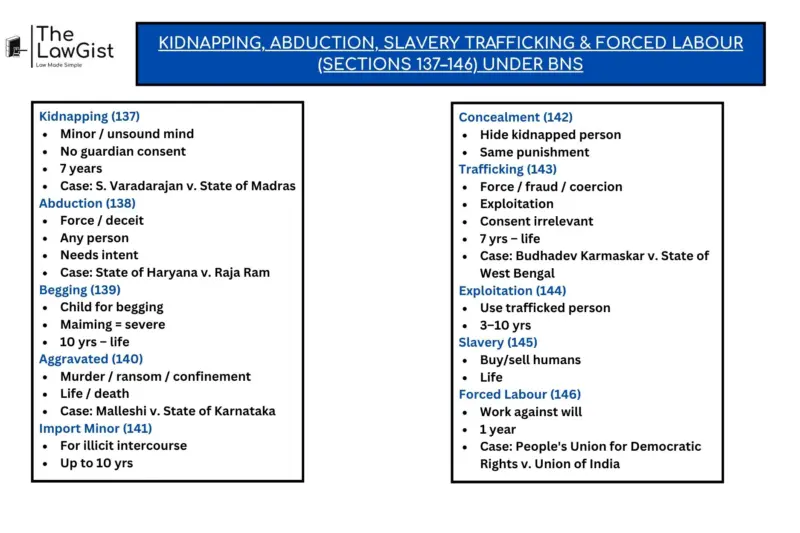

Simplified explanations of offences related to kidnapping, trafficking, slavery and forced labour.
KIDNAPPING, ABDUCTION, Slavery TRAFFICKING & FORCED LABOUR (Sections 137-146) UNDER BNS
These provisions deal with serious crimes involving taking away people, exploiting them, or forcing them into harmful situations under the Bharatiya Nyaya Sanhita (BNS) . The law aims to protect personal liberty, especially of children and vulnerable persons. |
Discover insights onLatin Maxims and Legal Glossary and simplify complex legal terms in seconds.The LawGist ensures exam success with quality Blogs and Articles on -Top Legal Picks (TLP),Current Affairs, latest Supreme Court judgments asCourtroom Chronicles. Backedby trusted resources and videos, The LawGist is every Professionals and Aspirant's first choice. Discover more atthelawgist.org
Section 137 - Kidnapping
Definition: Kidnapping is of two types:
- Kidnapping from India - Taking a person outside India without consent.
- Kidnapping from lawful guardianship - Taking a child or person of unsound mind without guardian's consent.
Key Points
- Applies mainly to children or mentally unsound persons
- Consent of guardian is essential
- Good faith belief of custody may be a defense (with limits)
Example
- A takes a 10-year-old child away from school without parental consent → Kidnapping
- A secretly takes someone abroad without consent → Kidnapping from India
Landmark Case
- S. Varadarajan vs. State of Madras- Court held that if a minor voluntarily goes with someone without inducement, it may not amount to kidnapping.
Section 138 - Abduction
Definition: Abduction means forcing or deceiving a person to go from one place to another.
Key Points
- Can apply to any person (not just minors)
- Requires force or deceit
- Not a standalone offence unless linked with intent
Example
- A threatens B with a weapon and forces him into a car → Abduction
- A lies to B and lures him somewhere → Abduction by deceit
Case Law
- State of Haryana vs. Raja Ram- Clarified difference between kidnapping and abduction.
Section 139 - Kidnapping for Begging
Definition: Kidnapping or using a child for begging purposes.
Key Points
- Severe punishment (10 years to life)
- Maiming a child leads to very harsh punishment
- Presumption against accused if child used for begging
Example
- A kidnaps children and forces them to beg on streets
- A injures a child to gain sympathy for begging
Section 140 - Kidnapping/Abduction for Serious Crimes
Definition: Covers kidnapping or abduction with intent:
- To murder
- For ransom
- For secret confinement
Key Points
- Ransom cases can lead to death penalty or life imprisonment
- Includes threats or harm to compel action
Example
- Kidnapping someone and demanding money → Ransom
- Kidnapping to kill or secretly confine
Landmark Case
- Malleshi vs. State of Karnataka- Upheld strict punishment in ransom cases
Section 141 - Importation of Minor for Illicit Intercourse
Definition:Bringing a minor into India for sexual exploitation.
Key Points
- Girl under 21, boy under 18
- Intent or knowledge of exploitation required
Example - Trafficking a minor from another country for prostitution
Section 142 - Concealing Kidnapped Person
Definition: Hiding or confining a kidnapped or abducted person knowingly.
Example - A hides a kidnapped victim in his house knowing the crime
Section 143 - Trafficking of Persons
Definition: Recruiting, transporting, or harboring persons through force, fraud, coercion, or abuse of power for exploitation.
Key Points
- Consent of victim is irrelevant
- Higher punishment for multiple victims, children, repeat offenders, and public servants
Example - Fake job promise leading to exploitation
Landmark Case
- Budhadev Karmaskar vs. State of West Bengal - Recognized dignity and rights of trafficked persons.
Section 144 - Exploitation of Trafficked Person
Definition: Using a trafficked person for sexual exploitation.
Example - Hiring a trafficked child for prostitution
Section 145 - Slavery
Definition: Habitual dealing in slaves (buying, selling, trafficking).
Example- Running a network that trades humans
Section 146 - Forced Labour
Definition: Compelling someone to work against their will.
Key Points
- Even indirect pressure can qualify
- Linked to bonded labour
Example- Forcing workers to work without pay under threat
Landmark Case
- People's Union for Democratic Rights vs. Union of India- Expanded meaning of forced labour under constitutional law.
| Section | Offence | Key Idea | Punishment |
| 137 | Kidnapping | Taking minor/person without consent | Up to 7 years + fine |
| 138 | Abduction | Force or deceit to move person | Depends on intent |
| 139 | Begging | Using child for begging | 10 years to life |
| 140 | Serious kidnapping | Murder, ransom, confinement | Life / Death |
| 141 | Import minor | For illicit intercourse | Up to 10 years |
| 142 | Concealment | Hiding kidnapped person | Same as kidnapper |
| 143 | Trafficking | Exploitation through coercion | 7 years to life |
| 144 | Exploitation | Using trafficked person | 3-10 years |
| 145 | Slavery | Dealing in slaves | Up to life |
| 146 | Forced labour | Work against will | Up to 1 year |
Conclusion
These sections collectively protect human freedom and dignity. They ensure:
- Protection of children and vulnerable persons
- Strict punishment for trafficking and exploitation
- Prevention of forced labour and slavery
Courts have interpreted these laws in a way that strongly supports human rights and victim protection. They remain essential tools to fight modern crimes like human trafficking, child exploitation, and bonded labour.
"Freedom and dignity are fundamental rights, and laws against kidnapping and trafficking exist to protect them."
SOURCE - MHA