




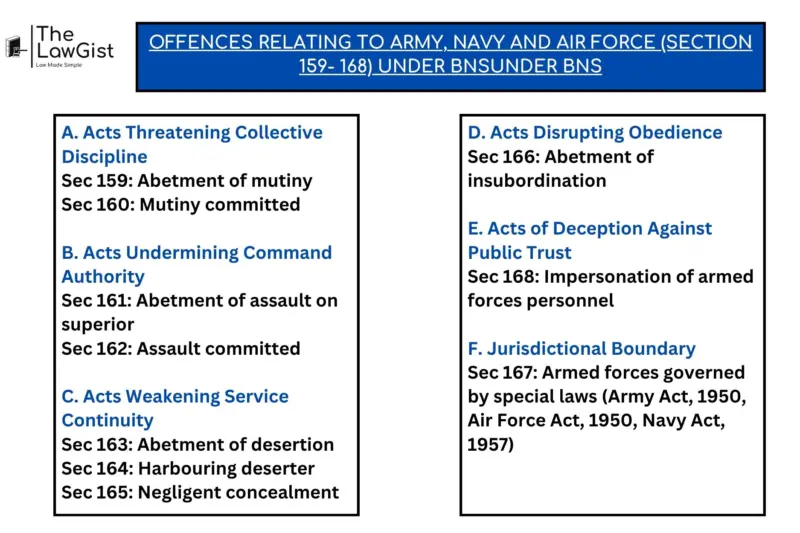

Article explaining key provisions of Chapter VIII - Offences Relating to Armed Forces under Bharatiya Nyaya Sanhita.
OFFENCES RELATING TO ARMY, NAVY AND AIR FORCE (SECTION 159- 168) UNDER BNS
In recent years, issues like military discipline, internal security, and the spread of misinformation or influence (including via social media) have highlighted the importance of strict laws governing armed forces. India has seen debates around discipline within forces, handling of desertion cases, and even impersonation scams involving fake army personnel. Chapter VIII of the Bharatiya Nyaya Sanhita (BNS) (earlier under the **Indian Penal Code) deals specifically with offences that threaten the discipline, loyalty, and functioning of the armed forces-namely the Army, Navy, and Air Force. These provisions are critical because the armed forces operate on strict hierarchy and obedience, and any disruption can endanger national security. |
Section 159 - Abetment of Mutiny or Seduction from Duty
Meaning: If someone encourages or tries to persuade a soldier to revolt (mutiny) or abandon duty, they commit an offence.
Punishment:
- Life imprisonment OR
- Up to 10 years + fine
Example:A civilian persuades soldiers to disobey orders during a conflict.
Case Law:
- State vs Mohd. Afzal (Parliament Attack Case, 2001) - Though not directly under this section, courts emphasized the seriousness of acts affecting armed forces discipline.
Section 160 - Abetment Leading to Mutiny
Meaning:If mutiny actually happens because of someone's instigation.
Punishment:
- Death penalty OR
- Life imprisonment OR
- Up to 10 years + fine
Example:A person instigates soldiers, and they actually revolt against commanding officers.
Key Insight:This is more severe than Section 159 because the act (mutiny) actually occurs.
Section 161 - Abetment of Assault on Superior Officer
Meaning:Encouraging a soldier to attack their superior officer.
Punishment:
- Up to 3 years + fine
Example:A colleague encourages a soldier to physically attack a commanding officer.
Section 162 - Assault Happens Due to Abetment
Meaning:If the assault actually occurs because of the instigation.
Punishment:
- Up to 7 years + fine
Example: A soldier attacks a superior after being provoked by someone.
Section 163 - Abetment of Desertion
Meaning: Helping or encouraging a soldier to leave service unlawfully.
Punishment:
- Up to 2 years OR
- Fine OR
- Both
Example:A person convinces a soldier to leave the army and settle abroad illegally.
Section 164 - Harbouring a Deserter
Meaning:Providing shelter to a soldier who has deserted, knowing about it.
Punishment:
- Up to 2 years OR
- Fine OR
- Both
Exception: No punishment if the deserter is sheltered by their spouse.
Example: A friend hides a soldier who has deserted duty.
Section 165 - Concealment on Merchant Vessel
Meaning: If a ship captain unknowingly carries a deserter due to negligence.
Penalty:
- Fine up to ₹3000
Example: A deserter hides on a cargo ship, and the captain fails to detect due to poor supervision.
Section 166 - Abetment of Insubordination
Meaning:Encouraging disobedience among armed forces personnel.
Punishment:
- Up to 2 years OR
- Fine OR
- Both
Example: A person encourages soldiers to ignore orders from their superior.
Section 167 - Armed Forces Personnel Not Punishable Under This Chapter
Meaning:Soldiers themselves are governed by special laws like:
- Army Act, 1950
- Air Force Act, 1950
- Navy Act, 1957
Key Point: These provisions mainly apply to civilians, not serving personnel.
Section 168 - Impersonating a Soldier
Meaning:Wearing army uniform or pretending to be military personnel with intent to deceive.
Punishment:
- Up to 3 months OR
- Fine up to ₹2000 OR
- Both
Example:A person wears army uniform to gain trust and commit fraud.
Recent Context: There have been multiple fraud cases where individuals impersonated army officers to scam people online.
| Section | Offence | Meaning | Punishment | Example |
| 159 | Abetment of mutiny | Encouraging revolt | Life / 10 yrs + fine | Influencing soldiers to rebel |
| 160 | Mutiny occurs | Revolt actually happens | Death / Life / 10 yrs | Instigation leads to mutiny |
| 161 | Abet assault | Encouraging attack on superior | Up to 3 yrs | Provoking soldier to attack officer |
| 162 | Assault occurs | Attack actually happens | Up to 7 yrs | Soldier attacks after instigation |
| 163 | Abet desertion | Encouraging leaving duty | Up to 2 yrs | Convincing soldier to flee |
| 164 | Harbour deserter | Sheltering deserter | Up to 2 yrs | Hiding runaway soldier |
| 165 | Ship concealment | Negligence in ship | Fine ₹3000 | Deserter hidden in ship |
| 166 | Insubordination | Encouraging disobedience | Up to 2 yrs | Asking soldiers to ignore orders |
| 167 | Exception | Armed forces governed separately | - | Army Act applies |
| 168 | Impersonation | Pretending to be soldier | 3 months / fine | Fake army officer scam |
Conclusion
Chapter VIII of the Bharatiya Nyaya Sanhita plays a vital role in safeguarding the discipline, hierarchy, and operational integrity of India's armed forces. These provisions ensure that civilians do not interfere with military functioning by encouraging rebellion, desertion, or impersonation.
In a modern context-where misinformation, cyber influence, and impersonation crimes are rising-these laws remain highly relevant. They not only protect national security but also reinforce the trust and structure necessary for armed forces to function effectively.
"Discipline in armed forces is not just a rule-it is the backbone of national security."
SOURCE – MHA
Discover insights onLatin Maxims and Legal Glossary and simplify complex legal terms in seconds.The LawGist ensures exam success with quality Blogs and Articles on -Top Legal Picks (TLP),Current Affairs, latest Supreme Court judgments asCourtroom Chronicles. Backedby trusted resources and videos, The LawGist is every Professionals and Aspirant's first choice. Discover more atthelawgist.org