

Article explaining key provisions of Chapter VIII - Offences Relating to Armed Forces under Bharatiya Nyaya Sanhita.
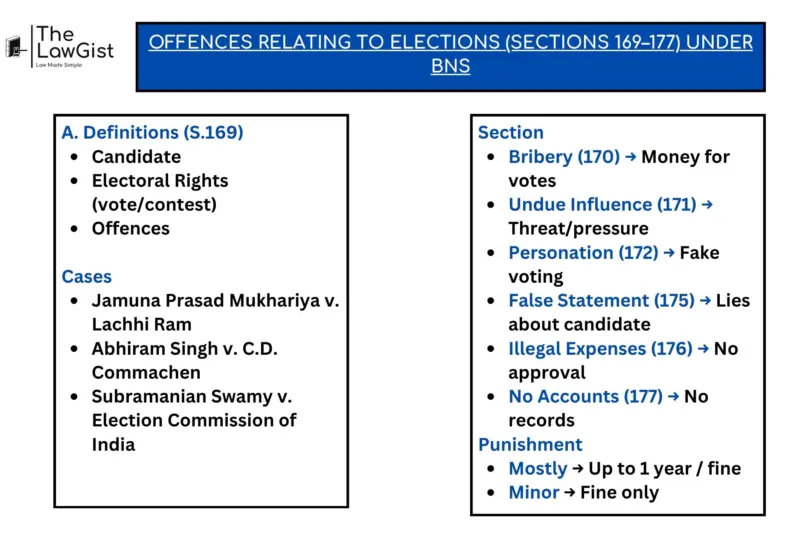
OFFENCES RELATING TO ELECTIONS (SECTIONS 169-177) UNDER BNS
Free and fair elections are essential for a democratic system.Sections 169 to 177 underBharatiya Nyaya Sanhita (BNS) aim to prevent electoral malpractices such as bribery, coercion, impersonation, and misinformation. In the modern context, these provisions have become increasingly relevant due to the misuse of money power, social media manipulation, and electoral fraud. The Election Commission of India plays a vital role in ensuring compliance with these laws and maintaining the integrity of elections. |
Section 169 - Definitions
Definition – Section 169 defines key terms. A "candidate" is a person who has been duly nominated for an election. "Electoral right" refers to the right to stand or not stand as a candidate, withdraw candidature, and vote or refrain from voting.
Example – A person deciding not to vote or withdrawing from contesting an election is exercising their electoral right.
Case Law
While no specific landmark case directly focuses on this section, courts have consistently interpreted electoral rights as part of democratic freedoms.
Section 170 - Bribery
Definition – Bribery involves giving, offering, or accepting gratification to influence the exercise of electoral rights. Gratification includes money, gifts, or any benefit. However, general promises of public policy do not amount to bribery.
Example – A candidate distributing cash or gifts to voters to secure votes is committing bribery.
Case Law
In Jamuna Prasad Mukhariya v. Lachhi Ram, the Supreme Court upheld laws prohibiting bribery, emphasizing that such practices corrupt the electoral process.
Section 171 - Undue Influence
Definition – Undue influence refers to voluntarily interfering with the free exercise of electoral rights. It includes threats, coercion, or inducing fear of divine displeasure.
Example – Threatening voters with harm or social boycott if they do not vote for a particular candidate constitutes undue influence.
Case Law
In Abhiram Singh v. C.D. Commachen, the Supreme Court held that appealing to religion in elections can amount to undue influence.
Section 172 - Personation
Definition – Personation occurs when a person votes in the name of another person, whether living or dead, or under a fictitious name, or votes more than once.
Example – Casting a vote by pretending to be another registered voter is an offence of personation.
Case Law
Courts have consistently treated impersonation as a serious electoral fraud, though most rulings arise in election petitions rather than standalone criminal cases.
Section 173 - Punishment for Bribery
Definition – This section prescribes punishment for bribery with imprisonment up to one year, or fine, or both. In cases of "treating" (food, drink, entertainment), punishment is limited to a fine.
Example – Providing free meals to voters to influence their voting behavior is punishable under this section.
Case Law
Judicial interpretations in election cases have reinforced that even indirect benefits can amount to bribery.
Section 174 - Punishment for Undue Influence and Personation
Definition – This section provides punishment for offences under Sections 171 and 172 with imprisonment up to one year, or fine, or both.
Example – A person threatening voters or impersonating another voter can be punished under this section.
Case Law
Courts have emphasized strict punishment to deter interference with electoral freedom.
Section 175 - False Statements
Definition – Making or publishing false statements about a candidate's personal character or conduct, knowing them to be false, with the intention of affecting election results is punishable with a fine.
Example – Spreading false allegations about a candidate's integrity through media to influence voters.
Case Law
Courts have taken strict action against defamatory statements during elections to maintain fairness.
Section 176 - Illegal Payments
Definition – Incurring or authorizing election expenses without the written consent of the candidate is prohibited. Limited exceptions exist for small expenses later approved.
Example – Printing posters or organizing rallies for a candidate without their permission.
Case Law
Election tribunals have invalidated results where unauthorized expenditures affected fairness.
Section 177 - Failure to Maintain Accounts
Definition – Failure to maintain proper accounts of election expenses, when required by law, is punishable with a fine.
Example – A candidate not keeping records of campaign expenses violates this provision.
Case Law
In Subramanian Swamy vs. Election Commission of India, the Supreme Court emphasized transparency in elections, indirectly reinforcing the importance of financial accountability.
Conclusion
Sections 169 to 177 collectively ensure that elections are conducted in a fair and transparent manner. They prohibit corrupt practices and protect the freedom of voters and candidates. In the present scenario, where elections are influenced by money, media, and technology, strict enforcement by authorities like the Election Commission of India is essential to uphold democratic values and maintain public trust.
"Discipline in armed forces is not just a rule-it is the backbone of national security."
SOURCE – MHA