




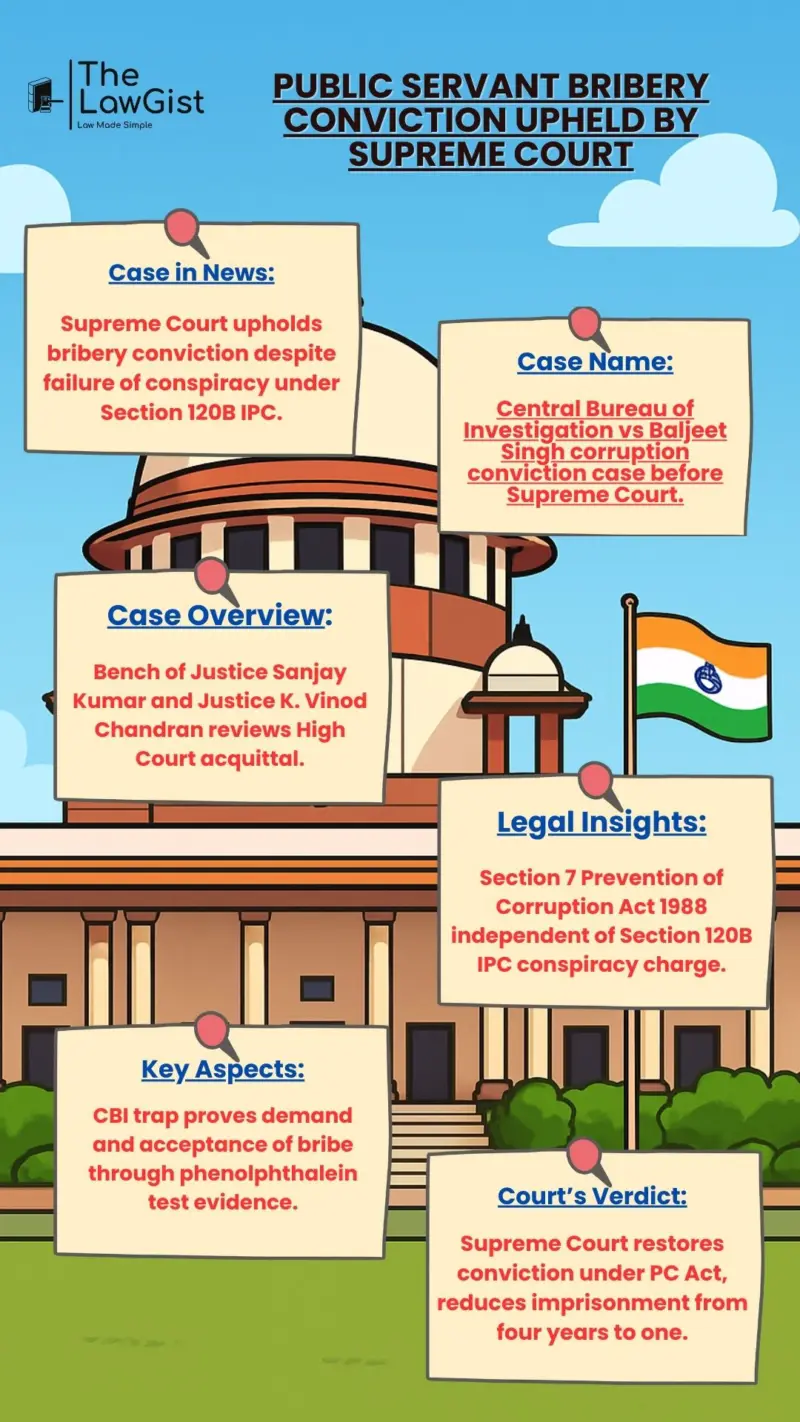

Supreme Court rules that a public servant can be convicted for bribery under Section 7 of the Prevention of Corruption Act even if conspiracy under Section 120B IPC fails.
Case in News Public Servant Bribery Conviction Upheld by Supreme Court despite acquittal of co-accused & failure of conspiracy charge. |
Discover powerfulLatin Maximsand simplify complex legal terms in seconds
Case Overview
Case Name:Central Bureau of Investigation Versus Baljeet Singh
The Supreme Court of India clarified an important principle under corruption law holding that a public servant who personally demands & accepts a bribe can still be convicted even if the conspiracy charge fails. The judgment was delivered by a bench comprising Justice Sanjay Kumar & Justice K. Vinod Chandran.
The case arose from a CBI trap operation in 2010 involving an Income Tax Inspector named Baljeet Singh. The Rajasthan High Court had earlier acquitted him on the ground that the alleged conspiracy under Section 120B IPC was not proven & the co-accused was acquitted. However the Supreme Court of India examined whether the failure of the conspiracy charge automatically invalidates the corruption offence.
Key Aspects
The case revolves around the distinction between the offence of criminal conspiracy & the independent offence of bribery under corruption law. The Court carefully examined evidence relating to the demand & acceptance of illegal gratification.
- A complainant approached the CBI alleging a demand of ₹5 lakh to settle an income tax assessment .
- The demand was allegedly made by Inspector Baljeet Singh on behalf of a superior officer.
- The CBI conducted a trap using phenolphthalein coated currency notes during pre-trap proceedings.
- The complainant handed over the envelope containing bribe money to the accused in his office .
- The trap team apprehended the accused & chemical tests confirmed contact with tainted currency.
- The Rajasthan High Court later acquitted both accused citing lack of conspiracy evidence.
Legal Insights
The Supreme Court of India emphasized that corruption offences can stand independently of conspiracy charges if evidence proves demand & acceptance of bribes.
- Section 7, Prevention of Corruption Act 1988 - Criminalizes demand & acceptance of illegal gratification by a public servant.
- Section 120B, Indian Penal Code (IPC) - Governs criminal conspiracy requiring proof of agreement between 2 or more persons.
- The Court held that failure to prove Section 120B IPC does not automatically nullify liability under Prevention of Corruption Act 1988.
- Conviction can be sustained solely on proof of demand & acceptance of bribe.
Court's Verdict
The Supreme Court of India set aside the Rajasthan High Court's acquittal of the Income Tax Inspector & restored his conviction under the Prevention of Corruption Act 1988. However considering the health condition of the accused, the Court reduced the sentence from 4 years of rigorous imprisonment to one year.
Source -Supreme Court of India
The LawGist ensures exam success with quality notes-TPL, Current Affairs, Recent Judgments, and more. Backed by trusted resources and videos, The LawGist is every aspirant's first choice.